Filippov Aleksandr, Bonjoc Kimberley-Jane C, Chea Junie, Bowles Nicole, Poku Erasmus, Chaudhry Ammar
Department of Diagnostic and Interventional Radiology, City of Hope National Medical Center, Duarte, CA, USA.
J Thorac Dis. 2020 Sep;12(9):5140-5146. doi: 10.21037/jtd-2019-pitd-13.
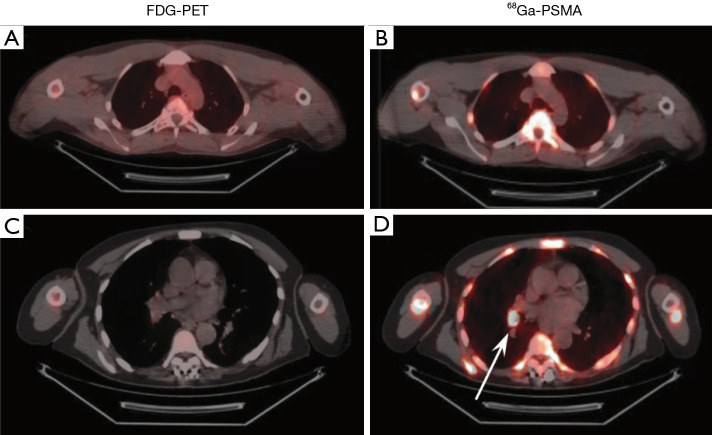
Theranostics is a re-emerging field of medicine that aims to create targeted agents that can be used for diagnostic and/or therapeutic indications. In the past, theranostics has been used to treat neoplasms, such as thyroid cancer and neuroblastomas. More recently, theranostics has seen a resurgence with advent of new therapeutic antibodies and small molecules which can be transformed into Theranostic agents through radioconjugating with a radioactive isotope. Positron emitting radioisotopes can be used for diagnostic purposes while alpha- and beta-emitting radioisotopes can be used for therapy. The technique of radiolabeling an existing therapeutic agent (small molecule or antibody) leverages the existing qualities of that drug, and potentiates therapeutic effect by conjugating it with a cytotoxic-energy bearing radioisotope (e.g., 131-iodine, 177-lutetium). Theranostics have been used for a few decades now, starting with 131-iodine for therapy of autoimmune thyroiditis (Graves' disease, Hashimoto's thyroiditis) as well as for thyroid cancer. Additionally, 131-iodine-meta-iodobenzylguanidine (131-I-MIBG) initially had been used for gastroenteropancreatic neuroendocrine (carcinoid) tumors. However, recently clinical trials have start enrolling patients to evaluate efficacy of 131-I-MIBG in patients with small cell carcinoma of the lung. In the era of precision medicine and personalized targeted therapeutics, Theranostics can play a key pivotal in improving diagnostic and therapeutic specificity by increasing potency of these targeted small molecules and antibodies with radioisotopes. In this review, we will review various clinically relevant Theranostics agent and their utility in thoracic disorders, notably within oncology.
治疗诊断学是医学领域中一个重新兴起的领域,旨在开发可用于诊断和/或治疗目的的靶向制剂。过去,治疗诊断学已被用于治疗肿瘤,如甲状腺癌和神经母细胞瘤。最近,随着新型治疗性抗体和小分子的出现,治疗诊断学迎来了复兴,这些抗体和小分子可通过与放射性同位素进行放射性缀合而转化为治疗诊断剂。发射正电子的放射性同位素可用于诊断,而发射α和β射线的放射性同位素可用于治疗。对现有治疗剂(小分子或抗体)进行放射性标记的技术利用了该药物的现有特性,并通过将其与携带细胞毒性能量的放射性同位素(例如131碘、177镥)缀合来增强治疗效果。治疗诊断学已经应用了几十年,从131碘用于自身免疫性甲状腺炎(格雷夫斯病、桥本甲状腺炎)以及甲状腺癌的治疗开始。此外,131碘间碘苄胍(131I-MIBG)最初用于胃肠胰神经内分泌(类癌)肿瘤。然而,最近临床试验已开始招募患者,以评估131I-MIBG对肺癌小细胞癌患者的疗效。在精准医学和个性化靶向治疗的时代,治疗诊断学通过增加这些靶向小分子和抗体与放射性同位素的效力,在提高诊断和治疗特异性方面可以发挥关键作用。在本综述中,我们将回顾各种临床相关的治疗诊断剂及其在胸部疾病,特别是肿瘤学中的应用。