Morzaria-Luna Hem Nalini, Turk-Boyer Peggy, Hernández José Manuel Dorantes, Polanco-Mizquez Elia, Downton-Hoffmann Caroline, Cruz-Piñón Gabriela, Carrillo-Lammens Tonatiuh, Loaiza-Villanueva Rene, Valdivia-Jiménez Paloma, Sánchez-Cruz Angeles, Peña-Mendoza Valeria, López-Ortiz Ariadna Montserrat, Koch Volker, Vázquez-Vera Leonardo, Arreola-Lizárraga José Alfredo, Amador-Castro Imelda G, Suárez Castillo Alvin N, Munguia-Vega Adrian
CEDO Intercultural, Apartado Postal #53. Puerto Peñasco, Sonora, México C.P. 83550. / P.O. Box 44208, Tucson, AZ 85733, United States.
Visiting Scientist. Northwest Fisheries Science Center, NOAA. 2725 Montlake Blvd. Seattle WA 98112, United States.
MethodsX. 2020 Oct 16;7:101108. doi: 10.1016/j.mex.2020.101108. eCollection 2020.
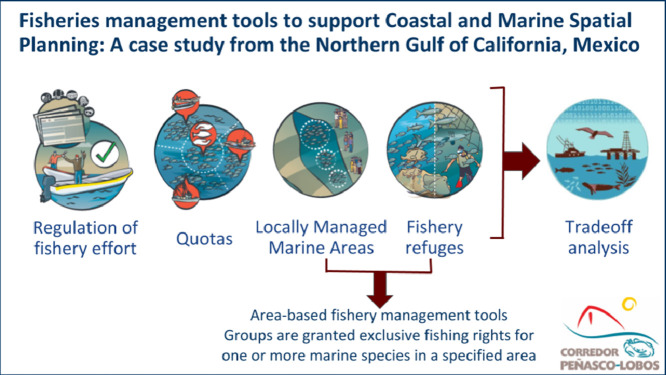
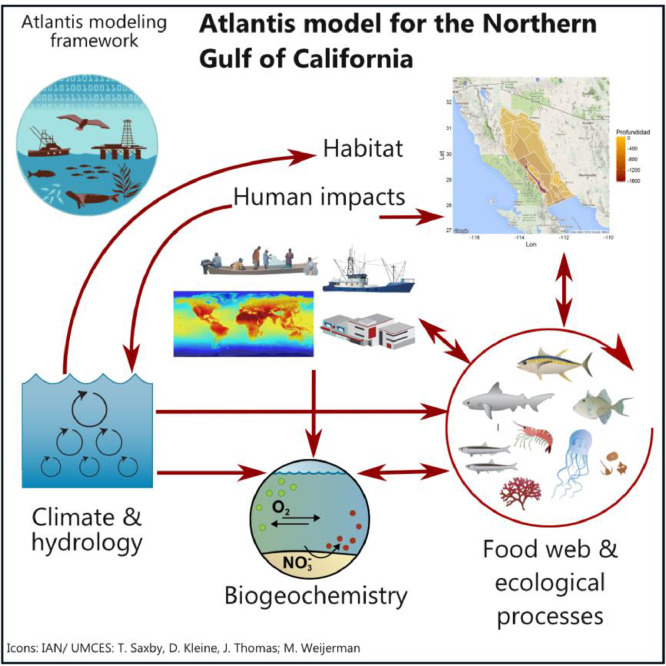
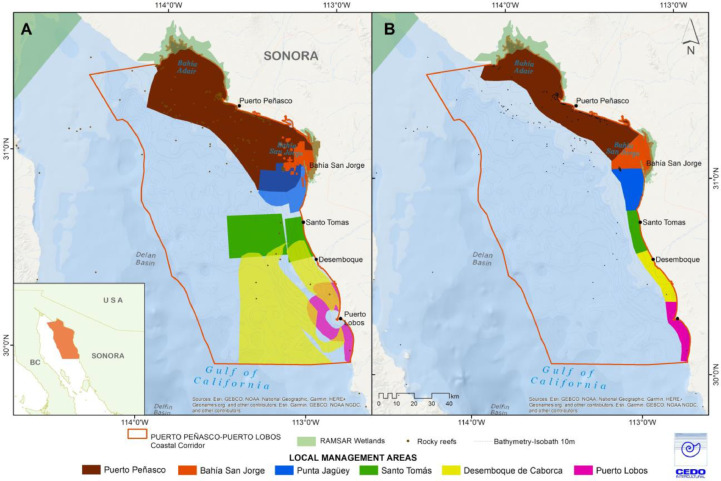
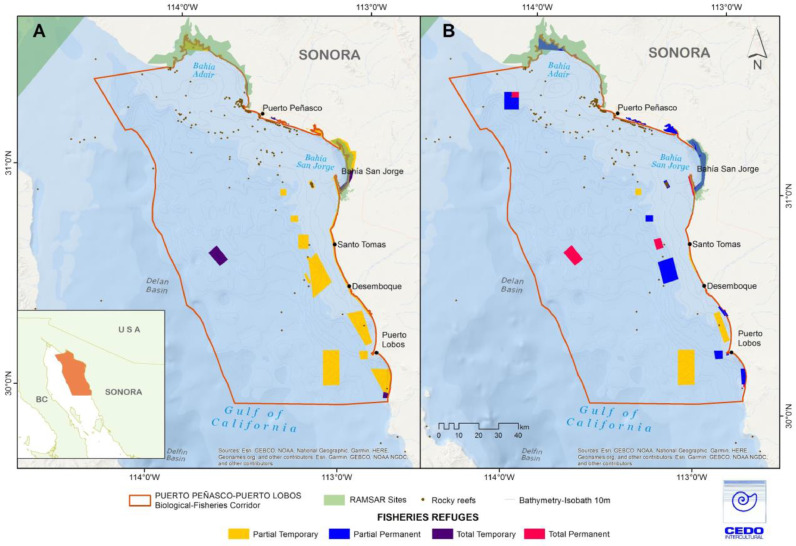
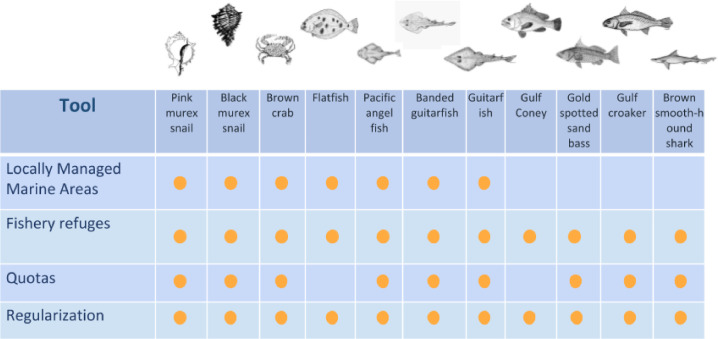
A management approach was developed that combined spatial and non-spatial tools to inform a Coastal and Marine Spatial Planning Process (CMSP) in the Puerto Peñasco-Puerto Lobos Coastal Corridor, Northern Gulf of California, Sonora, Mexico. Four fisheries management tools were applied with an emphasis on ecosystem level management for eleven small-scale fisheries. Two spatial management tools, using a spatial prioritization approach, were combined with a permit regularization process, a non-spatial quota prioritization, and a tradeoff analysis in a novel way: • Locally Managed Marine Areas were developed, these are spatial areas where individual community fishermen are assigned the rights to harvest and manage specific fisheries within defined geographic areas. • Fishery refuges that incorporate information on fisheries, ecological importance, and connectivity. • A non-spatial quota prioritization process using a framework for the integrated assessment of stocks, encompassing a vulnerability analysis, a sustainability analysis, and a management framework analysis. • A trade-off analysis of the combination of these different management tools, using an Atlantis ecosystem model for the northern Gulf of California, that tested the ecosystem effects of alternative scenarios to assess benefits in support of ecosystem-based management.
已开发出一种管理方法,该方法结合了空间和非空间工具,为墨西哥索诺拉州加利福尼亚湾北部佩尼亚斯科港 - 洛沃斯港沿海走廊的沿海和海洋空间规划进程(CMSP)提供信息。应用了四种渔业管理工具,重点是对11个小型渔业进行生态系统层面的管理。两种空间管理工具采用空间优先排序方法,并以一种新颖的方式与许可正规化程序、非空间配额优先排序和权衡分析相结合:• 开发了地方管理海洋区域,这些是空间区域,在其中为个体社区渔民分配在特定地理区域内捕捞和管理特定渔业的权利。• 渔业保护区纳入了有关渔业、生态重要性和连通性的信息。• 使用一个用于种群综合评估的框架进行非空间配额优先排序过程,该框架包括脆弱性分析、可持续性分析和管理框架分析。• 使用加利福尼亚湾北部的亚特兰蒂斯生态系统模型对这些不同管理工具的组合进行权衡分析,该模型测试了替代方案的生态系统影响,以评估支持基于生态系统管理的效益。