Lumba-Brown Angela, Tang Ken, Yeates Keith Owen, Zemek Roger
Department of Emergency Medicine Stanford University Palo Alto California.
Children's Hospital of Eastern Ontario Research Institute Ottawa Ontario Canada.
J Am Coll Emerg Physicians Open. 2020 Apr 24;1(5):938-946. doi: 10.1002/emp2.12056. eCollection 2020 Oct.
Motor vehicle collisions generate considerable transmitted forces resulting in traumatic brain injury in children presenting to emergency departments (EDs). To date, no large study has examined post-concussive symptoms in children sustaining concussions in motor vehicle collisions. This study aimed to compare trends in acute post-concussive symptom burden in children with concussion following motor vehicle collisions as compared to other injury mechanisms.
The study is a secondary analysis of the Predicting Persistent Post-concussive Problems in Pediatrics study, which prospectively recruited a multicenter cohort of 3029 children 5-17 years of age presenting to the ED with concussion from 2013-2015. Post-concussive symptom ratings were obtained at pre-specified time points for 12 weeks post-injury, using the validated Post-Concussion Symptom Inventory (PCSI). Symptom severity and recovery trajectories were measured using delta scores on the PCSI (mean post-injury symptom score minus perceived pre-injury score). A multivariable, longitudinal model evaluated the adjusted effect of mechanism of injury (motor vehicle collisions vs other mechanisms) on mean symptom scores, compared to perceived pre-injury reports, and the temporal change in mean scores over during recovery.
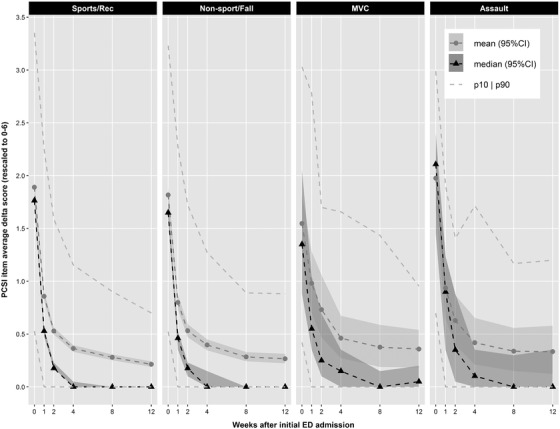
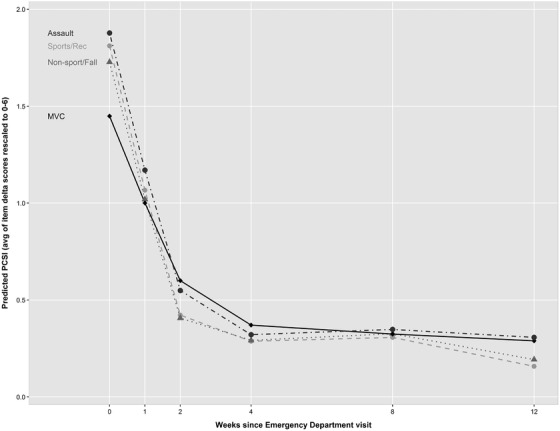
Of 3029 study participants, 56 (1.8%) sustained concussion from motor vehicle collisions. Children sustaining concussion in a motor vehicle collision had lower post-concussive symptom scores upon ED presentation, measured as differences from their perceived pre-injury reports, as compared to other injury mechanisms (-0.36 [95% confidence interval (CI) = -0.58, -0.15]). However, the motor vehicle collisions group showed the smallest decline in symptom burden over 1 month following injury (-0.54 [95% CI = -0.81, -0.27]).
Children sustaining concussions in motor vehicle collisions may have lower initial symptom burdens but slower symptom recovery at 1 month compared to other mechanisms of injury and may represent a distinct population for prognostic counseling in the ED requiring further research.
机动车碰撞会产生相当大的传递力,导致前往急诊科(ED)就诊的儿童发生创伤性脑损伤。迄今为止,尚无大型研究对机动车碰撞中遭受脑震荡的儿童的脑震荡后症状进行过研究。本研究旨在比较机动车碰撞导致脑震荡的儿童与其他损伤机制导致脑震荡的儿童在急性脑震荡后症状负担方面的趋势。
本研究是对“预测儿科持续性脑震荡后问题”研究的二次分析,该研究前瞻性招募了一个多中心队列,共3029名5至17岁的儿童,他们在2013年至2015年期间因脑震荡前往急诊科就诊。使用经过验证的脑震荡后症状量表(PCSI),在受伤后12周的预先指定时间点获取脑震荡后症状评分。使用PCSI上的差值分数(受伤后平均症状评分减去受伤前感知评分)来测量症状严重程度和恢复轨迹。一个多变量纵向模型评估了损伤机制(机动车碰撞与其他机制)对平均症状评分的调整效应(与受伤前感知报告相比),以及恢复期间平均评分的时间变化。
在3029名研究参与者中,56名(1.8%)因机动车碰撞遭受脑震荡。与其他损伤机制相比,在机动车碰撞中遭受脑震荡的儿童在急诊科就诊时,以与受伤前感知报告的差异衡量,其脑震荡后症状评分较低(-0.36 [95%置信区间(CI)= -0.58,-0.15])。然而,机动车碰撞组在受伤后1个月内症状负担的下降最小(-0.54 [95% CI = -0.81,-0.27])。
与其他损伤机制相比,在机动车碰撞中遭受脑震荡的儿童可能初始症状负担较低,但在1个月时症状恢复较慢,可能代表急诊科中一个需要进一步研究的独特的预后咨询人群。