Division of Rheumatology, Hospital for Special Surgery and Weill Cornell Medicine, New York, NY, USA.
Boehringer Ingelheim Pharmaceuticals, Inc., Ridgefield, CT, USA.
Rheumatology (Oxford). 2021 Feb 1;60(2):896-901. doi: 10.1093/rheumatology/keaa502.
We sought to evaluate perceptions of biosimilar products among US rheumatologists who prescribe TNF-α inhibitors, given that 10 TNF-α inhibitor biosimilars and two rituximab biosimilars have Food and Drug Administration (FDA) approval.
A 19-question self-administered online survey was conducted from 6 May to 1 June 2019, and fielded by WebMD, LLC. Rheumatologists (n = 9050) who were members of Medscape.com and its partner panels were invited to participate. Likert and other rating scales were used to collect responses, which were summarized descriptively.
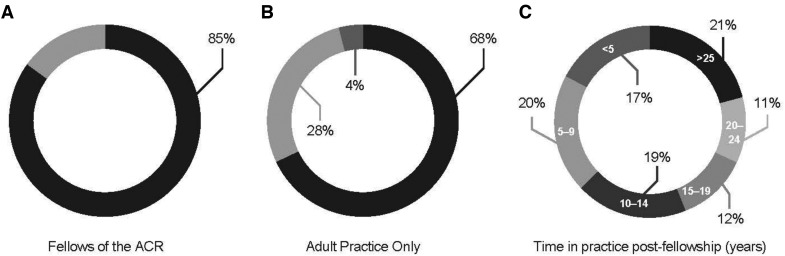
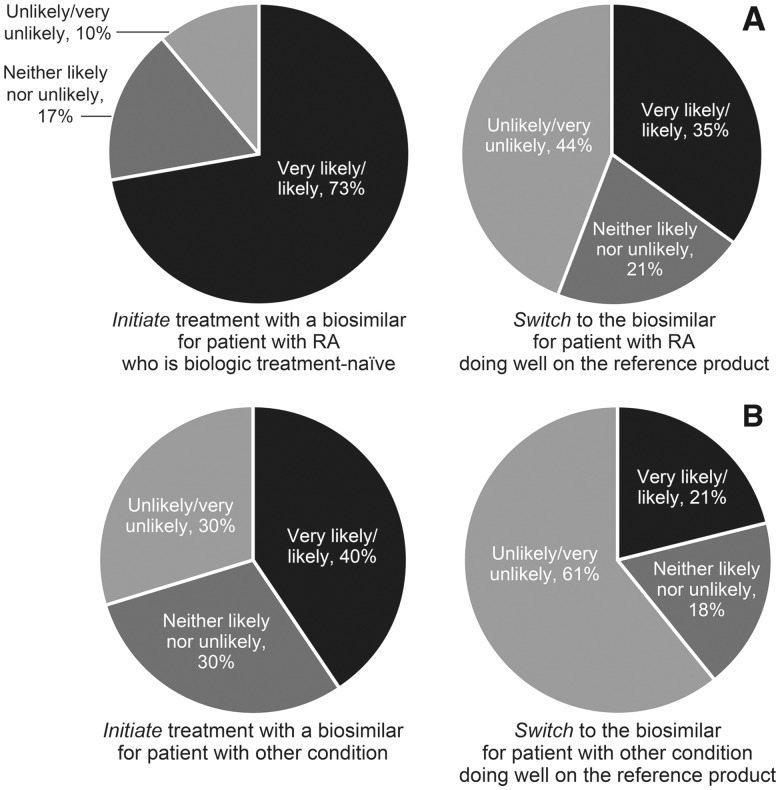
Responses were obtained from 320 board-certified US rheumatologists, 85% of whom were fellows of the ACR. Nearly all respondents were familiar with the FDA definition of a biosimilar product and were aware that an infliximab biosimilar was FDA approved; fewer realized that adalimumab, etanercept and rituximab biosimilars were also FDA approved. Most respondents (84%) were aware that an approved biosimilar was not automatically deemed interchangeable by the FDA. Rheumatologists were more likely to initiate biosimilar treatment for a biologic treatment-naïve patient with RA (73%) than they were to switch to the biosimilar for a patient with RA doing well on the reference product (35%).
The results of this survey suggest that US rheumatologists have a good understanding and acceptance of biosimilar products, particularly for the initiation of treatment in biologic-naïve individuals. They were hesitant to switch from a reference product to a biosimilar for a patient doing well on the reference product. Additional education on biosimilars is required to help inform treatment decisions by rheumatologists. A plain language summary of this article has been uploaded as supplementary material, available at Rheumatology online.
我们旨在评估美国开具 TNF-α 抑制剂的风湿病专家对生物类似药的看法,因为已有 10 种 TNF-α 抑制剂生物类似药和 2 种利妥昔单抗生物类似药获得美国食品和药物管理局(FDA)批准。
2019 年 5 月 6 日至 6 月 1 日,我们通过 WebMD,LLC 进行了一项包含 19 个问题的在线自我管理调查,并邀请 Medscape.com 及其合作小组的风湿病专家参与调查。采用李克特量表和其他评分量表收集应答,并用描述性方法进行总结。
共收到 320 名美国风湿病专家的回复,其中 85%为 ACR 研究员。几乎所有的应答者都熟悉 FDA 对生物类似药的定义,并且知道一种英夫利昔单抗生物类似药已获得 FDA 批准;但很少有人意识到阿达木单抗、依那西普和利妥昔单抗生物类似药也获得了 FDA 批准。大多数应答者(84%)意识到 FDA 批准的生物类似药并不自动被视为可互换。与对正在使用参比产品治疗且病情良好的 RA 患者进行生物类似药转换相比,风湿病专家更倾向于为生物治疗初治的 RA 患者开始生物类似药治疗(73%比 35%)。
本调查结果表明,美国风湿病专家对生物类似药有较好的理解和接受度,特别是在为生物治疗初治的患者开始治疗方面。他们不愿意将正在使用参比产品治疗且病情良好的患者转换为生物类似药。需要进一步开展生物类似药教育,以帮助风湿病专家做出治疗决策。本文的通俗语言摘要已作为补充材料上传,可在 Rheumatology 在线获取。