Xu Changdan, Zhang Hong, Yin Shiquan
Department of Medical Record, National Cancer Center/National Clinical Research Center for Cancer/Cancer Hospital, Chinese Academy of Medical Sciences and Peking Union Medical College, Beijing, China.
Front Public Health. 2024 Dec 23;12:1453962. doi: 10.3389/fpubh.2024.1453962. eCollection 2024.
The KAP survey evaluates health-related knowledge, attitudes, and practices through a structured questionnaire. By collecting qualitative and quantitative data, it measures the current situation, tests hypotheses, and provides insights for enhancing health behaviors and education. In 2019, the National Health Security Administration (NHSA) initiated DRG payment reforms. This study aims to improve the quality of health insurance and policy implementation by assessing physicians' knowledge, attitudes, and practices regarding the DRG system.
This study was a cross-sectional study designed with a questionnaire through simple random sampling method, and respondents were the doctors in the clinical departments of the sampled hospitals. The questionnaire included basic information, knowledge about DRGs, attitude toward DRGs and practice of implementation. Data were analyzed using descriptive statistical analysis, correlation, path analysis and generalized linear model.
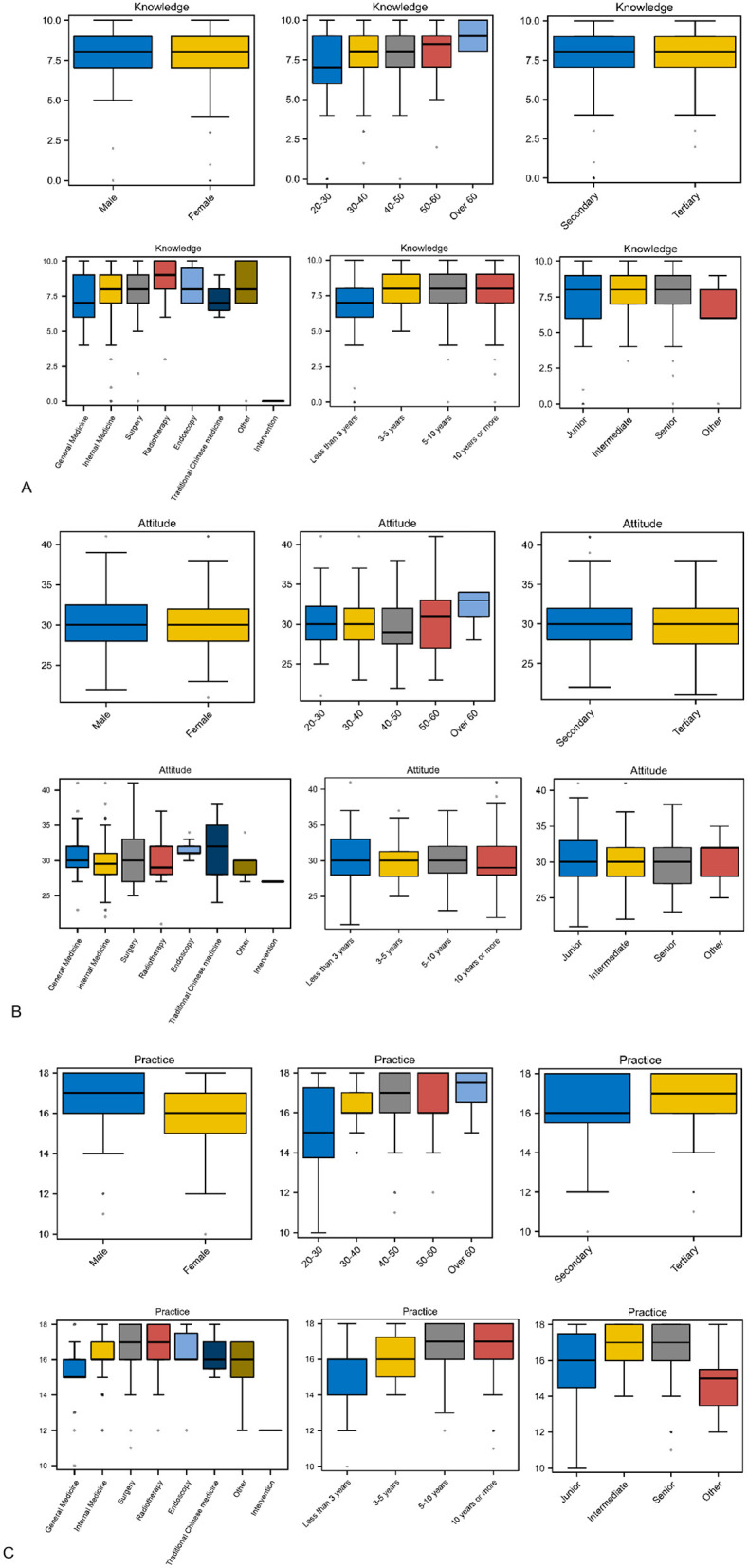
A total of 210 questionnaires were included. The majority of respondents aware that their healthcare organizations had already begun to implement the policy. With a mean score of 7.67 for knowledge, respondents basically had a good level of knowledge of DRGs. The mean attitude score of the respondents was 30.20, which was lower than the "positive attitude" criterion, and their main concerns were about matters other than treatment. Knowledge scores were significantly correlated with attitude scores ( < 0.001), whereas attitude scores were not associated with practice scores. Path analysis and generalized linear modeling indicate that knowledge effectively influences attitudes, whereas attitudes do not have an apparent impact on practice.
Oncologists' understanding of DRGs needs to be improved, and their knowledge and attitudes have not yet translated into demonstrable positive practice behaviors. This gap underscores the need for knowledge training and effective incentives.
知识、态度与实践(KAP)调查通过结构化问卷评估与健康相关的知识、态度和实践。通过收集定性和定量数据,它衡量当前状况、检验假设,并为促进健康行为和教育提供见解。2019年,国家卫生健康委员会启动了疾病诊断相关分组(DRG)支付改革。本研究旨在通过评估医生对DRG系统的知识、态度和实践,提高医疗保险和政策实施的质量。
本研究是一项横断面研究,通过简单随机抽样方法设计问卷,受访者为抽样医院临床科室的医生。问卷包括基本信息、关于DRG的知识、对DRG的态度和实施实践。数据采用描述性统计分析、相关性分析、路径分析和广义线性模型进行分析。
共纳入210份问卷。大多数受访者知晓其医疗机构已开始实施该政策。知识平均得分为7.67,受访者对DRG基本有较好的知识水平。受访者的态度平均得分为30.20,低于“积极态度”标准,他们主要关注的是治疗以外的事项。知识得分与态度得分显著相关(<0.001),而态度得分与实践得分无关。路径分析和广义线性模型表明,知识有效影响态度,而态度对实践没有明显影响。
肿瘤学家对DRG的理解需要提高,他们的知识和态度尚未转化为明显的积极实践行为。这一差距凸显了知识培训和有效激励措施的必要性。