Department of Orthodontics, Justus-Liebig-University Giessen, Schlangenzahl 14, 35392, Giessen, Germany.
Private Practice, Ethnomartiron 70A, 71409, Heraklion (Iraclio), Crete, Greece.
BMC Oral Health. 2020 Nov 4;20(1):308. doi: 10.1186/s12903-020-01304-2.
Recently, reports of unwanted tooth movements despite intact orthodontic bonded retainers have increased. These movements are not subject to relapse but are classified as a new developed malocclusion. The aims of the present pilot study were to analyze the prevalence of unwanted tooth movements despite intact bonded cuspid-to-cuspid retainers and to identify possible predisposing factors.
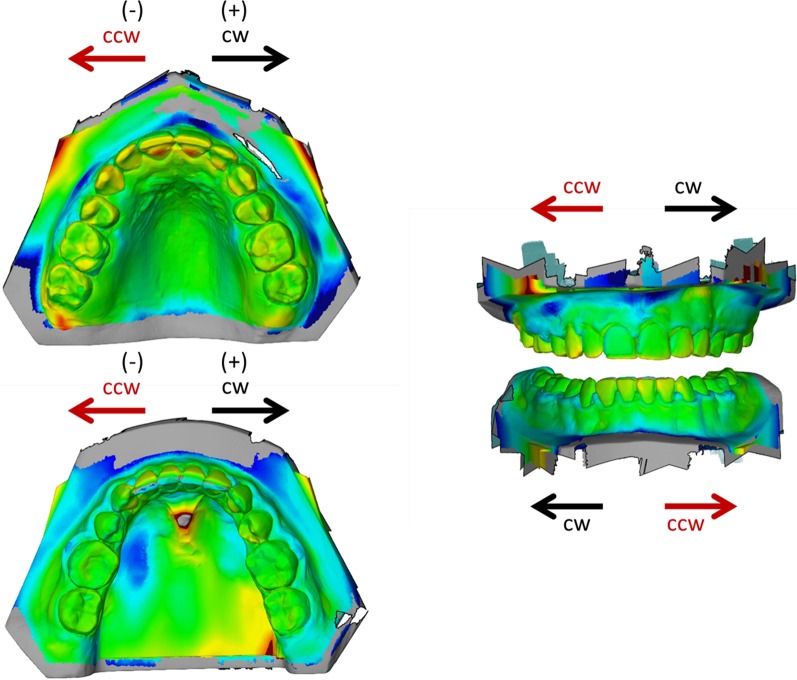
Plaster casts of all patients finishing orthodontic treatment during three consecutive years were assessed before treatment (T0), after multibracket appliance debonding (T1) and after two years of retention (T2). After multibracket appliance treatment, all patients received a cuspid-to-cuspid flexible spiral wire retainer bonded to each tooth of the retained segment in the upper and lower jaw. The study group (SG) consisted of 44 patients (16 male, 28 female) with tooth movements (T1-T2) of the retained segment despite intact bonded cuspid-to-cuspid retainer and the control group (CG) of 43 patients (19 male, 24 female) without unwanted tooth movements. The casts of the SG were digitized, superimposed and measured. Using the Chi-square test, Fisher´s exact test and Mann-Whitney-U-test (p < 0.05), mandibular plane angle, incisor proclination, oral dysfunctions or habits (T0) and intercanine distance, overjet and interincisal relationship (T0, T1, T2) were compared between SG and CG.
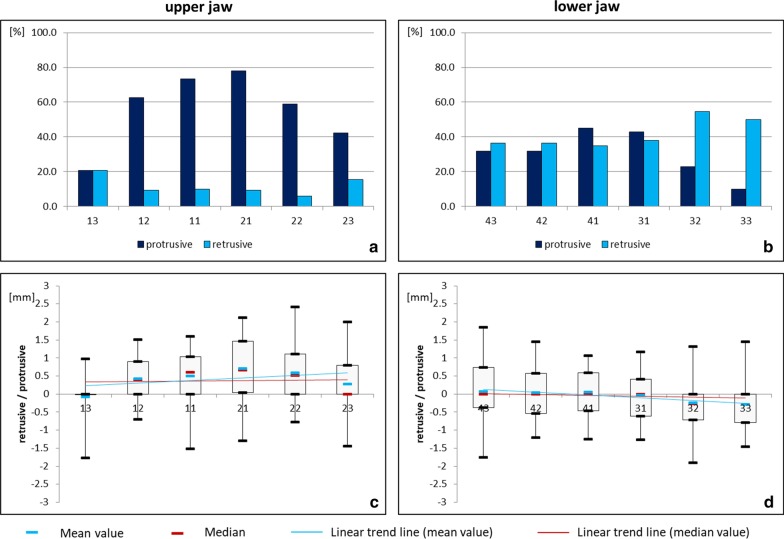
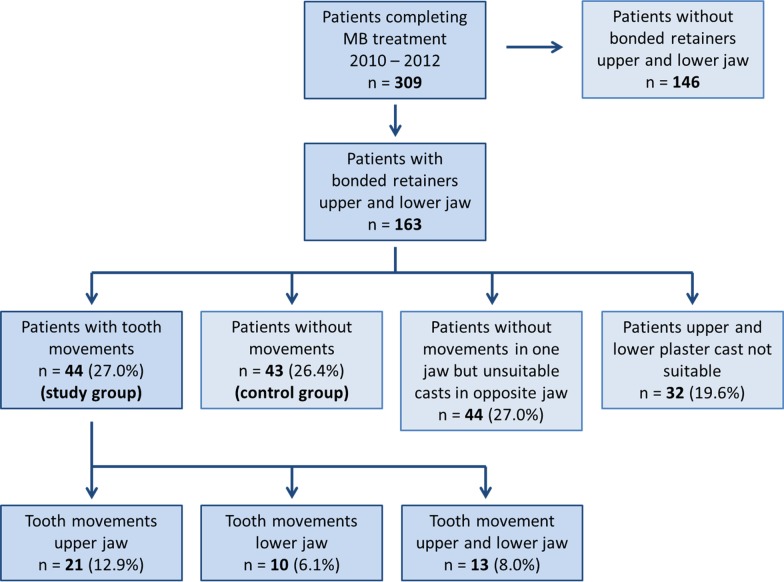
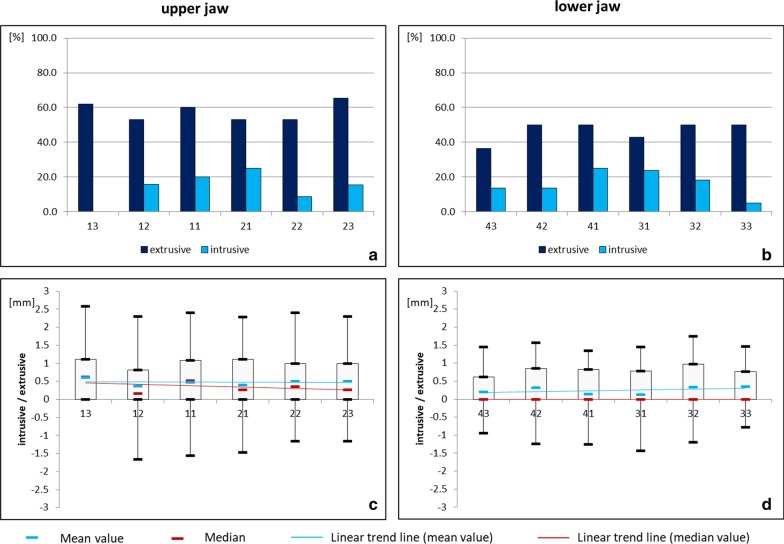
The prevalence of patients with unwanted tooth movements in one or both jaws was 27.0%. Maxillary retainers were affected more often (20.9%) than mandibular retainers (14.1%). The median amount of tooth movements was 0 to 0.66 mm with large interindividual variations. Oral dysfunctions or habits at T0, such as a lack of interincisal contact at all time points, were associated with unwanted tooth movements.
Unwanted tooth movements occurred more often with maxillary than mandibular retainers. Patients with oral dysfunctions/habits and without interincisal contact had a higher prevalence of unwanted tooth movements.
最近,尽管保持器完整,仍有报告称出现了不需要的牙齿移动,这种移动不受复发影响,但被归类为新出现的错颌。本研究旨在分析保持器完整的情况下仍出现尖牙间牙齿不需要移动的发生率,并确定可能的诱发因素。
连续三年完成正畸治疗的所有患者的石膏模型在治疗前(T0)、多托槽矫治器拆除后(T1)和两年保持器佩戴后(T2)进行评估。多托槽矫治器治疗完成后,所有患者均在上颌和下颌的保留牙段的每颗牙上粘结尖牙-尖牙的弹性螺旋丝保持器。研究组(SG)由 44 名患者(16 名男性,28 名女性)组成,尽管保持器完整,但仍有保留牙段的牙齿移动(T1-T2),对照组(CG)由 43 名患者(19 名男性,24 名女性)组成,他们没有不需要的牙齿移动。SG 的石膏模型被数字化、叠加和测量。使用卡方检验、Fisher 精确检验和曼-惠特尼 U 检验(p<0.05),比较 SG 和 CG 之间下颌平面角、切牙前倾、口腔功能或习惯(T0)以及尖牙间距离、覆盖和切牙关系(T0、T1、T2)。
在一个或两个颌骨中出现不需要的牙齿移动的患者发生率为 27.0%。上颌保持器的影响更常见(20.9%),而下颌保持器的影响较小(14.1%)。牙齿移动的中位数为 0 至 0.66mm,个体间差异较大。T0 时的口腔功能或习惯,如在所有时间点都没有切牙接触,与不需要的牙齿移动有关。
上颌保持器比下颌保持器更容易出现不需要的牙齿移动。有口腔功能/习惯和没有切牙接触的患者发生不需要的牙齿移动的发生率更高。