Chen Shanquan, Chen Xi, Law Stephen, Lucas Henry, Tang Shenlan, Long Qian, Xue Lei, Wang Zheng
The School of Clinical Medicine, University of Cambridge, Cambridge, UK.
Department of Health Policy and Management, Yale School of Public Health, New Haven, CT, USA.
BMC Health Serv Res. 2020 Nov 4;20(1):1008. doi: 10.1186/s12913-020-05831-0.
The proportion of people aged 60 years or over is growing faster than other age groups. Traditionally, retirement has been considered as both a loss to the labour market and an additional economic burden on the nation. More recently, it is widely accepted that retired people can still contribute to society in many ways, though the extent of their contributions will depend heavily on their state of health. In this context, a significant practical issue is how to encourage older people to use the health services they need. This study aims to evaluate the effects of pensions on older adults' health service utilization, and estimate the level of pension required to influence such utilization.
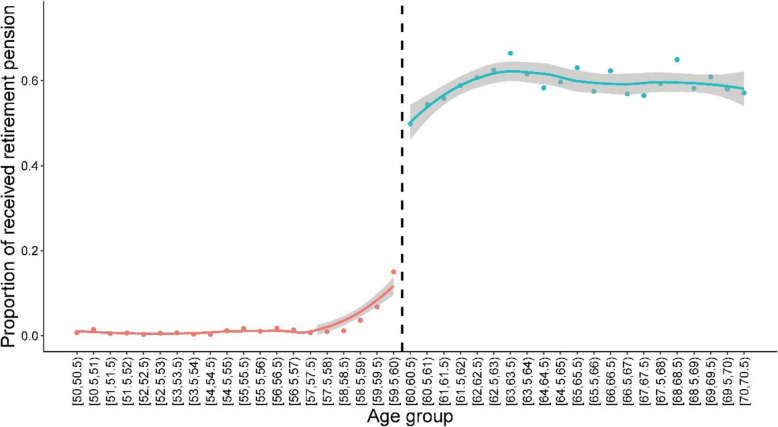
Using data from a nationally representative sample survey, the China Health and Retirement Longitudinal Study, we adopted a fuzzy regression discontinuity design and undertook segmented regression analysis.
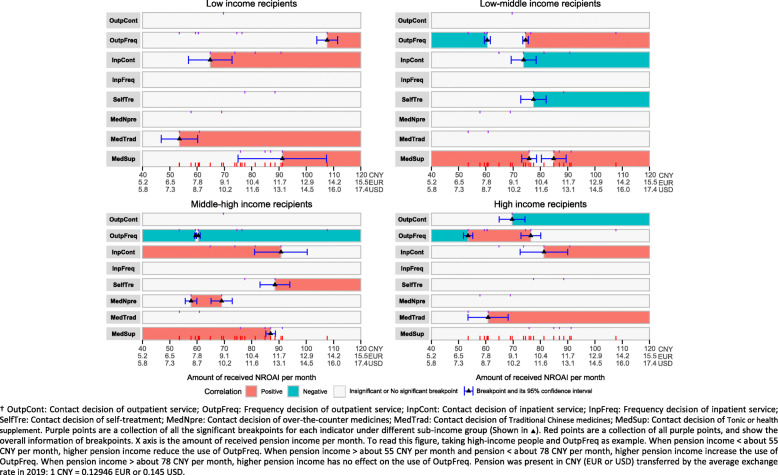
It was found that a pension did encourage low-income people to use both outpatient (OR = 1.219, 95% 1.018-1.460) and inpatient services (OR = 1.269, 95% 1.020-1.579); but also encouraged both low- and high-income people to choose self-treatment, specifically over-the-counter (OR = 1.208, 95% 1.037-1.407; OR = 1.206, 95% 1.024-1.419; respectively) and traditional Chinese medicines (OR = 1.452, 95% 1.094-1.932; OR = 1.456, 95% 1.079-1.955; respectively). However, receiving a pension had no effect on the frequency of outpatient and inpatient service use. Breakpoints for a pension to promote health service utilization were mainly located in the range 55-95 CNY (7.1-12.3 EUR or 8.0-13.8 USD).
A pension was found to have mixed effects on health service utilization for different income groups. Our study enriches existing evidence on the impact of pensions on healthcare-seeking behaviour and can be helpful in policy design and the formulation of improved models relating to pensions and healthcare utilisation.
60岁及以上人群的增长速度快于其他年龄组。传统上,退休被视为劳动力市场的损失以及国家额外的经济负担。最近,人们普遍认为退休人员仍能在许多方面为社会做出贡献,尽管他们的贡献程度在很大程度上取决于其健康状况。在这种背景下,一个重要的实际问题是如何鼓励老年人使用他们所需的医疗服务。本研究旨在评估养老金对老年人医疗服务利用的影响,并估计影响这种利用所需的养老金水平。
我们使用来自具有全国代表性的样本调查——中国健康与养老追踪调查(China Health and Retirement Longitudinal Study)的数据,采用模糊回归断点设计并进行分段回归分析。
研究发现,养老金确实鼓励低收入人群使用门诊服务(比值比[OR]=1.219,95%置信区间[CI]为1.018 - 1.460)和住院服务(OR = 1.269,95% CI为1.020 - 1.579);同时也鼓励低收入和高收入人群选择自我治疗,特别是非处方药(分别为OR = 1.208,95% CI为1.037 - 1.407;OR = 1.206,95% CI为1.024 - 1.419)和中药(分别为OR = 1.452,95% CI为1.094 - 1.932;OR = 1.456,95% CI为1.079 - 1.955)。然而,领取养老金对门诊和住院服务的使用频率没有影响。养老金促进医疗服务利用的断点主要位于55 - 95元人民币(7.1 - 12.3欧元或8.0 - 13.8美元)范围内。
研究发现养老金对不同收入群体的医疗服务利用有不同影响。我们的研究丰富了关于养老金对就医行为影响的现有证据,有助于政策设计以及制定与养老金和医疗利用相关的改进模型。