Haas Randall, Watson James, Buonasera Tammy, Southon John, Chen Jennifer C, Noe Sarah, Smith Kevin, Llave Carlos Viviano, Eerkens Jelmer, Parker Glendon
Department of Anthropology, University of California Davis, One Shields Ave., Davis, CA 95616, USA.
Collasuyo Archaeological Research Institute, Jiron Nicaragua 199, Puno, Puno, Peru.
Sci Adv. 2020 Nov 4;6(45). doi: 10.1126/sciadv.abd0310. Print 2020 Nov.
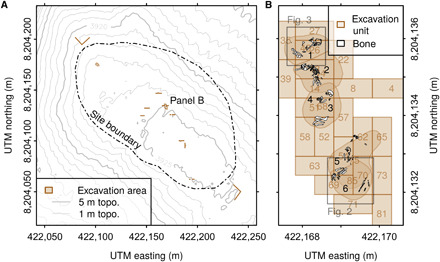
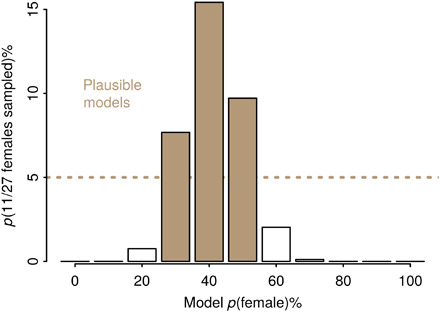
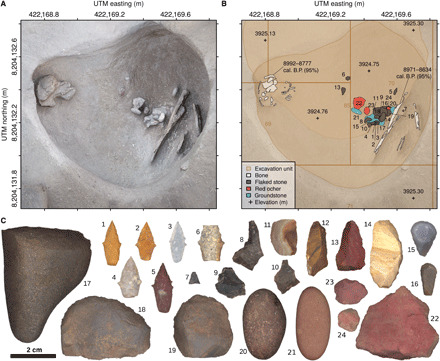
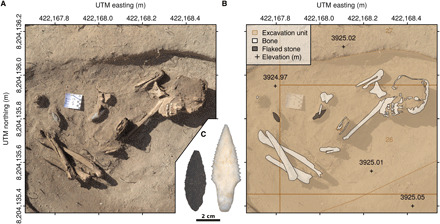
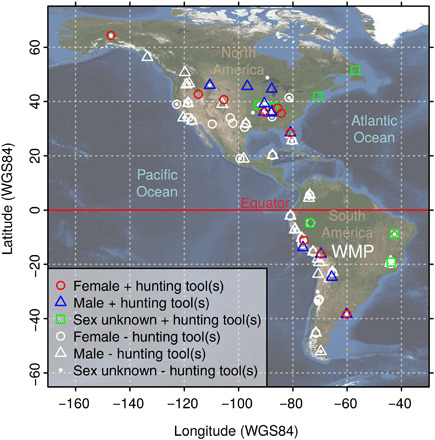
Sexual division of labor with females as gatherers and males as hunters is a major empirical regularity of hunter-gatherer ethnography, suggesting an ancestral behavioral pattern. We present an archeological discovery and meta-analysis that challenge the man-the-hunter hypothesis. Excavations at the Andean highland site of Wilamaya Patjxa reveal a 9000-year-old human burial (WMP6) associated with a hunting toolkit of stone projectile points and animal processing tools. Osteological, proteomic, and isotopic analyses indicate that this early hunter was a young adult female who subsisted on terrestrial plants and animals. Analysis of Late Pleistocene and Early Holocene burial practices throughout the Americas situate WMP6 as the earliest and most secure hunter burial in a sample that includes 10 other females in statistical parity with early male hunter burials. The findings are consistent with nongendered labor practices in which early hunter-gatherer females were big-game hunters.
以女性为采集者、男性为狩猎者的性别分工是狩猎采集民族志的一个主要经验规律,暗示了一种祖传行为模式。我们提出了一项考古发现和元分析,对男性狩猎者假说提出了挑战。在安第斯高地的维拉马亚·帕特贾遗址的发掘揭示了一座有9000年历史的人类墓葬(WMP6),与一个由石制投射尖器和动物加工工具组成的狩猎工具包相关。骨骼学、蛋白质组学和同位素分析表明,这位早期的狩猎者是一名年轻成年女性,以陆地植物和动物为食。对美洲晚更新世和早全新世埋葬习俗的分析将WMP6定位为最早且最确凿的狩猎者墓葬,在一个样本中,该样本包括另外10名女性,在统计学上与早期男性狩猎者墓葬相当。这些发现与无性别劳动实践一致,即早期狩猎采集社会的女性是大型猎物的狩猎者。