Faculty of Biological Sciences, Institute of Molecular Biosciences, Goethe University Frankfurt, Max-von-Laue Straße 9, 60438, Frankfurt am Main, Germany.
Institute of Biochemical Engineering, Technical University of Munich, Boltzmannstr. 15, 85748, Garching, Germany.
Sci Rep. 2020 Nov 4;10(1):19021. doi: 10.1038/s41598-020-75926-5.
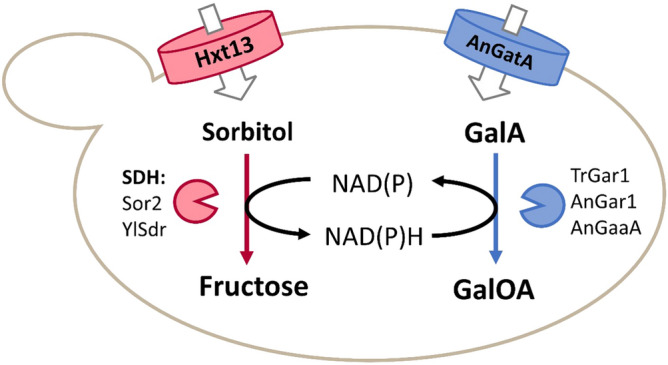
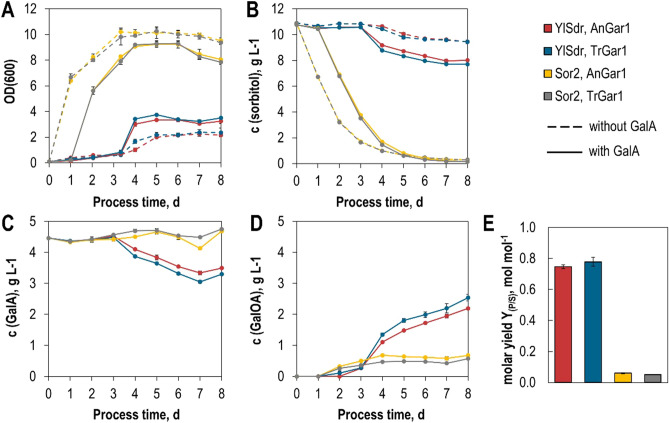
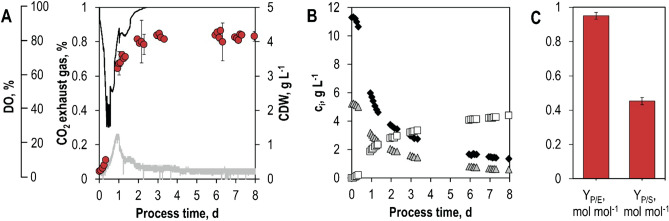
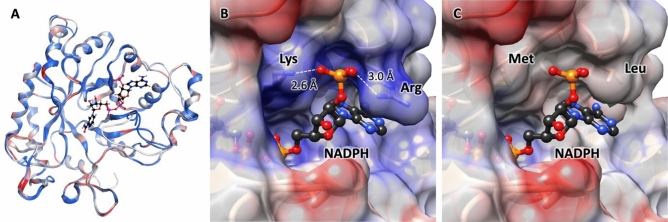
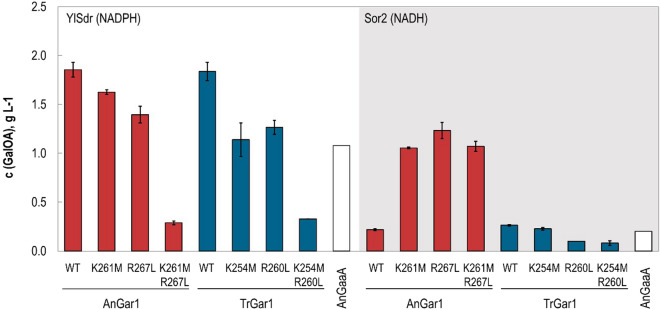
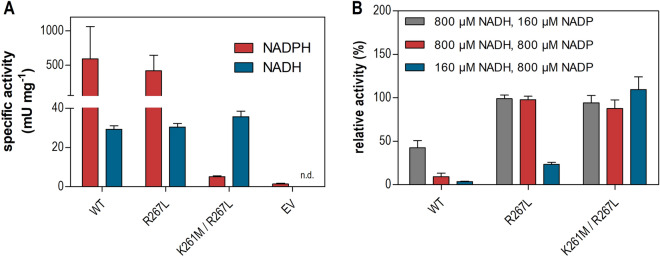
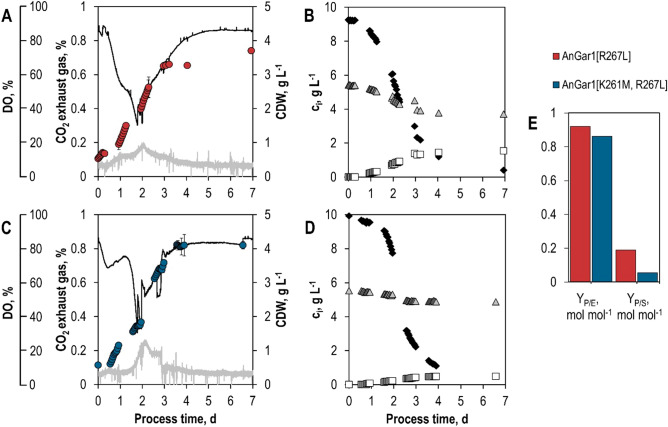
D-Galacturonic acid (GalA) is the major constituent of pectin-rich biomass, an abundant and underutilized agricultural byproduct. By one reductive step catalyzed by GalA reductases, GalA is converted to the polyhydroxy acid L-galactonate (GalOA), the first intermediate of the fungal GalA catabolic pathway, which also has interesting properties for potential applications as an additive to nutrients and cosmetics. Previous attempts to establish the production of GalOA or the full GalA catabolic pathway in Saccharomyces cerevisiae proved challenging, presumably due to the inefficient supply of NADPH, the preferred cofactor of GalA reductases. Here, we tested this hypothesis by coupling the reduction of GalA to the oxidation of the sugar alcohol sorbitol that has a higher reduction state compared to glucose and thereby yields the necessary redox cofactors. By choosing a suitable sorbitol dehydrogenase, we designed yeast strains in which the sorbitol metabolism yields a "surplus" of either NADPH or NADH. By biotransformation experiments in controlled bioreactors, we demonstrate a nearly complete conversion of consumed GalA into GalOA and a highly efficient utilization of the co-substrate sorbitol in providing NADPH. Furthermore, we performed structure-guided mutagenesis of GalA reductases to change their cofactor preference from NADPH towards NADH and demonstrated their functionality by the production of GalOA in combination with the NADH-yielding sorbitol metabolism. Moreover, the engineered enzymes enabled a doubling of GalOA yields when glucose was used as a co-substrate. This significantly expands the possibilities for metabolic engineering of GalOA production and valorization of pectin-rich biomass in general.
半乳糖醛酸(GalA)是果胶丰富生物质的主要成分,是一种丰富但未充分利用的农业副产品。通过半乳糖醛酸还原酶催化的一个还原步骤,GalA 转化为多羟基酸 L-半乳糖酸盐(GalOA),这是真菌 GalA 分解代谢途径的第一个中间产物,它也具有作为营养物和化妆品添加剂的潜在有趣性质。以前在酿酒酵母中建立 GalOA 或完整 GalA 分解代谢途径的生产的尝试被证明具有挑战性,这可能是由于 NADPH 的供应效率低下所致,NADPH 是半乳糖醛酸还原酶的首选辅因子。在这里,我们通过将 GalA 的还原与糖醇山梨醇的氧化偶联来测试这一假设,与葡萄糖相比,山梨醇具有更高的还原态,从而产生必要的氧化还原辅因子。通过选择合适的山梨醇脱氢酶,我们设计了酵母菌株,其中山梨醇代谢产生 NADPH 或 NADH 的“过剩”。通过在控制生物反应器中的生物转化实验,我们证明了消耗的 GalA 几乎完全转化为 GalOA,并且山梨醇作为共底物的利用率非常高,提供了 NADPH。此外,我们对半乳糖醛酸还原酶进行了基于结构的突变,以改变它们对半辅因子的偏好,从 NADPH 转向 NADH,并通过与产生 NADH 的山梨醇代谢相结合生产 GalOA 来证明其功能。此外,当使用葡萄糖作为共底物时,工程化酶使 GalOA 产量增加了一倍。这大大扩展了 GalOA 生产的代谢工程和一般果胶丰富生物质的增值的可能性。