Müller Anke Katharina, Helms Ute, Rohrer Carsten, Möhler Monika, Hellwig Frank, Glei Michael, Schwerdtle Tanja, Lorkowski Stefan, Dawczynski Christine
Department of Nutritional Biochemistry and Physiology, Institute of Nutritional Sciences, Friedrich Schiller University Jena, Dornburger Str. 25, 07743 Jena, Germany.
Competence Cluster for Nutrition and Cardiovascular Health (nutriCARD) Halle-Jena-Leipzig, Dornburger Str. 25, 07743 Jena, Germany.
Foods. 2020 Nov 3;9(11):1596. doi: 10.3390/foods9111596.
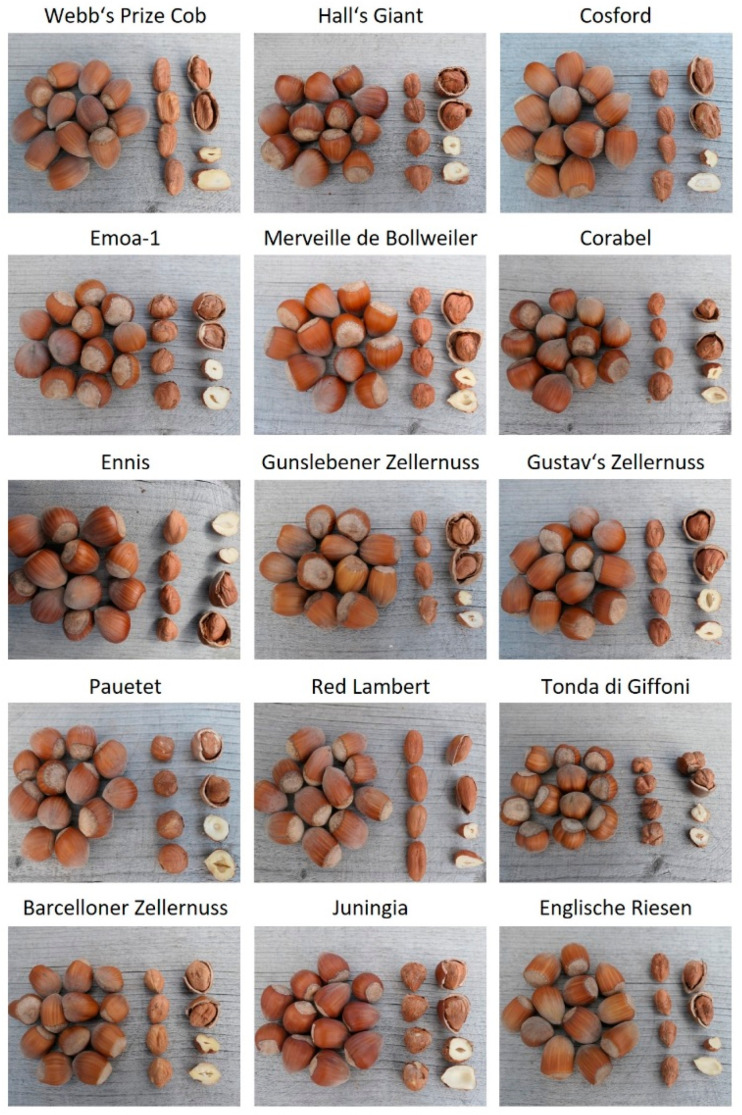
Hazelnuts are rarely cultivated in Germany, although they are a valuable source for macro- and micronutrients and can thus contribute to a healthy diet. Near the present, 15 varieties were cultivated in Thuringia, Germany, as a pilot study for further research. The aim of our study was to evaluate the micro- and macronutrient composition of representative, randomly mixed samples of the 15 different hazelnut cultivars. Protein, fat, and fiber contents were determined using established methods. Fatty acids, tocopherols, minerals, trace elements, and ultra-trace elements were analyzed using gas chromatography, high-performance liquid chromatography, and inductively coupled plasma triple quadrupole mass-spectrometry, respectively. We found that the different hazelnut varieties contained valuable amounts of fat, protein, dietary fiber, minerals, trace elements, and α-tocopherol, however, in different quantities. The variations in nutrient composition were independent of growth conditions, which were identical for all hazelnut varieties. Therefore, each hazelnut cultivar has its specific nutrient profile.
榛子在德国很少种植,尽管它们是大量宏量营养素和微量营养素的宝贵来源,因此有助于健康饮食。目前,德国图林根州种植了15个品种作为进一步研究的试点。我们研究的目的是评估这15个不同榛子品种代表性随机混合样本中的微量营养素和宏量营养素组成。使用既定方法测定蛋白质、脂肪和纤维含量。分别使用气相色谱法、高效液相色谱法和电感耦合等离子体质谱三重四极杆质谱法分析脂肪酸、生育酚、矿物质、微量元素和超微量元素。我们发现,不同的榛子品种含有大量的脂肪、蛋白质、膳食纤维、矿物质、微量元素和α-生育酚,但含量各不相同。营养成分的差异与生长条件无关,所有榛子品种的生长条件都是相同的。因此,每个榛子品种都有其特定的营养特征。