Pharmacy Practice, University of Connecticut School of Pharmacy, Storrs, Connecticut, USA.
Evidence-Based Practice Center, Hartford Hospital, Hartford, Connecticut, USA.
BMJ Open. 2020 Nov 5;10(11):e040499. doi: 10.1136/bmjopen-2020-040499.
As oral factor Xa (oFXa) inhibitor use has increased, so has publication of case series describing related bleeding managed with four-factor prothrombin complex concentrate (4F-PCC).
This review aimed to identify case series describing 4F-PCC management of oFXa inhibitor-related bleeding and appraise their methodological and reporting quality.
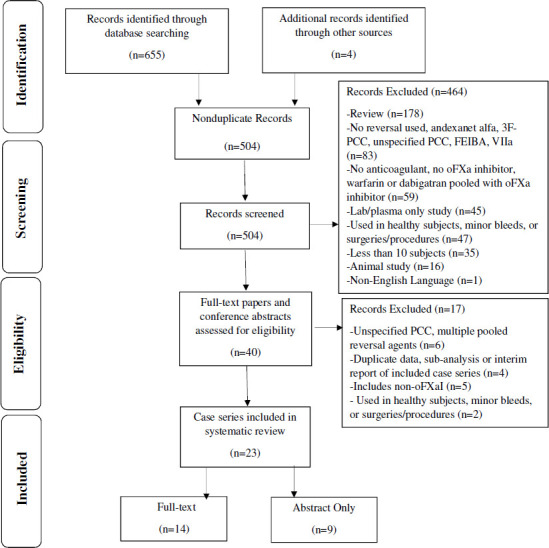
We searched Medline and EMBASE (1 January 2011 to 31 May 2020) to identify series of ≥10 patients with oFXa inhibitor-related major bleeding given off-label 4F-PCC. Case series were evaluated using a validated tool adapted for this topic. The tool addressed patient selection, bleed/outcome ascertainment, causal/temporal association and reporting.
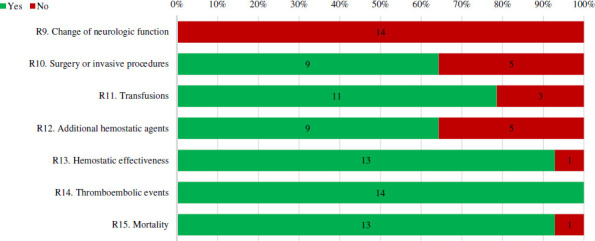
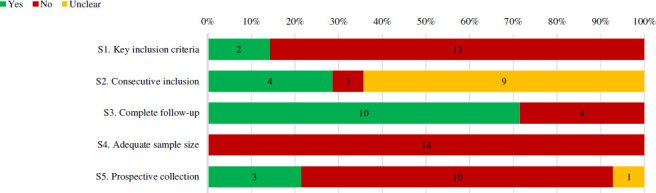
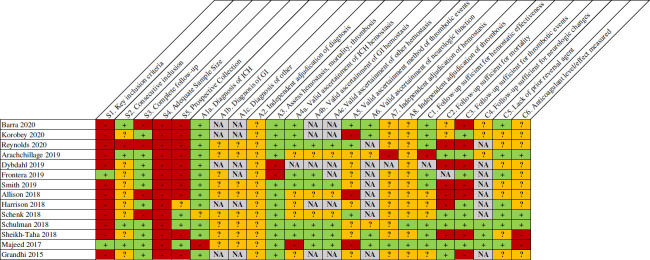
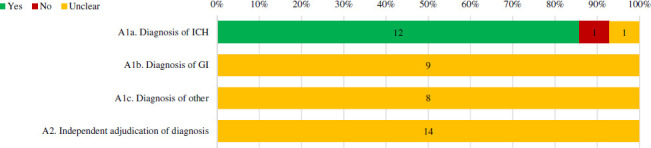
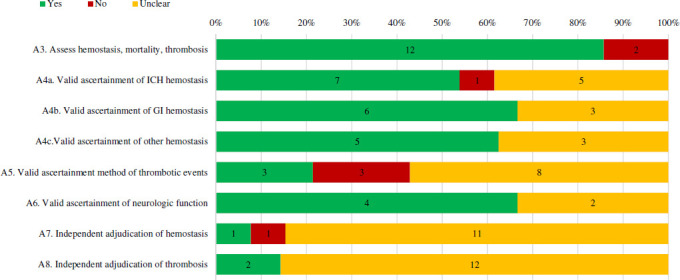
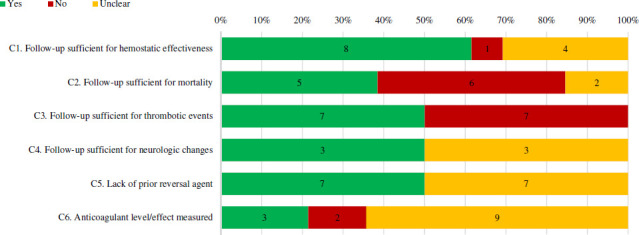
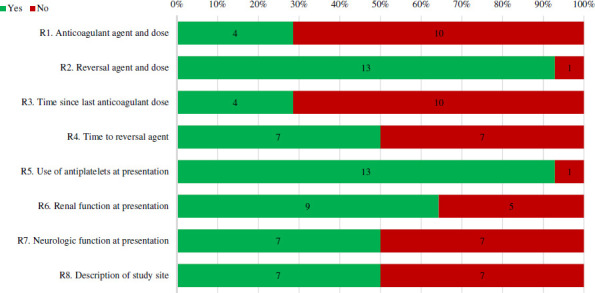
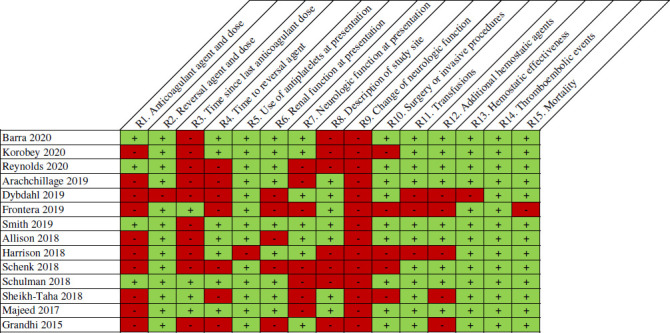
We identified 14 case series. None had ≥100 patients (range=13-84), three were prospective, two detailed appropriate inclusion criteria and four noted consecutive inclusion. While 12 series provided clear/appropriate methods for diagnosis of intracranial haemorrhage (ICH); none did so for extracranial bleeds and it was not clear whether bleeding was adjudicated in any. Haemostatic effectiveness, thrombosis and mortality were together evaluated in 12 series, but only seven used validated methods to evaluate/diagnosis haemostasis in ICH, six in gastrointestinal bleeds, five in other bleeds and three in thrombosis. Independent adjudication of haemostasis (n=1) and thrombosis (n=2) was infrequent. Thirty-day follow-up for mortality and thrombosis was noted in five and seven series. Anticoagulation measurement/levels in at least some patients were conveyed in three series. Few series provided data on anticoagulant agent/dose (n=4), time from anticoagulant (n=4), time-to-reversal (n=7), baseline (n=7) or change (n=0) in neurologic function.
Although many case series describe off-label use of 4F-PCC for oFXa inhibitor-related bleeding, methodological flaws and/or poor reporting necessitates caution in interpretation.
随着口服因子 Xa(oFXa)抑制剂的应用增加,描述使用四种因子凝血酶原复合物浓缩物(4F-PCC)治疗相关出血的病例系列报告也越来越多。
本综述旨在确定描述使用 4F-PCC 治疗 oFXa 抑制剂相关出血的病例系列,并评估其方法学和报告质量。
我们检索了 Medline 和 EMBASE(2011 年 1 月 1 日至 2020 年 5 月 31 日),以确定接受 oFXa 抑制剂相关大出血的病例系列,这些病例系列使用未经批准的 4F-PCC。病例系列使用针对该主题进行了调整的经过验证的工具进行评估。该工具涉及患者选择、出血/结局确定、因果关系和报告。
我们确定了 14 个病例系列。没有一个系列有≥100 名患者(范围为 13-84 名),其中 3 个是前瞻性的,2 个详细说明了适当的纳入标准,4 个注意到连续纳入。虽然 12 个系列提供了明确/适当的方法来诊断颅内出血(ICH);但对于颅外出血均未明确说明,并且不清楚是否对任何出血进行了裁决。12 个系列一起评估了止血效果、血栓形成和死亡率,但只有 7 个使用了经过验证的方法来评估/诊断 ICH 中的止血,6 个用于胃肠道出血,5 个用于其他出血,3 个用于血栓形成。独立的止血(n=1)和血栓形成(n=2)裁决很少。5 个和 7 个系列分别记录了 30 天的死亡率和血栓形成随访。至少在三个系列中报告了一些患者的抗凝剂测量/水平。很少有系列提供关于抗凝剂/剂量(n=4)、从抗凝剂开始的时间(n=4)、逆转时间(n=7)、基线(n=7)或神经功能变化(n=0)的数据。
尽管许多病例系列描述了 oFXa 抑制剂相关出血的 4F-PCC 未经批准使用,但方法学缺陷和/或报告不良需要谨慎解释。