Nunes Willian G, Freitas Bruno G A, Beraldo Renato M, Filho Rubens Maciel, Da Silva Leonardo M, Zanin Hudson
Advanced Energy Storage Division, Center for Innovation on New Energies, Carbon Sci-Tech Labs and Manufacturing Group, School of Electrical and Computer Engineering, University of Campinas, Av. Albert Einstein 400, Campinas, SP, 13083-852, Brazil.
Advanced Energy Storage Division, Center for Innovation on New Energies, School of Chemical Engineering, University of Campinas, Av. Albert Einstein 500, Campinas, SP, 13083-852, Brazil.
Sci Rep. 2020 Nov 5;10(1):19195. doi: 10.1038/s41598-020-75851-7.
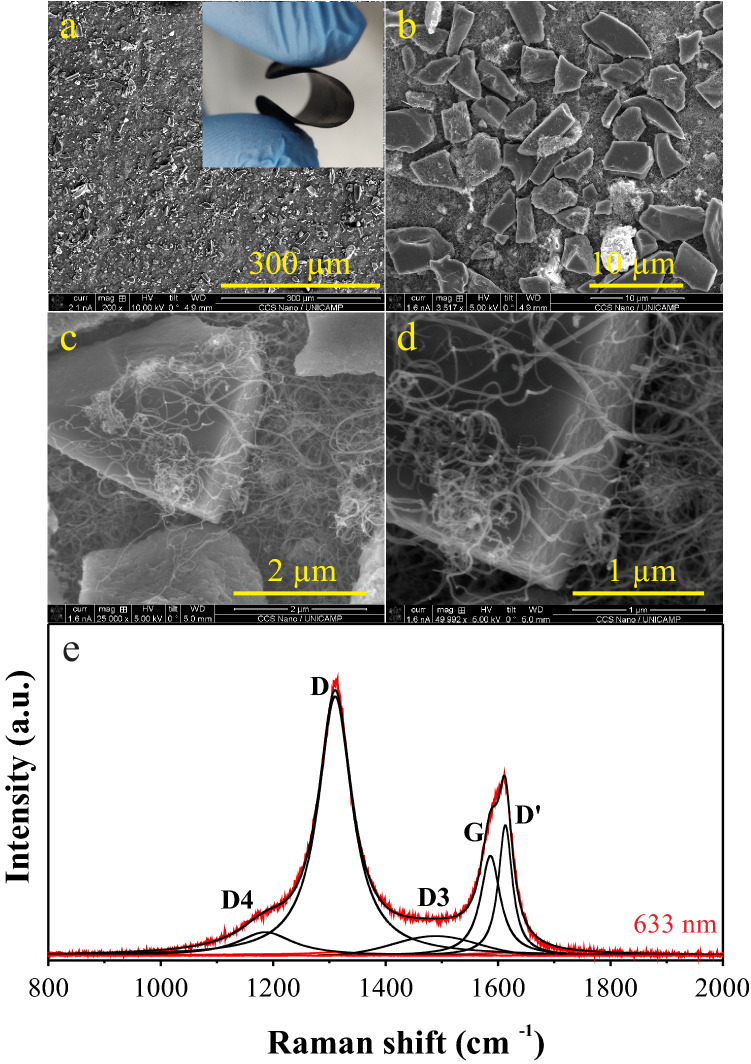
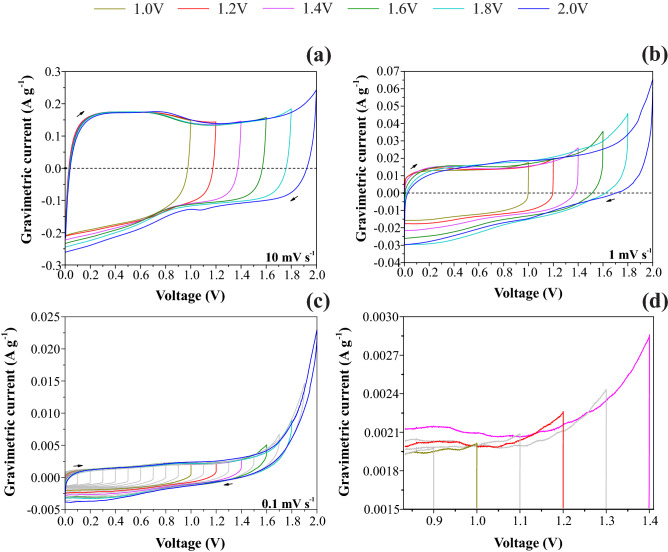
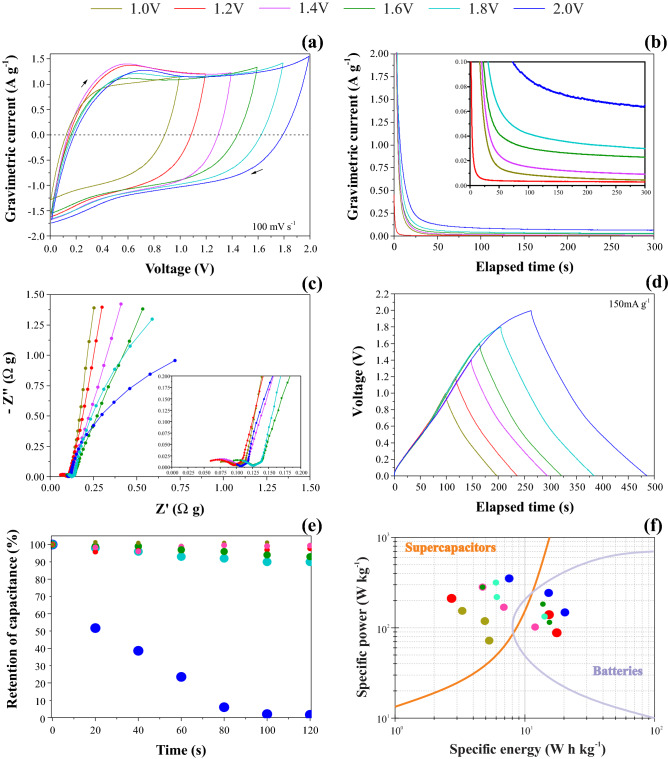
It is common to find in the literature different values for the working voltage window (WVW) range for aqueous-based supercapacitors. In many cases, even with the best intentions of the widening the operating voltage window, the measured current using the cyclic voltammetry (CV) technique includes a significant contribution from the irreversible Faradaic reactions involved in the water-splitting process, masked by fast scan rates. Sometimes even using low scan rates is hard to determine precisely the correct WVW of the aqueous-based electrochemical capacitor. In this sense, we discuss here the best practices to determine the WVW for capacitive current in an absence of water splitting using complementary techniques such as CV, chronoamperometry (CA), and the electrochemical impedance spectroscopy (EIS). To accomplish this end, we prepare and present a model system composed of multiwalled carbon nanotubes buckypaper electrodes housed in the symmetric coin cell and soaked with an aqueous-based electrolyte. The system electrochemical characteristics are carefully evaluated during the progressive enlargement of the cell voltage window. The presence of residual Faradaic current is verified in the transients from the CA study, as well as the impedance changes revealed by EIS as a function of the applied voltage, is discussed. We verify that an apparent voltage window of 2.0 V determined using the CV technique is drastically decreased to 1.2 V after a close inspection of the CA findings used to discriminate the presence of a parasitic Faradaic process. Some orientations are presented to instigate the establishment in the literature of some good scientific practices concerned with the reliable characterization of supercapacitors.
在文献中,常见到水基超级电容器的工作电压窗口(WVW)范围有不同的值。在许多情况下,即使有意拓宽工作电压窗口,使用循环伏安法(CV)技术测得的电流也包含水分解过程中不可逆法拉第反应的显著贡献,这在快速扫描速率下被掩盖了。有时,即使使用低扫描速率也很难精确确定水基电化学电容器的正确WVW。从这个意义上讲,我们在此讨论使用CV、计时电流法(CA)和电化学阻抗谱(EIS)等互补技术在不存在水分解的情况下确定电容电流WVW的最佳做法。为此,我们制备并展示了一个模型系统,该系统由多壁碳纳米管巴基纸电极组成,置于对称纽扣电池中,并用一种水基电解质浸泡。在逐步扩大电池电压窗口的过程中,仔细评估该系统的电化学特性。讨论了在CA研究的瞬态中残余法拉第电流的存在,以及EIS揭示的阻抗随施加电压的变化。我们验证,在仔细检查用于区分寄生法拉第过程存在的CA结果后,使用CV技术确定的2.0V表观电压窗口大幅降至1.2V。本文还提出了一些建议,以促使文献中建立一些关于超级电容器可靠表征的良好科学实践。