Brandão Andreia, Paulo Paula, Maia Sofia, Pinheiro Manuela, Peixoto Ana, Cardoso Marta, Silva Maria P, Santos Catarina, Eeles Rosalind A, Kote-Jarai Zsofia, Muir Kenneth, Schleutker Johanna, Wang Ying, Pashayan Nora, Batra Jyotsna, Grönberg Henrik, Neal David E, Nordestgaard Børge G, Tangen Catherine M, Southey Melissa C, Wolk Alicja, Albanes Demetrius, Haiman Christopher A, Travis Ruth C, Stanford Janet L, Mucci Lorelei A, West Catharine M L, Nielsen Sune F, Kibel Adam S, Cussenot Olivier, Berndt Sonja I, Koutros Stella, Sørensen Karina Dalsgaard, Cybulski Cezary, Grindedal Eli Marie, Park Jong Y, Ingles Sue A, Maier Christiane, Hamilton Robert J, Rosenstein Barry S, Vega Ana, Kogevinas Manolis, Wiklund Fredrik, Penney Kathryn L, Brenner Hermann, John Esther M, Kaneva Radka, Logothetis Christopher J, Neuhausen Susan L, Ruyck Kim De, Razack Azad, Newcomb Lisa F, Lessel Davor, Usmani Nawaid, Claessens Frank, Gago-Dominguez Manuela, Townsend Paul A, Roobol Monique J, Teixeira Manuel R
Cancer Genetics Group, IPO Porto Research Center (CI-IPOP), Portuguese Oncology Institute of Porto (IPO Porto), 4200-072 Porto, Portugal.
Department of Genetics, Portuguese Oncology Institute of Porto (IPO Porto), 4200-072 Porto, Portugal.
Cancers (Basel). 2020 Nov 4;12(11):3254. doi: 10.3390/cancers12113254.
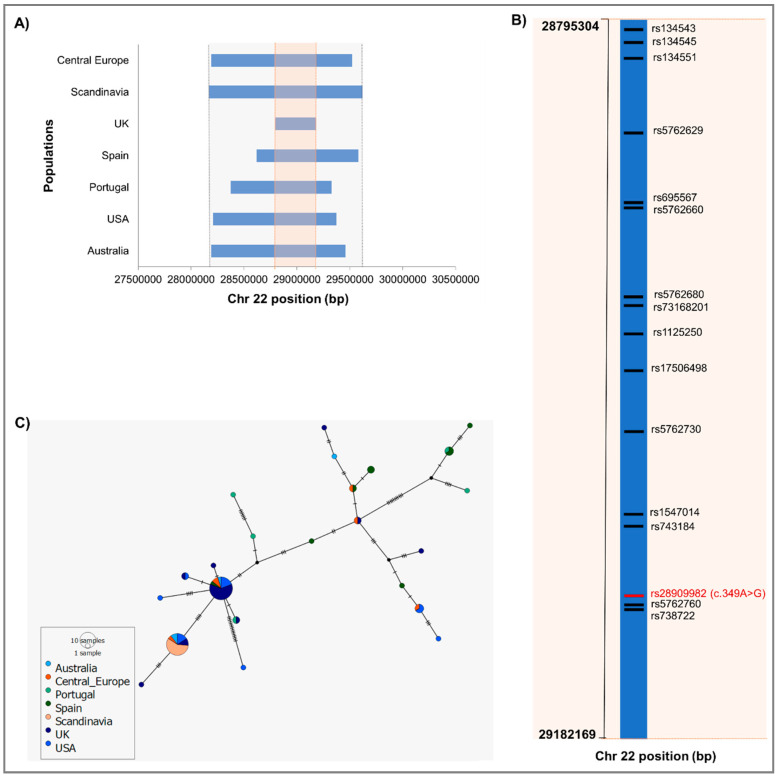
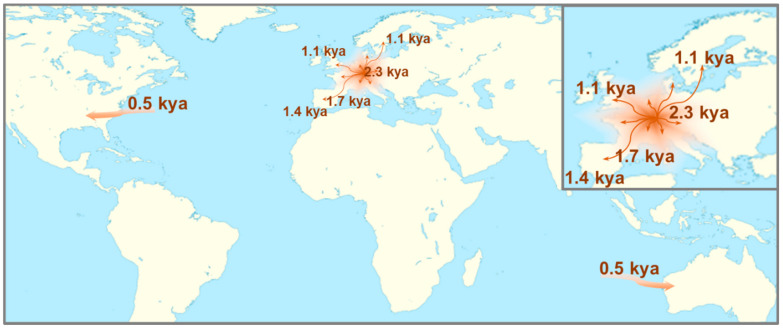
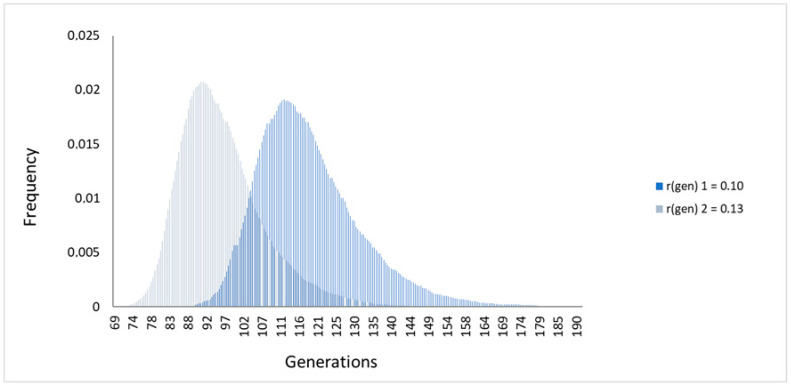
The identification of recurrent founder variants in cancer predisposing genes may have important implications for implementing cost-effective targeted genetic screening strategies. In this study, we evaluated the prevalence and relative risk of the recurrent variant c.349A>G in a series of 462 Portuguese patients with early-onset and/or familial/hereditary prostate cancer (PrCa), as well as in the large multicentre PRACTICAL case-control study comprising 55,162 prostate cancer cases and 36,147 controls. Additionally, we investigated the potential shared ancestry of the carriers by performing identity-by-descent, haplotype and age estimation analyses using high-density SNP data from 70 variant carriers belonging to 11 different populations included in the PRACTICAL consortium. The missense variant c.349A>G was found significantly associated with an increased risk for PrCa (OR 1.9; 95% CI: 1.1-3.2). A shared haplotype flanking the variant in all carriers was identified, strongly suggesting a common founder of European origin. Additionally, using two independent statistical algorithms, implemented by DMLE+2.3 and ESTIAGE, we were able to estimate the age of the variant between 2300 and 3125 years. By extending the haplotype analysis to 14 additional carrier families, a shared core haplotype was revealed among all carriers matching the conserved region previously identified in the high-density SNP analysis. These findings are consistent with c.349A>G being a founder variant associated with increased PrCa risk, suggesting its potential usefulness for cost-effective targeted genetic screening in PrCa families.
在癌症易感基因中鉴定复发性始祖变异可能对实施具有成本效益的靶向基因筛查策略具有重要意义。在本研究中,我们评估了复发性变异c.349A>G在462例葡萄牙早发性和/或家族性/遗传性前列腺癌(PrCa)患者系列中的患病率和相对风险,以及在包含55162例前列腺癌病例和36147例对照的大型多中心PRACTICAL病例对照研究中的情况。此外,我们通过使用来自PRACTICAL联盟中11个不同人群的70名变异携带者的高密度SNP数据进行同源性、单倍型和年龄估计分析,研究了携带者潜在的共同祖先。发现错义变异c.349A>G与PrCa风险增加显著相关(OR 1.9;95%CI:1.1 - 3.2)。在所有携带者中鉴定出变异侧翼的共享单倍型,强烈提示其欧洲起源的共同始祖。此外,使用由DMLE+2.3和ESTIAGE实现的两种独立统计算法,我们能够估计该变异的年龄在2300至3125年之间。通过将单倍型分析扩展到另外14个携带者家族,在所有携带者中揭示了一个共享的核心单倍型,与先前在高密度SNP分析中鉴定的保守区域相匹配。这些发现与c.349A>G是与PrCa风险增加相关的始祖变异一致,表明其在PrCa家族中进行具有成本效益的靶向基因筛查的潜在用途。