Oregon Institute of Occupational Health Sciences, Oregon Health & Science University, 3181 SW Sam Jackson Park Road - L606, Portland, OR, 97239, USA.
Current Address: Key Laboratory of Protein Modification and Degradation, School of Basic Medical Sciences, Guangzhou Medical University, Guangzhou, 511436, China.
BMC Biol. 2020 Nov 6;18(1):160. doi: 10.1186/s12915-020-00872-7.
Circadian rhythms across mammalian tissues are coordinated by a master clock in the suprachiasmatic nucleus (SCN) that is principally entrained by light-dark cycles. Prior investigations have shown, however, that time-restricted feeding (TRF)-daily alternation of fasting and food availability-synchronizes peripheral clocks independent of the light-dark cycle and of the SCN. This has led to the idea that downstream peripheral clocks are entrained indirectly by food intake rhythms. However, TRF is not a normal eating pattern, and it imposes non-physiologic long fasts that rodents do not typically experience. Therefore, we tested whether normal feeding patterns can phase-shift or entrain peripheral tissues by measuring circadian rhythms of the liver, kidney, and submandibular gland in mPer2 mice under different food schedules.
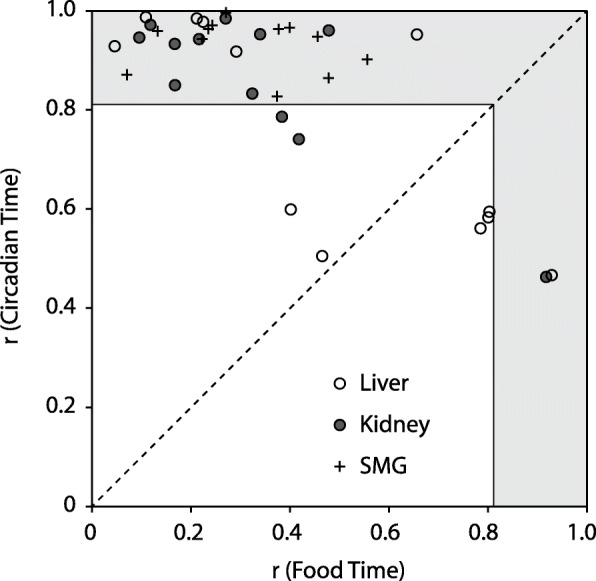
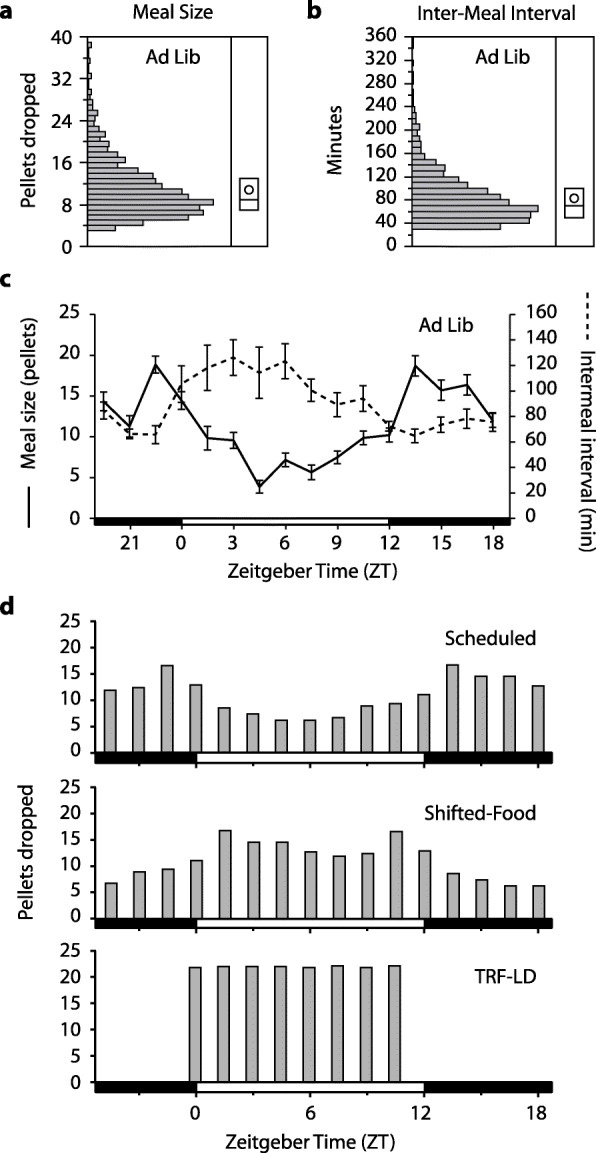
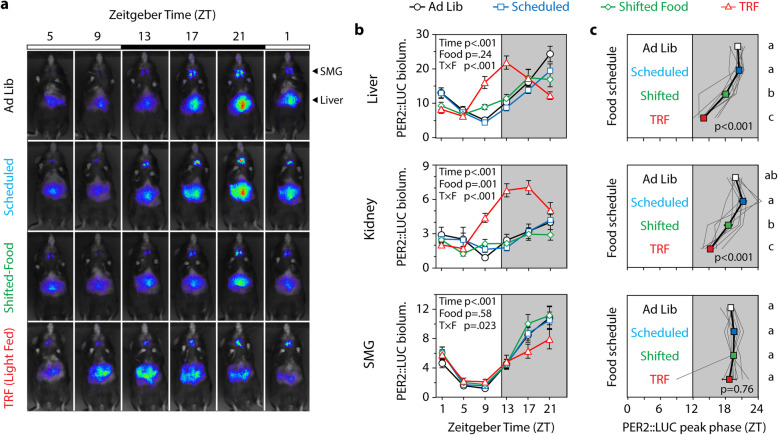
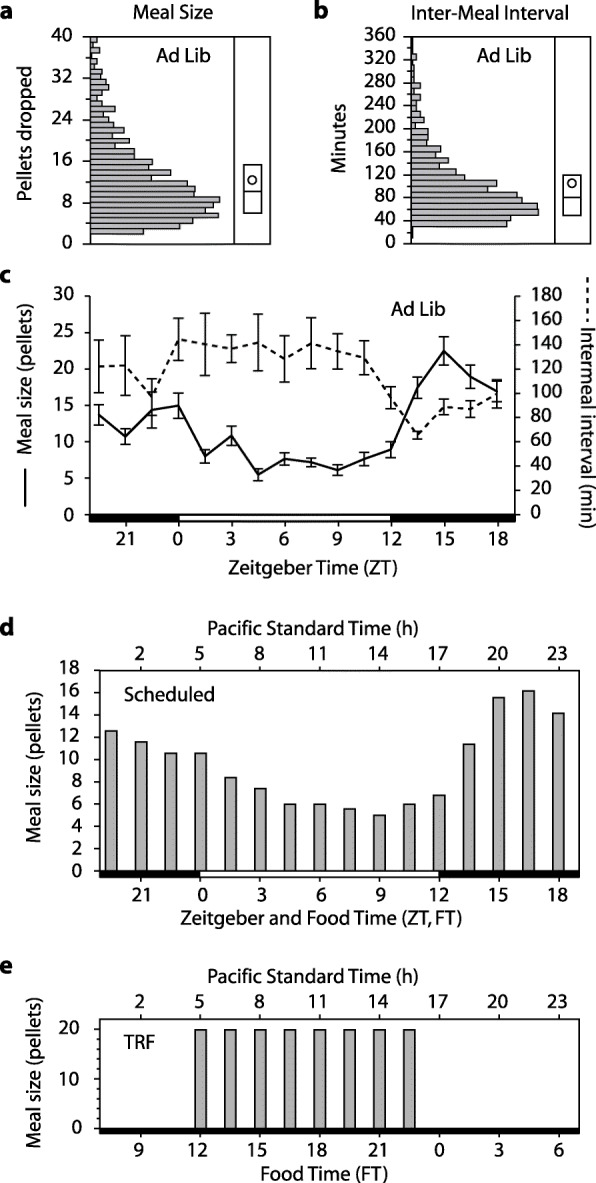
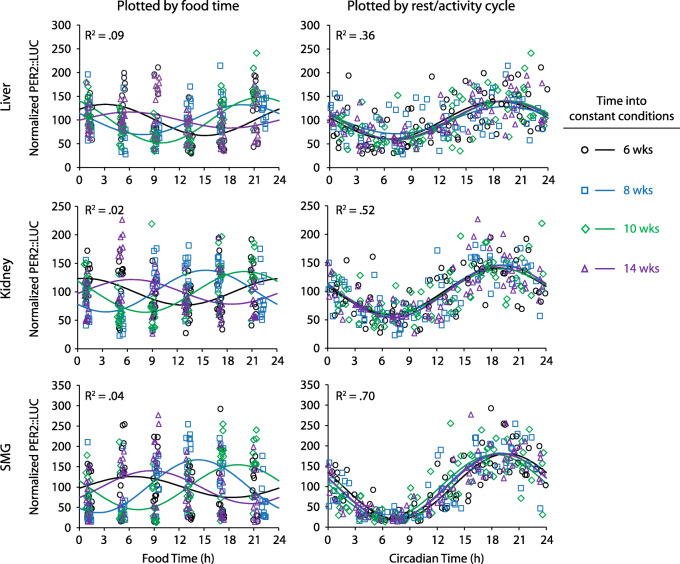
We employed home cage feeders to first measure ad libitum food intake and then to dispense 20-mg pellets on a schedule mimicking that pattern. In both conditions, PER2::LUC bioluminescence peaked during the night as expected. Surprisingly, shifting the scheduled feeding by 12 h advanced peripheral clocks by only 0-3 h, much less than predicted from TRF protocols. To isolate the effects of feeding from the light-dark cycle, clock phase was then measured in mice acclimated to scheduled feeding over the course of 3 months in constant darkness. In these conditions, peripheral clock phases were better predicted by the rest-activity cycle than by the food schedule, contrary to expectation based on TRF studies. At the end of both experiments, mice were exposed to a modified TRF with food provided in eight equally sized meals over 12 h. In the light-dark cycle, this advanced the phase of the liver and kidney, though less so than in TRF with ad libitum access; in darkness, this entrained the liver and kidney but had little effect on the submandibular gland or the rest-activity cycle.
These data suggest that natural feeding patterns can only weakly affect circadian clocks. Instead, in normally feeding mice, the central pacemaker in the brain may set the phase of peripheral organs via pathways that are independent of feeding behavior.
哺乳动物组织中的昼夜节律由视交叉上核(SCN)中的主钟协调,主要通过光-暗周期进行调节。然而,先前的研究表明,限时进食(TRF)-每天禁食和食物供应的交替-可独立于光-暗周期和 SCN 使外周时钟同步。这导致了这样一种观点,即下游外周时钟通过食物摄入节律间接被调节。然而,TRF 不是一种正常的饮食模式,它会导致啮齿动物通常不会经历的非生理性长时间禁食。因此,我们通过测量 mPer2 小鼠在不同食物时间表下肝脏、肾脏和颌下腺的昼夜节律,测试正常的喂养模式是否可以通过相位移动或使外周组织同步。
我们使用家庭笼饲养器首先测量随意进食,然后根据模仿该模式的时间表分配 20mg 丸剂。在这两种情况下,PER2::LUC 生物发光如预期的那样在夜间达到峰值。令人惊讶的是,将预定的喂食时间提前 12 小时仅将外周时钟提前 0-3 小时,远低于 TRF 方案的预测。为了将进食的影响与光-暗周期隔离开来,然后在 3 个月的恒定黑暗中适应预定进食的小鼠中测量时钟相位。在这些条件下,外周时钟相位更受休息-活动周期的预测,而不是食物时间表,与基于 TRF 研究的预期相反。在这两个实验结束时,小鼠暴露于经过改良的 TRF,在 12 小时内提供八份等量的食物。在光-暗周期中,这使肝脏和肾脏的相位提前,尽管不如自由进食的 TRF 那么明显;在黑暗中,这使肝脏和肾脏同步,但对颌下腺或休息-活动周期几乎没有影响。
这些数据表明,自然喂养模式只能对昼夜节律产生微弱的影响。相反,在正常进食的小鼠中,大脑中的中央起搏器可能通过独立于进食行为的途径设定外周器官的相位。