Faculty of Health and Medical Sciences, University of Surrey, Guildford GU2 7XH , United Kingdom.
Sleep and Performance Research Center, Washington State University, Spokane, WA 99210.
Proc Natl Acad Sci U S A. 2018 Jul 24;115(30):7825-7830. doi: 10.1073/pnas.1801183115. Epub 2018 Jul 10.
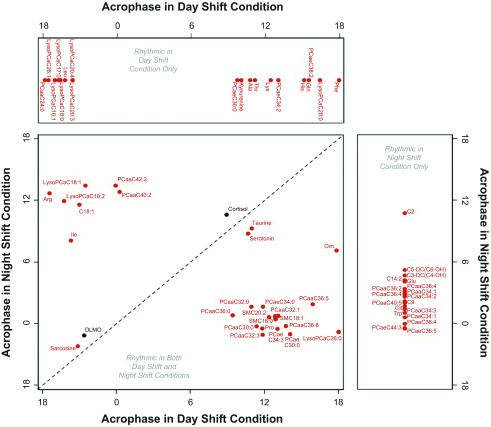
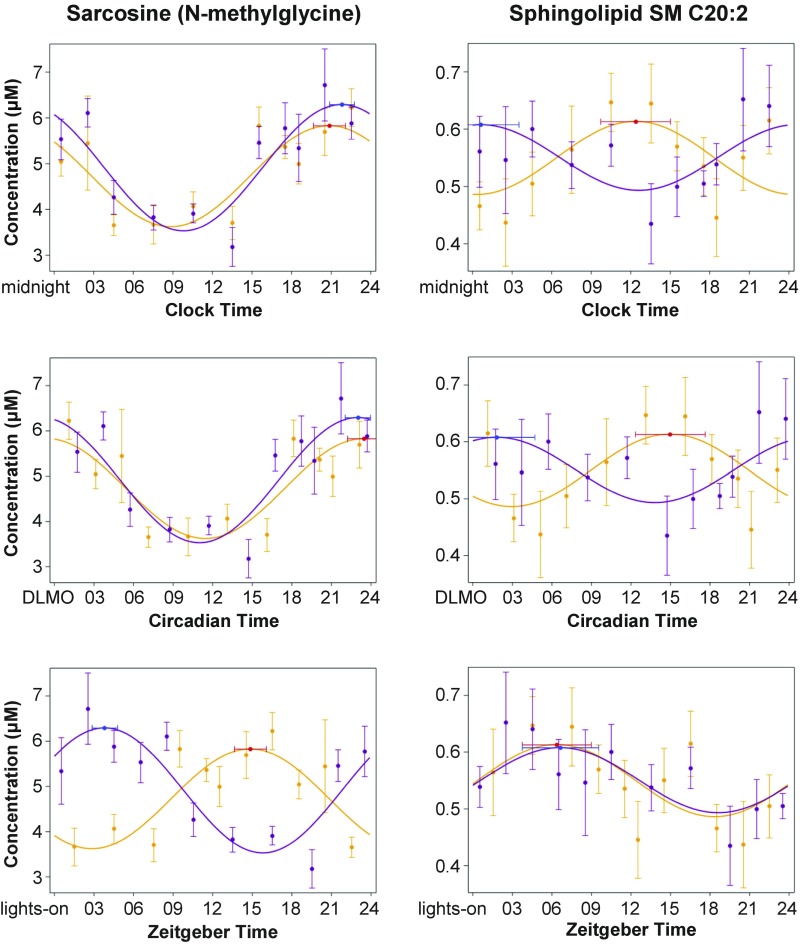
Misalignment between internal circadian rhythmicity and externally imposed behavioral schedules, such as occurs in shift workers, has been implicated in elevated risk of metabolic disorders. To determine underlying mechanisms, it is essential to assess whether and how peripheral clocks are disturbed during shift work and to what extent this is linked to the central suprachiasmatic nuclei (SCN) pacemaker and/or misaligned behavioral time cues. Investigating rhythms in circulating metabolites as biomarkers of peripheral clock disturbances may offer new insights. We evaluated the impact of misaligned sleep/wake and feeding/fasting cycles on circulating metabolites using a targeted metabolomics approach. Sequential plasma samples obtained during a 24-h constant routine that followed a 3-d simulated night-shift schedule, compared with a simulated day-shift schedule, were analyzed for 132 circulating metabolites. Nearly half of these metabolites showed a 24-h rhythmicity under constant routine following either or both simulated shift schedules. However, while traditional markers of the circadian clock in the SCN-melatonin, cortisol, and expression-maintained a stable phase alignment after both schedules, only a few metabolites did the same. Many showed reversed rhythms, lost their rhythms, or showed rhythmicity only under constant routine following the night-shift schedule. Here, 95% of the metabolites with a 24-h rhythmicity showed rhythms that were driven by behavioral time cues externally imposed during the preceding simulated shift schedule rather than being driven by the central SCN circadian clock. Characterization of these metabolite rhythms will provide insight into the underlying mechanisms linking shift work and metabolic disorders.
内部生物钟节律与外部强加的行为时间表(如轮班工作者)之间的失配与代谢紊乱风险增加有关。为了确定潜在的机制,评估轮班工作期间外周时钟是否以及如何受到干扰,以及这种干扰与中央视交叉上核(SCN)起搏器和/或行为时间线索的失配程度之间的关系至关重要。研究作为外周时钟干扰标志物的循环代谢物节律可能提供新的见解。我们使用靶向代谢组学方法评估了睡眠/觉醒和进食/禁食周期失配对循环代谢物的影响。通过 3 天模拟夜班时间表与模拟白班时间表比较,在遵循 24 小时恒常作息时间表期间获得的连续血浆样本用于分析 132 种循环代谢物。这些代谢物中近一半在遵循任一种或两种模拟轮班时间表的恒常作息下表现出 24 小时节律性。然而,虽然 SCN 中的生物钟传统标志物-褪黑素、皮质醇和 表达-在两种时间表后保持稳定的相位对齐,但只有少数代谢物表现出相同的情况。许多代谢物表现出相反的节律、失去节律或仅在遵循夜班时间表的恒常作息下表现出节律性。在这里,95%具有 24 小时节律性的代谢物的节律是由先前模拟轮班时间表中外部强加的行为时间线索驱动的,而不是由中央 SCN 生物钟驱动的。这些代谢物节律的特征将提供有关轮班工作和代谢紊乱之间关联的潜在机制的深入了解。