Department of Psychiatry, University of Michigan, Ann Arbor, Michigan.
Swartz Center for Computational Neuroscience, University of California San Diego, La Jolla, California.
Biol Psychiatry Cogn Neurosci Neuroimaging. 2021 Mar;6(3):370-379. doi: 10.1016/j.bpsc.2020.08.013. Epub 2020 Sep 1.
Abnormal gaze discrimination in schizophrenia (SZ) is associated with impairment in social functioning, but the neural mechanisms remain unclear. Evidence suggests that local neural oscillations and inter-areal communication through neural synchronization are critical physiological mechanisms supporting basic and complex cognitive processes. The roles of these mechanisms in abnormal gaze processing in SZ have not been investigated. The present study examined local neural oscillations and connectivity between anterior and bilateral posterior brain areas during gaze processing.
During electroencephalography recording, 28 participants with SZ and 34 healthy control participants completed a gaze discrimination task. Time-frequency decomposition of electroencephalography data was used to examine neural oscillatory power and intertrial phase consistency at bilateral posterior and midline anterior scalp sites. In addition, connectivity between these anterior and posterior sites, in terms of cross-frequency coupling between theta phase and gamma amplitude, was examined using the Kullback-Leibler Modulation Index.
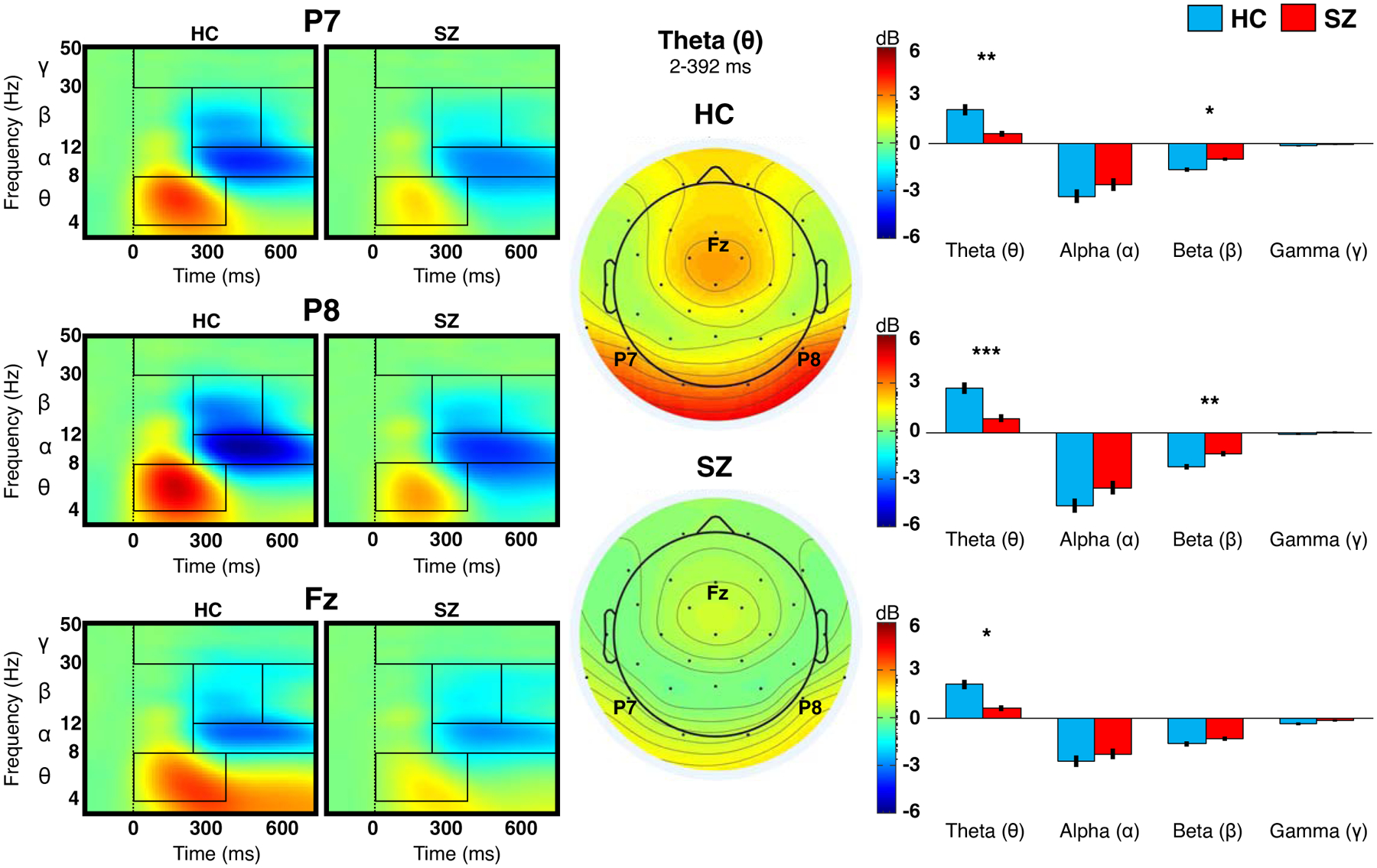
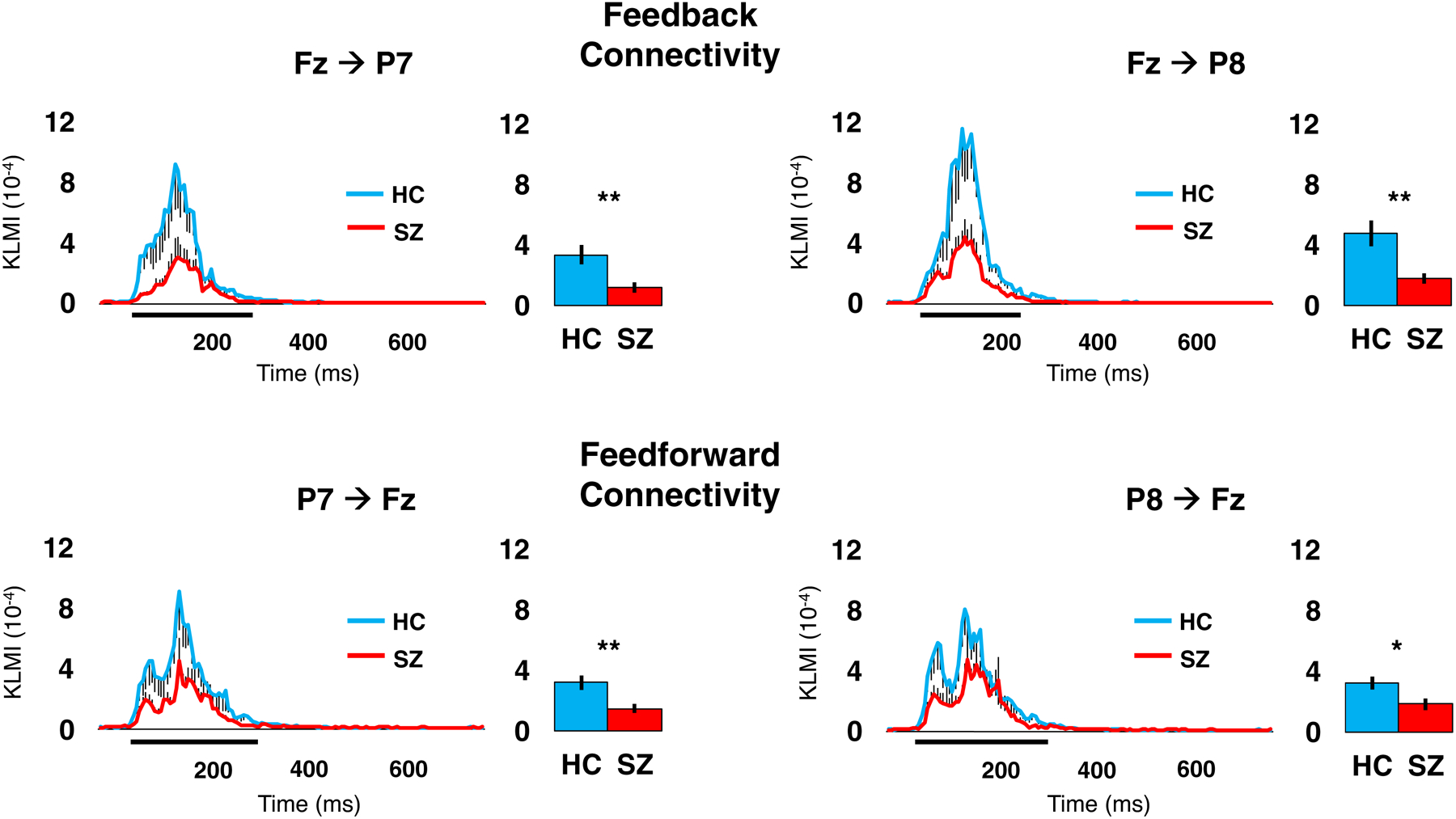
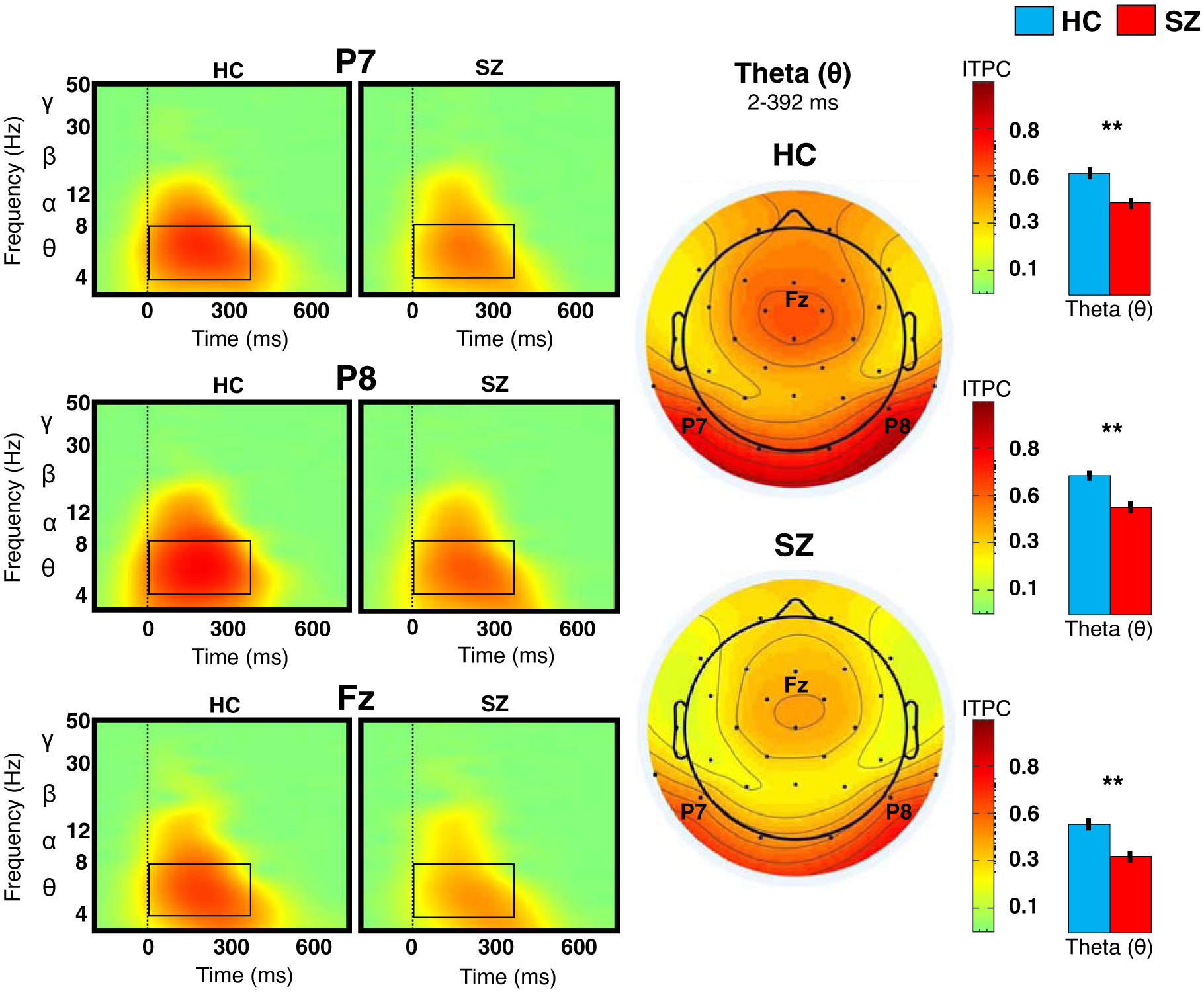
Participants with SZ showed reduced total power of theta-band activity relative to healthy control participants at all sites examined. This group difference could be accounted for by reduced intertrial phase consistency of theta activity in SZ participants, which was related to reduced gaze discrimination accuracy in SZ. In addition, SZ participants exhibited reduced Kullback-Leibler indexing, both feedforward and feedback connectivity, between the posterior and anterior sites.
These findings suggest that abnormal theta phase consistency and dysconnection between posterior face processing and anterior areas may underlie gaze processing deficits in SZ.
精神分裂症(SZ)患者的异常目光辨别与社会功能障碍有关,但神经机制尚不清楚。有证据表明,局部神经振荡和通过神经同步的区域间通讯是支持基本和复杂认知过程的关键生理机制。这些机制在 SZ 患者异常目光处理中的作用尚未得到研究。本研究检查了在目光处理过程中,前脑区和双侧后脑区之间的局部神经振荡和连接。
在脑电图记录期间,28 名 SZ 患者和 34 名健康对照参与者完成了目光辨别任务。使用时频分解方法对双侧后脑和中线前头皮部位的脑电图数据进行神经振荡功率和试验间相位一致性的分析。此外,还使用 Kullback-Leibler 调制指数来检查这些前脑区和后脑区之间的连接,即theta 相位与gamma 振幅之间的跨频耦合。
与健康对照组相比,SZ 患者在所有检查部位的 theta 波段活动的总功率均降低。这种组间差异可以用 SZ 患者 theta 活动的试验间相位一致性降低来解释,这与 SZ 患者的目光辨别准确性降低有关。此外,SZ 患者的 Kullback-Leibler 索引值降低,包括前馈和反馈连接。
这些发现表明,异常的 theta 相位一致性和后脑区与前脑区之间的连接中断可能是 SZ 患者目光处理缺陷的基础。