Nephrology, Dialysis and Transplantation Unit, Department of Emergency and Organ Transplantation, University of Bari, Bari, Italy.
Clinical Pathology, Center of Molecular Medicine, Department of Medical and Surgical Sciences, University of Foggia, Foggia, Italy.
Front Immunol. 2020 Oct 8;11:574271. doi: 10.3389/fimmu.2020.574271. eCollection 2020.
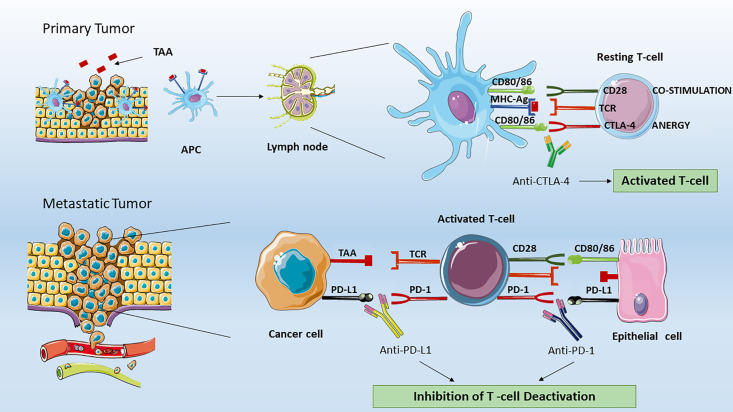
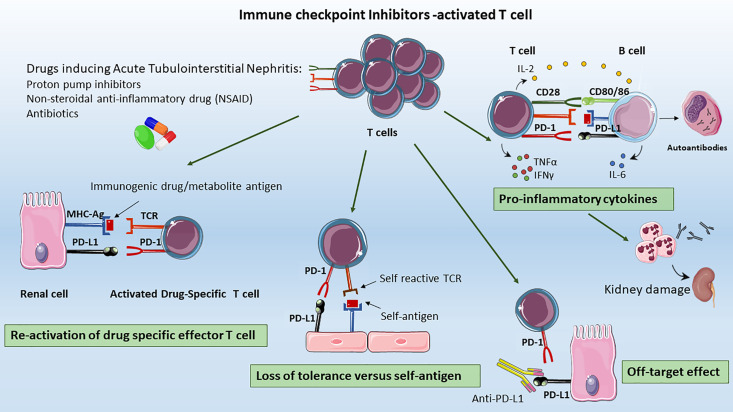
Immune checkpoint inhibitors (ICIs) are a novel class of immunotherapy drugs that have improved the treatment of a broad spectrum of cancers as metastatic melanoma, non-small lung cancer or renal cell carcinoma. These humanized monoclonal antibodies target inhibitory receptors (e.g. CTLA-4, PD-1, LAG-3, TIM-3) and ligands (PD-L1) expressed on T lymphocytes, antigen presenting cells and tumor cells and elicit an anti-tumor response by stimulating immune system. Nevertheless, the improved overall survival is complicated by the manifestation of Immune-related Adverse Effects (irAEs). During treatment with ICIs, the most common adverse kidney effect is represented by the development of acute kidney injury (AKI) with the acute tubulointerstitial nephritis as recurrent histological feature. The mechanisms involved in ICIs-induced AKI include the re-activation of effector T cells previously stimulated by nephrotoxic drugs (i.e. by antibiotics), the loss of tolerance versus self-renal antigens, the increased PD-L1 expression by tubular cells or the establishment of a pro-inflammatory milieu with the release of self-reactive antibodies. For renal transplant recipient treated with ICIs, the increased incidence of rejection is a serious concern. Therefore, the combination of ICIs with mTOR inhibitors represents an emerging strategy. Finally, it is relevant to anticipate which patients under ICIs would experience severe irAEs and from a kidney perspective, to predict patients with higher risk of AKI. Here, we provide a detailed overview of ICIs-related nephrotoxicity and the recently described multicenter studies. Several factors have been reported as biomarkers of ICIs-irAEs, in this review we speculate on potential biomarkers for ICIs-associated AKI.
免疫检查点抑制剂 (ICIs) 是一类新型的免疫治疗药物,已改善了转移性黑色素瘤、非小细胞肺癌或肾细胞癌等广泛癌症的治疗效果。这些人源化单克隆抗体针对 T 淋巴细胞、抗原提呈细胞和肿瘤细胞上表达的抑制性受体(例如 CTLA-4、PD-1、LAG-3、TIM-3)和配体(PD-L1),通过刺激免疫系统引发抗肿瘤反应。然而,免疫相关不良反应 (irAEs) 的表现使总体生存率的提高变得复杂。在使用 ICI 治疗期间,最常见的不良肾脏作用表现为急性肾损伤 (AKI) 的发展,其特征是反复出现急性肾小管间质性肾炎的组织学特征。ICI 诱导的 AKI 涉及的机制包括先前受肾毒性药物(例如抗生素)刺激的效应 T 细胞的再激活、对自身肾抗原的耐受性丧失、肾小管细胞中 PD-L1 表达增加或释放自身反应性抗体建立促炎环境。对于接受 ICI 治疗的肾移植受者,排斥反应的发生率增加是一个严重的问题。因此,ICI 与 mTOR 抑制剂的联合使用代表了一种新兴的策略。最后,从预测 AKI 的角度出发,预测哪些患者在接受 ICI 治疗后会经历严重的 irAEs 是很重要的。在这里,我们详细概述了与 ICI 相关的肾毒性以及最近描述的多中心研究。已经报道了几种作为 ICI-irAEs 生物标志物的因素,在这篇综述中,我们推测了潜在的与 ICI 相关 AKI 的生物标志物。