Jo Wonyoung, Won Taejoon, Daoud Abdel, Čiháková Daniela
Department of Biomedical Engineering, Johns Hopkins University, Whiting School of Engineering, Baltimore, MD, United States.
Department of Pathobiology, University of Illinois Urbana-Champaign, College of Veterinary Medicine, Urbana, IL, United States.
Front Immunol. 2024 Feb 5;15:1340373. doi: 10.3389/fimmu.2024.1340373. eCollection 2024.
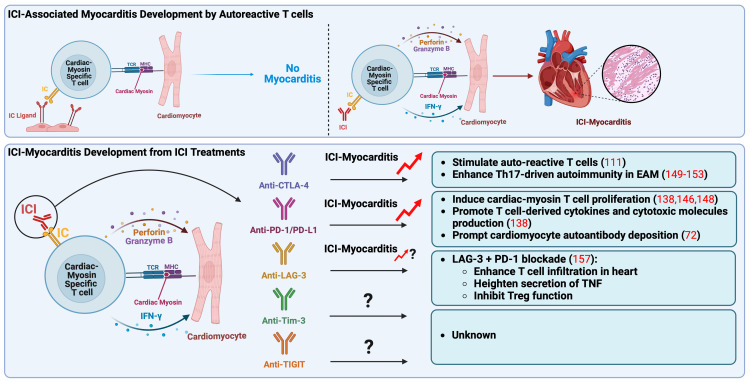
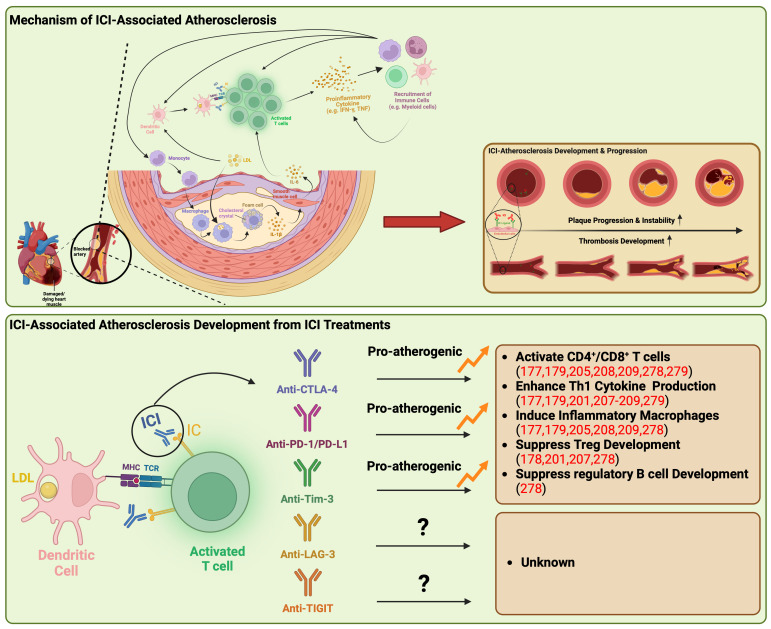
Immune checkpoint inhibitors (ICIs) are specialized monoclonal antibodies (mAbs) that target immune checkpoints and their ligands, counteracting cancer cell-induced T-cell suppression. Approved ICIs like cytotoxic T-lymphocyte antigen-4 (CTLA-4), programmed death-1 (PD-1), its ligand PD-L1, and lymphocyte activation gene-3 (LAG-3) have improved cancer patient outcomes by enhancing anti-tumor responses. However, some patients are unresponsive, and others experience immune-related adverse events (irAEs), affecting organs like the lung, liver, intestine, skin and now the cardiovascular system. These cardiac irAEs include conditions like myocarditis, atherosclerosis, pericarditis, arrhythmias, and cardiomyopathy. Ongoing clinical trials investigate promising alternative co-inhibitory receptor targets, including T cell immunoglobulin and mucin domain-containing protein 3 (Tim-3) and T cell immunoreceptor with immunoglobulin and ITIM domain (TIGIT). This review delves into the mechanisms of approved ICIs (CTLA-4, PD-1, PD-L1, and LAG-3) and upcoming options like Tim-3 and TIGIT. It explores the use of ICIs in cancer treatment, supported by both preclinical and clinical data. Additionally, it examines the mechanisms behind cardiac toxic irAEs, focusing on ICI-associated myocarditis and atherosclerosis. These insights are vital as ICIs continue to revolutionize cancer therapy, offering hope to patients, while also necessitating careful monitoring and management of potential side effects, including emerging cardiac complications.
免疫检查点抑制剂(ICIs)是一类专门的单克隆抗体(mAbs),它们靶向免疫检查点及其配体,对抗癌细胞诱导的T细胞抑制。已获批的ICIs,如细胞毒性T淋巴细胞抗原4(CTLA-4)、程序性死亡1(PD-1)及其配体PD-L1以及淋巴细胞激活基因3(LAG-3),通过增强抗肿瘤反应改善了癌症患者的预后。然而,一些患者对此无反应,另一些患者则出现免疫相关不良事件(irAEs),影响肺、肝、肠、皮肤等器官,现在还影响心血管系统。这些心脏irAEs包括心肌炎、动脉粥样硬化、心包炎、心律失常和心肌病等病症。正在进行的临床试验正在研究有前景的替代性共抑制受体靶点,包括含T细胞免疫球蛋白和粘蛋白结构域蛋白3(Tim-3)以及具有免疫球蛋白和ITIM结构域的T细胞免疫受体(TIGIT)。本综述深入探讨了已获批的ICIs(CTLA-4、PD-1、PD-L1和LAG-3)以及Tim-3和TIGIT等即将出现的选择的作用机制。它探讨了ICIs在癌症治疗中的应用,并得到了临床前和临床数据的支持。此外,它还研究了心脏毒性irAEs背后的机制,重点关注ICI相关的心肌炎和动脉粥样硬化。随着ICIs继续彻底改变癌症治疗方式,为患者带来希望,同时也需要仔细监测和管理潜在的副作用,包括新出现的心脏并发症,这些见解至关重要。