Elmas Omer Faruk, Mayisoglu Herman, Celik Murat, Kilitci Asuman, Akdeniz Necmettin
Department of Dermatology and Veneorology, Ahi Evran University Faculty of Medicine, Kirsehir, Turkey.
Department of Dermatology and Veneorology, Medicana Hospital, Istanbul, Turkey.
North Clin Istanb. 2020 Aug 31;7(5):494-498. doi: 10.14744/nci.2020.32656. eCollection 2020.
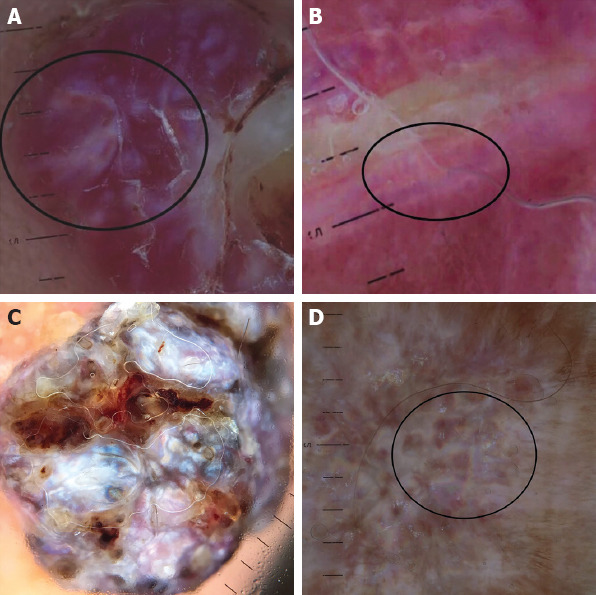
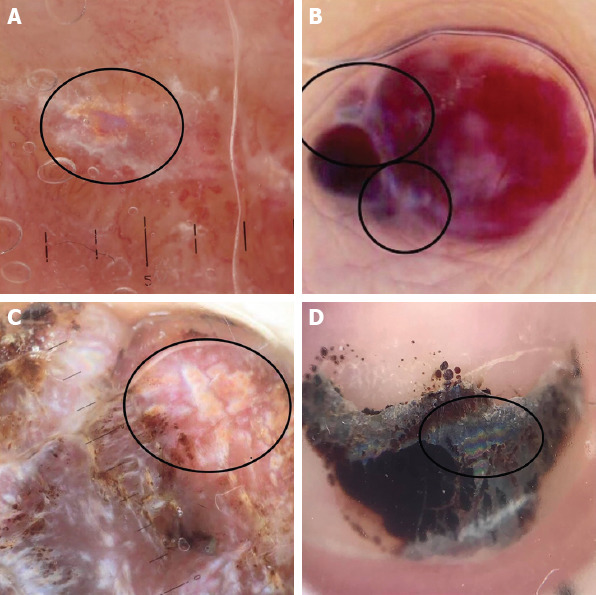
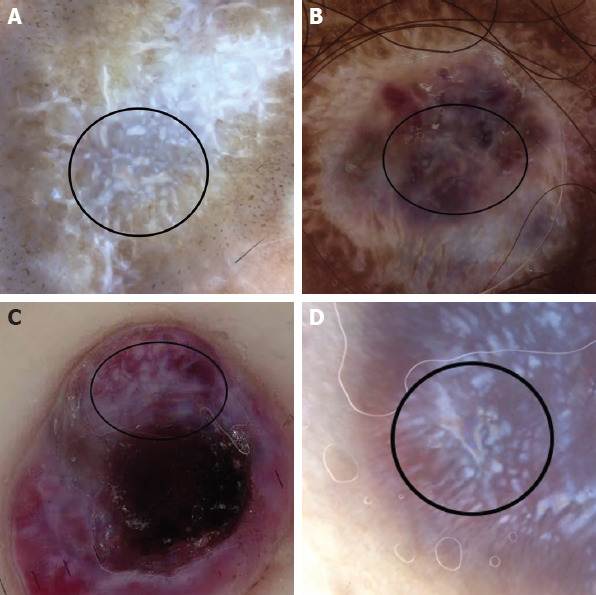
Rainbow pattern is a dermoscopic finding composed of multiple colors simulating a rainbow. It is known as a characteristic feature of Kaposi's sarcoma. Here, we reported different non-Kaposi's sarcoma conditions with a rainbow pattern aiming to discuss the diagnostic significance of the finding.
In this multicenter study, dermoscopic images of the non-Kaposi's sarcoma lesions having a histopathological diagnosis were reviewed for the presence of a rainbow pattern. Dermoscopic examination was performed by a polarized handheld dermoscope with x10 magnification.
A total of 840 lesions were reviewed and 21 (2%) non-Kaposi sarcoma lesions having dermoscopic rainbow pattern were detected. These lesions were as follows; pyogenic granuloma (n=4, 19%), hypertrophic scar (n=4, 19%), basal cell carcinoma (n=2, 10%), dermatofibroma (n=2, 10%), angiokeratoma (n=2, 10%), blue nevus (n=1, 5%), granuloma annulare (n=1, 5%), strawberry angioma (n=1, 5%), epidermal cyst (n=1, 5%), malignant melanoma (n=1, 5%), dissecting cellulitis (n=1, 5%) and subungual hematoma (n=1, 5%). The most common localization was limb (n=14, 67%) followed by face (n=3, 14%).
We suggest that the rainbow pattern is a complex and quite unspecific optic phenomenon which can be seen both in vascular and non-vascular lesions. Its diagnostic significance should be considered in the context of the other structural dermoscopic finding. To the best of our knowledge, to our knowledge, this is the most comprehensive study focusing on rainbow pattern in non-Kaposi's sarcoma lesions. Here, we also reported rainbow pattern in dissecting cellulitis, granuloma annulare and subungual hematoma which has not been shown to have rainbow pattern previously.
彩虹样模式是一种皮肤镜表现,由多种颜色组成,形似彩虹。它是卡波西肉瘤的一个特征性表现。在此,我们报告了具有彩虹样模式的不同非卡波西肉瘤情况,旨在探讨该表现的诊断意义。
在这项多中心研究中,对具有组织病理学诊断的非卡波西肉瘤病变的皮肤镜图像进行回顾,以检查是否存在彩虹样模式。使用带10倍放大倍数的偏振手持式皮肤镜进行皮肤镜检查。
共回顾了840个病变,检测到21个(2%)具有皮肤镜彩虹样模式的非卡波西肉瘤病变。这些病变如下:化脓性肉芽肿(n = 4,19%)、肥厚性瘢痕(n = 4,19%)、基底细胞癌(n = 2,10%)、皮肤纤维瘤(n = 2,10%)、血管角皮瘤(n = 2,10%)、蓝痣(n = 1,5%)、环状肉芽肿(n = 1,5%)、草莓状血管瘤(n = 1,5%)、表皮囊肿(n = 1,5%)、恶性黑色素瘤(n = 1,5%)、蜂窝织炎(n = 1,5%)和甲下血肿(n = 1,5%)。最常见的部位是四肢(n = 14,67%),其次是面部(n = 3,14%)。
我们认为彩虹样模式是一种复杂且相当非特异性的光学现象,在血管性和非血管性病变中均可出现。其诊断意义应结合其他皮肤镜结构表现来考虑。据我们所知,这是关于非卡波西肉瘤病变中彩虹样模式的最全面研究。在此,我们还报告了蜂窝织炎、环状肉芽肿和甲下血肿中的彩虹样模式,此前尚未显示这些病变有彩虹样模式。