Departamento de Química, Faculdade de Ciências e Tecnologia, Universidade Nova de Lisboa, 2829-516 Caparica, Portugal.
Departamento de Bioquímica, Facultad de Medicina, Universidad Autónoma de Madrid (UAM), c/Arturo Duperier 4, 28029 Madrid, Spain.
Molecules. 2020 Nov 5;25(21):5144. doi: 10.3390/molecules25215144.
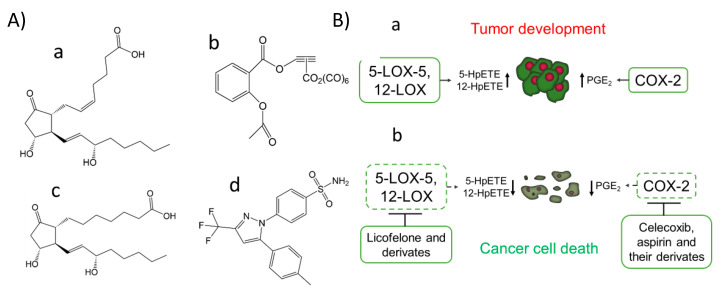
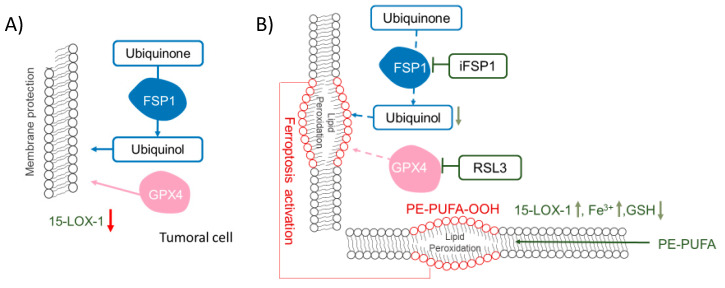
Cancer is one of the highest prevalent diseases in humans. The chances of surviving cancer and its prognosis are very dependent on the affected tissue, body location, and stage at which the disease is diagnosed. Researchers and pharmaceutical companies worldwide are pursuing many attempts to look for compounds to treat this malignancy. Most of the current strategies to fight cancer implicate the use of compounds acting on DNA damage checkpoints, non-receptor tyrosine kinases activities, regulators of the hedgehog signaling pathways, and metabolic adaptations placed in cancer. In the last decade, the finding of a lipid peroxidation increase linked to 15-lipoxygenases isoform 1 (15-LOX-1) activity stimulation has been found in specific successful treatments against cancer. This discovery contrasts with the production of other lipid oxidation signatures generated by stimulation of other lipoxygenases such as 5-LOX and 12-LOX, and cyclooxygenase (COX-2) activities, which have been suggested as cancer biomarkers and which inhibitors present anti-tumoral and antiproliferative activities. These findings support the previously proposed role of lipid hydroperoxides and their metabolites as cancer cell mediators. Depletion or promotion of lipid peroxidation is generally related to a specific production source associated with a cancer stage or tissue in which cancer originates. This review highlights the potential therapeutical use of chemical derivatives to stimulate or block specific cellular routes to generate lipid hydroperoxides to treat this disease.
癌症是人类最常见的疾病之一。癌症的存活率及其预后与受影响的组织、身体部位以及诊断时疾病所处的阶段密切相关。世界各地的研究人员和制药公司都在尝试寻找治疗这种恶性肿瘤的化合物。目前大多数对抗癌症的策略都涉及使用作用于 DNA 损伤检查点、非受体酪氨酸激酶活性、 hedgehog 信号通路调节剂和癌症中代谢适应的化合物。在过去的十年中,人们发现与 15-脂氧合酶同工酶 1(15-LOX-1)活性刺激相关的脂质过氧化增加,这在针对癌症的特定成功治疗中得到了证实。这一发现与其他脂氧合酶(如 5-LOX 和 12-LOX)和环氧化酶(COX-2)活性刺激产生的其他脂质氧化特征形成对比,这些特征被认为是癌症生物标志物,其抑制剂具有抗肿瘤和抗增殖活性。这些发现支持了先前提出的脂质氢过氧化物及其代谢物作为癌细胞介质的作用。脂质过氧化的消耗或促进通常与特定的产生源有关,该源与癌症起源的特定阶段或组织有关。这篇综述强调了化学衍生物在刺激或阻断特定细胞途径以产生脂质氢过氧化物来治疗这种疾病方面的潜在治疗用途。