Sports Medicine Center, Children's Hospital Colorado, Aurora, CO 80045, USA.
Department of Orthopedics, University of Colorado School of Medicine, Aurora, CO 80045, USA.
Sensors (Basel). 2020 Nov 5;20(21):6297. doi: 10.3390/s20216297.
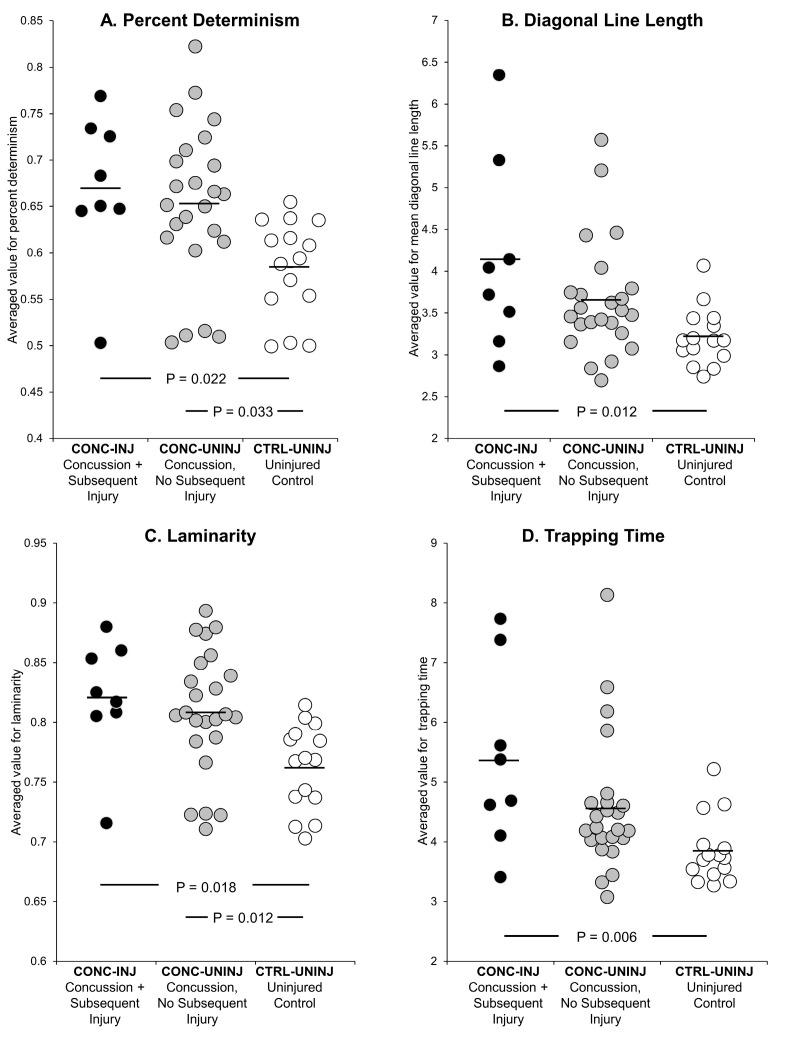
Persistent gait alterations can occur after concussion and may underlie future musculoskeletal injury risk. We compared dual-task gait stability measures among adolescents who did/did not sustain a subsequent injury post-concussion, and uninjured controls. Forty-seven athletes completed a dual-task gait evaluation. One year later, they reported sport-related injuries and sport participation volumes. There were three groups: concussion participants who sustained a sport-related injury (n = 8; age =15.4 ± 3.5 years; 63% female), concussion participants who did not sustain a sport-related injury (n = 24; 14.0 ± 2.6 years; 46% female), and controls (n = 15; 14.2 ± 1.9 years; 53% female). Using cross-recurrence quantification, we quantified dual-task gait stability using diagonal line length, trapping time, percent determinism, and laminarity. The three groups reported similar levels of sports participation (11.8 ± 5.8 vs. 8.6 ± 4.4 vs. 10.9 ± 4.3 hours/week; = 0.37). The concussion/subsequent injury group walked slower (0.76 ± 0.14 vs. 0.65 ± 0.13 m/s; = 0.008) and demonstrated higher diagonal line length (0.67 ± 0.08 vs. 0.58 ± 0.05; = 0.02) and trapping time (5.3 ± 1.5 vs. 3.8 ± 0.6; = 0.006) than uninjured controls. Dual-task diagonal line length (hazard ratio =1.95, 95% CI = 1.05-3.60), trapping time (hazard ratio = 1.66, 95% CI = 1.09-2.52), and walking speed (hazard ratio = 0.01, 95% CI = 0.00-0.51) were associated with subsequent injury. Dual-task gait stability measures can identify altered movement that persists despite clinical concussion recovery and is associated with future injury risk.
持续性步态改变可能发生在脑震荡后,并可能是未来肌肉骨骼损伤风险的基础。我们比较了患有脑震荡后是否发生后续损伤的青少年以及未受伤对照组的双重任务步态稳定性测量值。47 名运动员完成了双重任务步态评估。一年后,他们报告了与运动相关的损伤和运动参与量。有三组:患有脑震荡且发生运动相关损伤的参与者(n=8;年龄=15.4±3.5 岁;63%为女性)、患有脑震荡但未发生运动相关损伤的参与者(n=24;14.0±2.6 岁;46%为女性)和对照组(n=15;14.2±1.9 岁;53%为女性)。使用交叉重现量化法,我们使用对角线长度、陷捕时间、确定性百分比和层状来量化双重任务步态稳定性。三组报告的运动参与水平相似(11.8±5.8 比 8.6±4.4 比 10.9±4.3 小时/周;=0.37)。脑震荡/后续损伤组行走速度较慢(0.76±0.14 比 0.65±0.13 m/s;=0.008),对角线长度(0.67±0.08 比 0.58±0.05;=0.02)和陷捕时间(5.3±1.5 比 3.8±0.6;=0.006)均高于未受伤对照组。双重任务对角线长度(危险比=1.95,95%置信区间=1.05-3.60)、陷捕时间(危险比=1.66,95%置信区间=1.09-2.52)和行走速度(危险比=0.01,95%置信区间=0.00-0.51)与后续损伤相关。双重任务步态稳定性测量值可以识别出尽管临床脑震荡恢复但仍持续存在的运动改变,并与未来的损伤风险相关。