Department of Pathology, Netherlands Cancer Institute, Amsterdam, The Netherlands.
Department of Molecular Oncology, Netherlands Cancer Institute, Amsterdam, The Netherlands.
BMC Med Genomics. 2020 Nov 10;13(1):169. doi: 10.1186/s12920-020-00814-w.
'Precision oncology' can ensure the best suitable treatment at the right time by tailoring treatment towards individual patient and comprehensive tumour characteristics. In current molecular pathology, diagnostic tests which are part of the standard of care (SOC) only cover a limited part of the spectrum of genomic changes, and often are performed in an iterative way. This occurs at the expense of valuable patient time, available tissue sample, and interferes with 'first time right' treatment decisions. Whole Genome Sequencing (WGS) captures a near complete view of genomic characteristics of a tumour in a single test. Moreover, WGS facilitates faster implementation of new treatment relevant biomarkers. At present, WGS mainly has been applied in study settings, but its performance in a routine diagnostic setting remains to be evaluated. The WIDE study aims to investigate the feasibility and validity of WGS-based diagnostics in clinical practice.
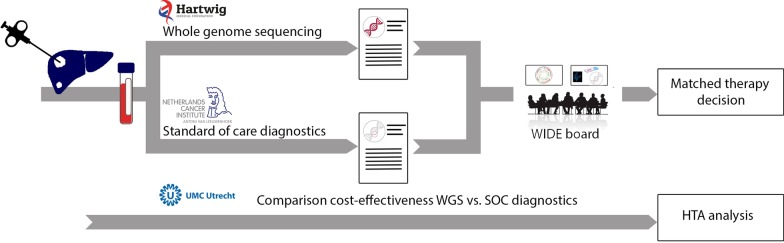
1200 consecutive patients in a single comprehensive cancer centre with (suspicion of) a metastasized solid tumour will be enrolled with the intention to analyse tumour tissue with WGS, in parallel to SOC diagnostics. Primary endpoints are (1) feasibility of implementation of WGS-based diagnostics into routine clinical care and (2) clinical validation of WGS by comparing identification of treatment-relevant variants between WGS and SOC molecular diagnostics. Secondary endpoints entail (1) added clinical value in terms of additional treatment options and (2) cost-effectiveness of WGS compared to SOC diagnostics through a Health Technology Assessment (HTA) analysis. Furthermore, the (3) perceived impact of WGS-based diagnostics on clinical decision making will be evaluated through questionnaires. The number of patients included in (experimental) therapies initiated based on SOC or WGS diagnostics will be reported with at least 3 months follow-up. The clinical efficacy is beyond the scope of WIDE. Key performance indicators will be evaluated after every 200 patients enrolled, and procedures optimized accordingly, to continuously improve the diagnostic performance of WGS in a routine clinical setting.
WIDE will yield the optimal conditions under which WGS can be implemented in a routine molecular diagnostics setting and establish the position of WGS compared to SOC diagnostics in routine clinical care.
“精准肿瘤学”可以通过针对个体患者和综合肿瘤特征来定制治疗,从而确保在最佳时机提供最合适的治疗。在当前的分子病理学中,作为标准护理(SOC)一部分的诊断测试仅涵盖基因组变化谱的有限部分,并且通常以迭代的方式进行。这以牺牲有价值的患者时间、可用的组织样本为代价,并干扰了“第一次就做对”的治疗决策。全基因组测序(WGS)在单次测试中捕获肿瘤基因组特征的近乎完整视图。此外,WGS 有助于更快地实施新的治疗相关生物标志物。目前,WGS 主要应用于研究环境,但在常规诊断环境中的性能仍有待评估。WIDE 研究旨在调查基于 WGS 的诊断在临床实践中的可行性和有效性。
将对单一综合癌症中心的 1200 名疑似转移性实体瘤患者进行前瞻性、连续入组,旨在分析肿瘤组织的 WGS,同时并行 SOC 诊断。主要终点是:(1)WGS 诊断在常规临床护理中的实施可行性,以及(2)通过比较 WGS 和 SOC 分子诊断对治疗相关变体的识别来验证 WGS 的临床有效性。次要终点包括:(1)在附加治疗选择方面的附加临床价值,以及(2)通过卫生技术评估(HTA)分析比较 WGS 与 SOC 诊断的成本效益。此外,还将通过问卷调查评估 WGS 诊断对临床决策的影响。将报告根据 SOC 或 WGS 诊断启动的实验性治疗的患者数量,并至少进行 3 个月的随访。WIDE 的临床疗效不在研究范围内。将在每入组 200 名患者后评估关键性能指标,并相应优化程序,以持续提高 WGS 在常规临床环境中的诊断性能。
WIDE 将确定在常规分子诊断环境中实施 WGS 的最佳条件,并确定 WGS 在常规临床护理中的地位相对于 SOC 诊断。