Department of Fisheries and Wildlife, Michigan State University, East Lansing, MI, USA.
U.S. Environmental Protection Agency, Seattle, WA, USA.
BMC Vet Res. 2020 Nov 10;16(1):430. doi: 10.1186/s12917-020-02642-7.
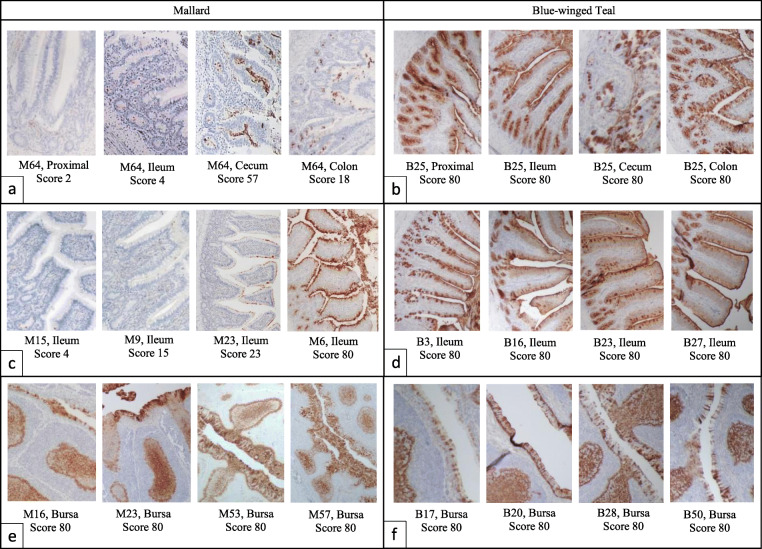
Individual heterogeneity in pathogen load can affect disease transmission dynamics; therefore, identifying intrinsic factors responsible for variation in pathogen load is necessary for determining which individuals are prone to be most infectious. Because low pathogenic avian influenza viruses (LPAIV) preferentially bind to alpha-2,3 sialic acid receptors (SAα2,3Gal) in the intestines and bursa of Fabricius in wild ducks (Anas and Spatula spp.), we investigated juvenile mallards (Anas platyrhyncos) and blue-winged teals (Anas discors) orally inoculated with A/northern pintail/California/44221-761/2006 (H5N9) and the virus titer relationship to occurrence frequency of SAα2,3Gal in the intestines and bursa. To test the natural variation of free-ranging duck populations, birds were hatched and raised in captivity from eggs collected from nests of free-ranging birds in North Dakota, USA. Data generated from qPCR were used to quantify virus titers in cloacal swabs, ileum tissue, and bursa of Fabricius tissue, and lectin histochemistry was used to quantify the occurrence frequency of SAα2,3Gal. Linear mixed models were used to analyze infection status, species, and sex-based differences. Multiple linear regression was used to analyze the relationship between virus titer and SAα2,3Gal occurrence frequency.
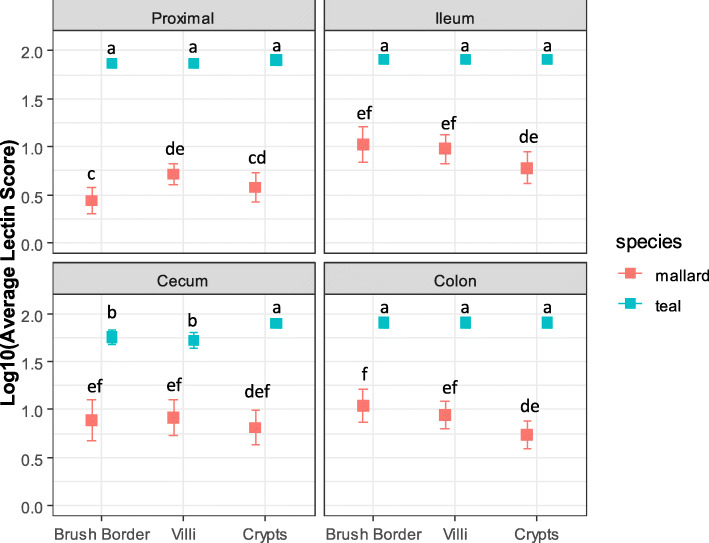
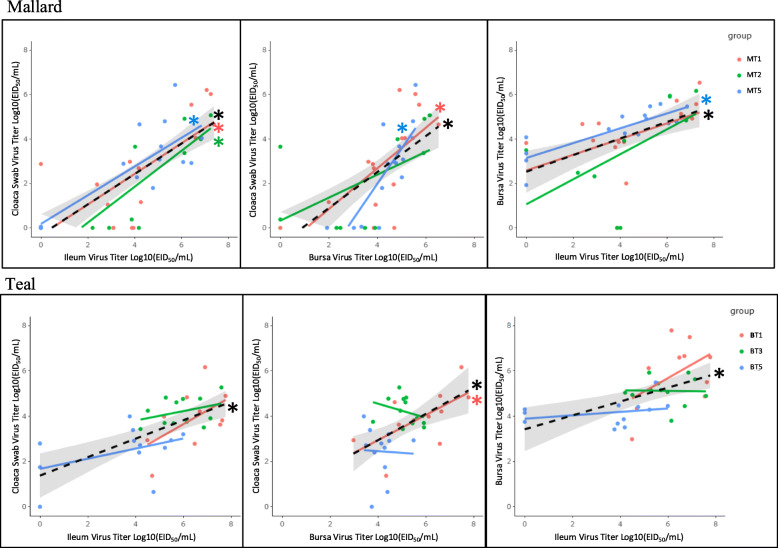
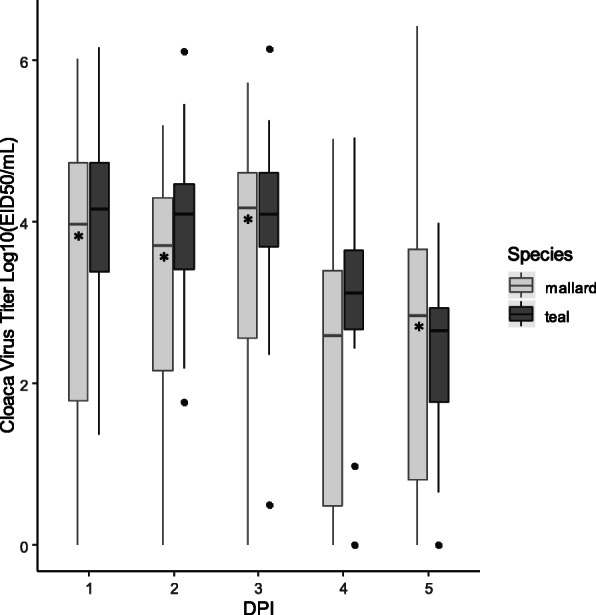
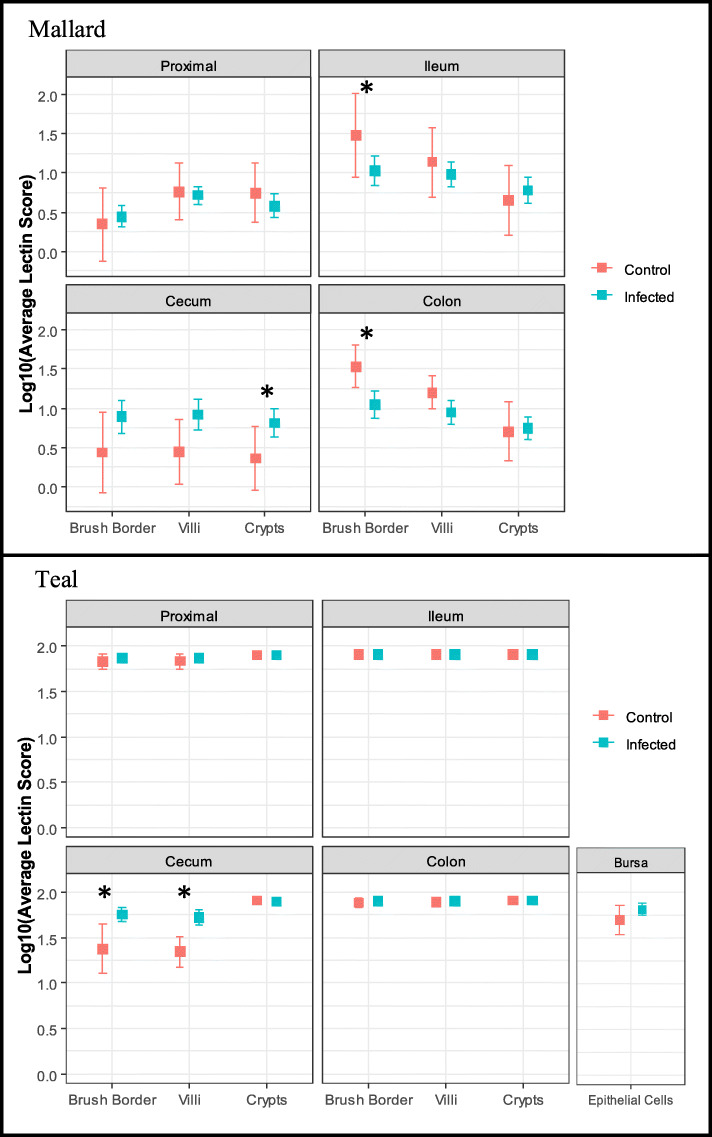
In mallards, we found high individual variation in virus titers significantly related to high variation of SAα2,3Gal in the ileum. In contrast to mallards, individual variation in teals was minimal and significant relationships between virus titers and SAα2,3Gal were not determined. Collectively, teals had both higher virus titers and a higher occurrence frequency of SAα2,3Gal compared to mallards, which may indicate a positive association between viral load and SAα2,3Gal. Statistically significant differences were observed between infected and control birds indicating that LPAIV infection may influence the occurrence frequency of SAα2,3Gal, or vice versa, but only in specific tissues.
The results of this study provide quantitative evidence that SAα2,3Gal abundance is related to LPAIV titers; thus, SAα2,3Gal should be considered a potential intrinsic factor influencing variation in LPAIV load.
病原体负荷的个体异质性会影响疾病传播动态;因此,确定导致病原体负荷变化的内在因素对于确定哪些个体更容易具有高度传染性是必要的。因为低致病性禽流感病毒(LPAIV)优先结合野生鸭(鸭属和瓣蹼鹬属)肠道和法氏囊中的α-2,3 唾液酸受体(SAα2,3Gal),我们研究了口服接种 A/北方针尾鸭/加利福尼亚/44221-761/2006(H5N9)的幼年绿头鸭(Anas platyrhyncos)和斑背潜鸭(Anas discors)以及病毒滴度与肠道和法氏囊中 SAα2,3Gal 出现频率的关系。为了测试自由放养鸭群的自然变异,从美国北达科他州自由放养鸟类巢中收集的卵孵化并饲养雏鸟。从 qPCR 生成的数据用于定量粪便拭子、回肠组织和法氏囊组织中的病毒滴度,并使用凝集素组织化学定量测定 SAα2,3Gal 的出现频率。线性混合模型用于分析感染状态、物种和性别差异。多元线性回归用于分析病毒滴度与 SAα2,3Gal 出现频率之间的关系。
在绿头鸭中,我们发现病毒滴度的个体差异很大,与回肠中 SAα2,3Gal 的高变异性显著相关。与绿头鸭不同的是,斑背潜鸭的个体差异很小,病毒滴度和 SAα2,3Gal 之间没有确定显著关系。总的来说,与绿头鸭相比,斑背潜鸭的病毒滴度更高,SAα2,3Gal 的出现频率也更高,这可能表明病毒载量与 SAα2,3Gal 之间存在正相关。感染和对照鸟类之间存在统计学显著差异表明,LPAIV 感染可能会影响 SAα2,3Gal 的出现频率,反之亦然,但仅在特定组织中。
本研究的结果提供了定量证据表明 SAα2,3Gal 的丰度与 LPAIV 滴度相关;因此,SAα2,3Gal 应被视为影响 LPAIV 负荷变化的潜在内在因素。