United States Fish and Wildlife Service, Pocatello, Idaho, USA.
PLoS One. 2013 Aug 21;8(8):e72611. doi: 10.1371/journal.pone.0072611. eCollection 2013.
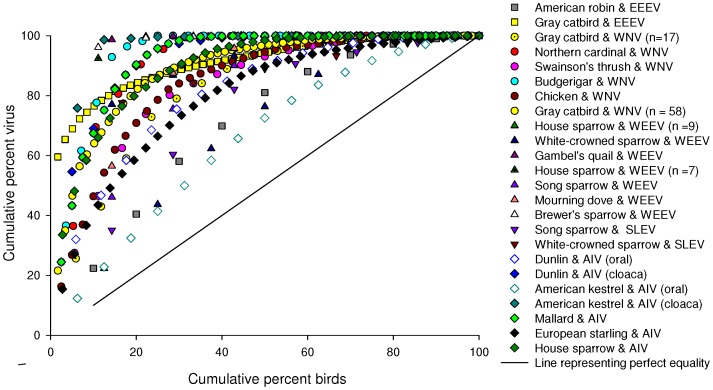
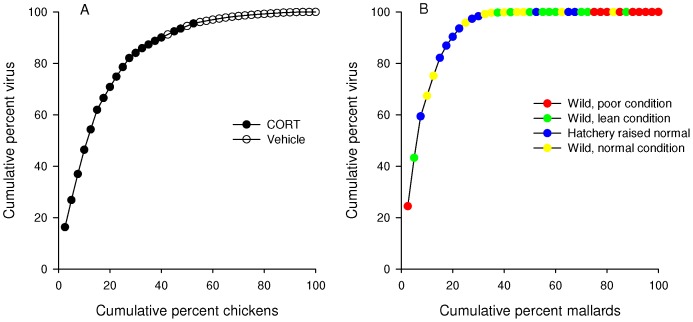
A major challenge in disease ecology is to understand the role of individual variation of infection load on disease transmission dynamics and how this influences the evolution of resistance or tolerance mechanisms. Such information will improve our capacity to understand, predict, and mitigate pathogen-associated disease in all organisms. In many host-pathogen systems, particularly macroparasites and sexually transmitted diseases, it has been found that approximately 20% of the population is responsible for approximately 80% of the transmission events. Although host contact rates can account for some of this pattern, pathogen transmission dynamics also depend upon host infectiousness, an area that has received relatively little attention. Therefore, we conducted a meta-analysis of pathogen shedding rates of 24 host (avian) - pathogen (RNA-virus) studies, including 17 bird species and five important zoonotic viruses. We determined that viral count data followed the Weibull distribution, the mean Gini coefficient (an index of inequality) was 0.687 (0.036 SEM), and that 22.0% (0.90 SEM) of the birds shed 80% of the virus across all studies, suggesting an adherence of viral shedding counts to the Pareto Principle. The relative position of a bird in a distribution of viral counts was affected by factors extrinsic to the host, such as exposure to corticosterone and to a lesser extent reduced food availability, but not to intrinsic host factors including age, sex, and migratory status. These data provide a quantitative view of heterogeneous virus shedding in birds that may be used to better parameterize epidemiological models and understand transmission dynamics.
疾病生态学的一个主要挑战是理解个体感染负荷的变化在疾病传播动力学中的作用,以及这如何影响抗性或耐受性机制的进化。这些信息将提高我们理解、预测和减轻所有生物体中与病原体相关疾病的能力。在许多宿主-病原体系统中,特别是大型寄生虫和性传播疾病,已经发现大约 20%的人口负责大约 80%的传播事件。尽管宿主接触率可以解释部分这种模式,但病原体的传播动力学还取决于宿主的传染性,而这一领域受到的关注相对较少。因此,我们对 24 个宿主(鸟类)-病原体(RNA 病毒)研究的病原体脱落率进行了荟萃分析,其中包括 17 种鸟类和 5 种重要的人畜共患病病毒。我们确定病毒计数数据符合威布尔分布,平均基尼系数(不平等指数)为 0.687(0.036 SEM),22.0%(0.90 SEM)的鸟类在所有研究中排出 80%的病毒,这表明病毒脱落计数符合帕累托原则。鸟类中病毒计数分布的相对位置受到宿主外部因素的影响,如暴露于皮质酮,在较小程度上受到食物供应减少的影响,但不受内在宿主因素的影响,如年龄、性别和迁徙状态。这些数据提供了鸟类中不均匀病毒脱落的定量观点,可用于更好地参数化流行病学模型和理解传播动力学。