School of Medicine, Deakin University, Geelong, Victoria, Australia.
National Indigenous Knowledges Education Research Innovation (NIKERI) Institute, Deakin University, Geelong, Victoria, Australia.
Int J Equity Health. 2020 Nov 9;19(1):201. doi: 10.1186/s12939-020-01306-0.
Mobile clinics have been used to deliver primary health care to populations that otherwise experience difficulty in accessing services. Indigenous populations in Australia, Canada, New Zealand, and the United States experience greater health inequities than non-Indigenous populations. There is increasing support for Indigenous-governed and culturally accessible primary health care services which meet the needs of Indigenous populations. There is some support for primary health care mobile clinics implemented specifically for Indigenous populations to improve health service accessibility. The purpose of this review is to scope the literature for evidence of mobile primary health care clinics implemented specifically for Indigenous populations in Australia, Canada, New Zealand, and the United States.
This review was undertaken using the Joanna Brigg Institute (JBI) scoping review methodology. Review objectives, inclusion criteria and methods were specified in advance and documented in a published protocol. The search included five academic databases and an extensive search of the grey literature.
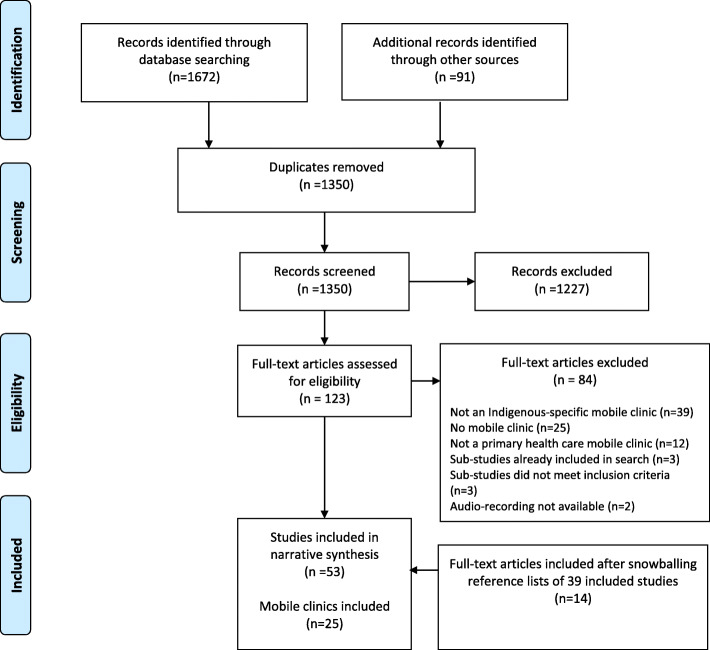
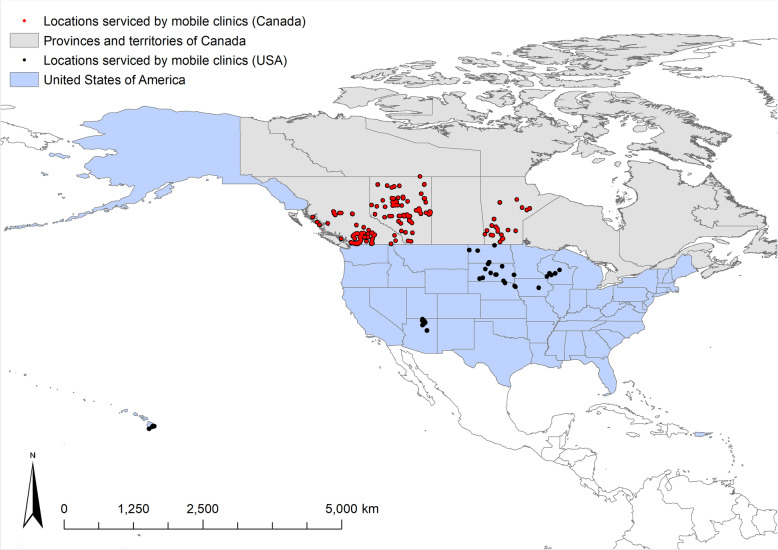
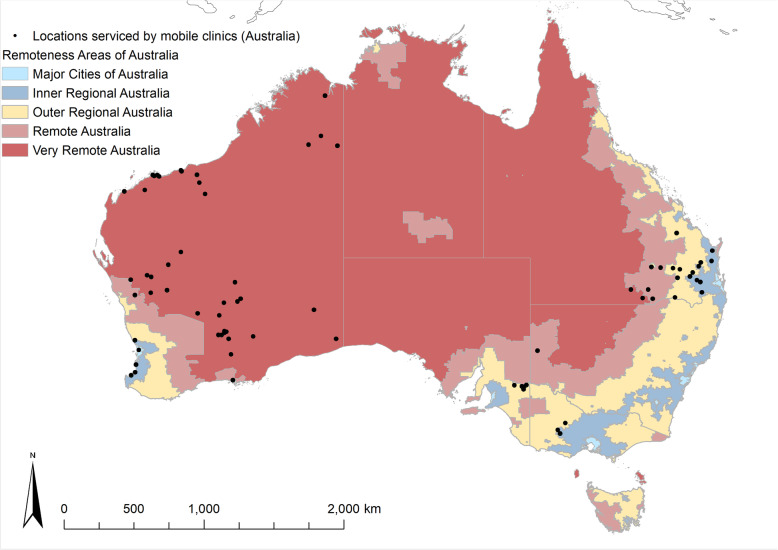
The search resulted in 1350 unique citations, with 91 of these citations retrieved from the grey literature and targeted organisational websites. Title, abstract and full-text screening was conducted independently by two reviewers, with 123 citations undergoing full text review. Of these, 39 citations discussing 25 mobile clinics, met the inclusion criteria. An additional 14 citations were snowballed from a review of the reference lists of included citations. Of these 25 mobile clinics, the majority were implemented in Australia (n = 14), followed by United States (n = 6) and Canada (n = 5). No primary health mobile clinics specifically for Indigenous people in New Zealand were retrieved. There was a pattern of declining locations serviced by mobile clinics with an increasing population. Furthermore, only 13 mobile clinics had some form of evaluation.
This review identifies geographical gaps in the implementation of primary health care mobile clinics for Indigenous populations in Australia, Canada, New Zealand, and the United States. There is a paucity of evaluations supporting the use of mobile clinics for Indigenous populations and a need for organisations implementing mobile clinics specifically for Indigenous populations to share their experiences. Engaging with the perspectives of Indigenous people accessing mobile clinic services is imperative to future evaluations.
The protocol for this review has been peer-reviewed and published in JBI Evidence Synthesis (doi: 10.11124/JBISRIR-D-19-00057).
流动诊所被用于向那些难以获得服务的人群提供基本医疗服务。澳大利亚、加拿大、新西兰和美国的原住民群体比非原住民群体面临更大的健康不平等。越来越多的人支持由原住民管理和具有文化可及性的基本医疗服务,以满足原住民群体的需求。也有一些支持专门为原住民群体实施的基本医疗流动诊所,以改善卫生服务的可及性。本综述的目的是确定澳大利亚、加拿大、新西兰和美国专门为原住民群体实施的流动基本医疗诊所的文献范围。
本综述采用 Joanna Brigg 研究所(JBI)的范围综述方法进行。在预先规定了综述目标、纳入标准和方法,并在已发表的方案中进行了记录。检索包括五个学术数据库和广泛的灰色文献搜索。
检索产生了 1350 条独特的引文,其中 91 条来自灰色文献和目标组织网站。两名评审员独立进行标题、摘要和全文筛选,对 123 篇全文进行了审查。其中,39 篇讨论 25 个流动诊所的文章符合纳入标准。从纳入文章的参考文献中进一步查阅了 14 篇文章。这 25 个流动诊所中,大多数在澳大利亚实施(n=14),其次是美国(n=6)和加拿大(n=5)。新西兰没有检索到专门为原住民提供的基本医疗流动诊所。流动诊所服务的地点随着人口的增加而减少,存在地理分布上的差距。此外,只有 13 个流动诊所进行了某种形式的评估。
本综述确定了澳大利亚、加拿大、新西兰和美国为原住民群体实施基本医疗流动诊所的地理差距。针对原住民群体使用流动诊所的评估很少,需要实施专门为原住民群体的流动诊所的组织分享他们的经验。了解流动诊所服务使用者的观点对于未来的评估至关重要。
该综述的方案已经过同行评审,并发表在 JBI 证据综合(doi:10.11124/JBISRIR-D-19-00057)上。