Institute for Genomic Health, Icahn School of Medicine at Mount Sinai, New York, NY, USA.
Department of Anesthesiology and Critical Care, Perelman School of Medicine, University of Pennsylvania, Philadelphia, PA, USA.
Pharmacogenomics J. 2021 Apr;21(2):174-189. doi: 10.1038/s41397-020-00194-5. Epub 2020 Nov 10.
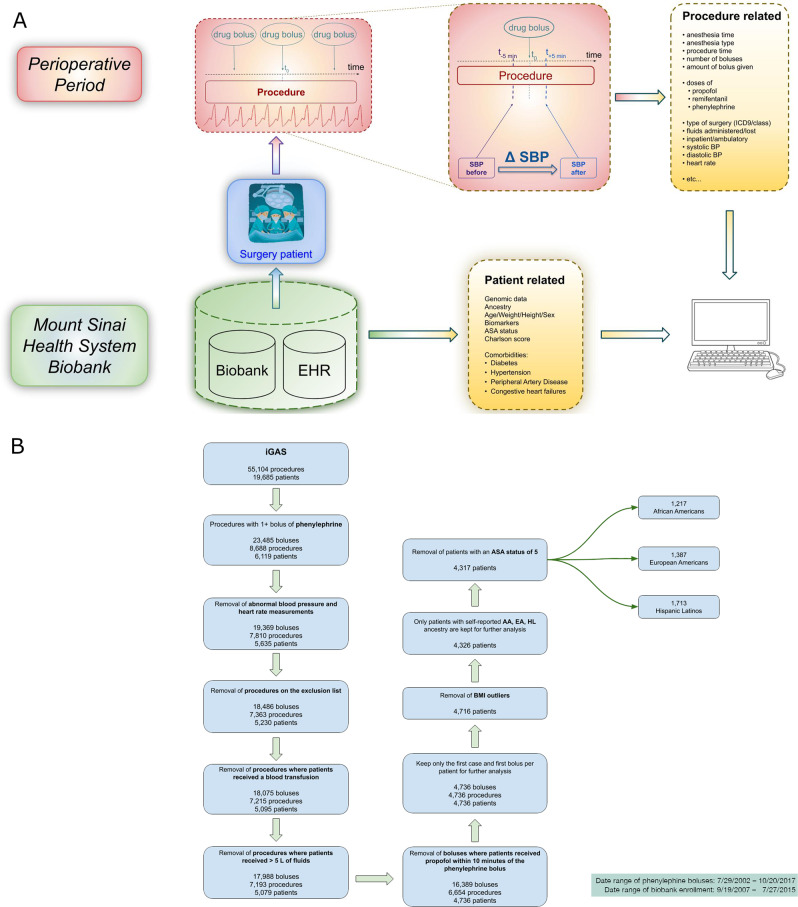
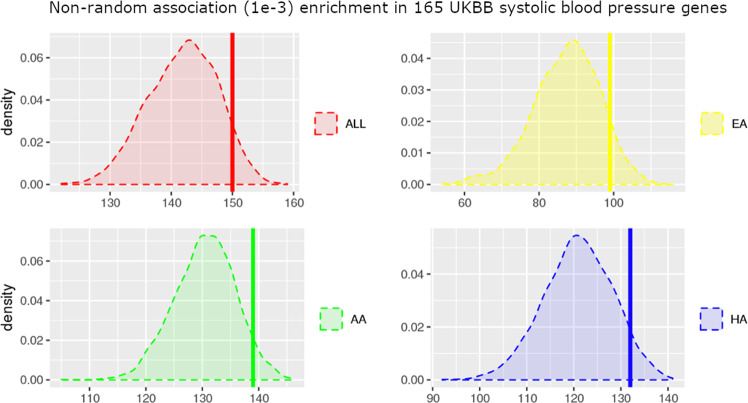
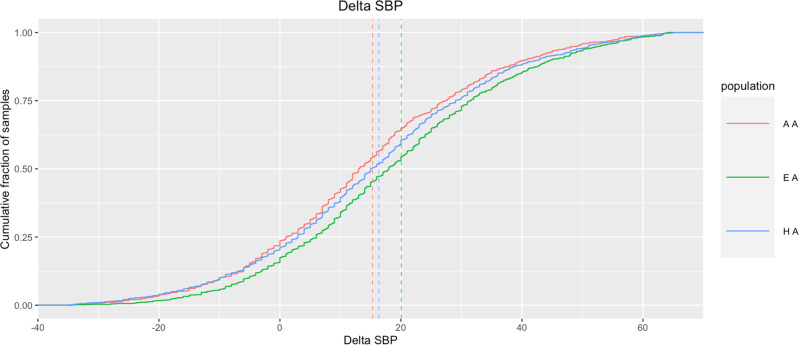
The emergence of genomic data in biobanks and health systems offers new ways to derive medically important phenotypes, including acute phenotypes occurring during inpatient clinical care. Here we study the genetic underpinnings of the rapid response to phenylephrine, an α1-adrenergic receptor agonist commonly used to treat hypotension during anesthesia and surgery. We quantified this response by extracting blood pressure (BP) measurements 5 min before and after the administration of phenylephrine. Based on this derived phenotype, we show that systematic differences exist between self-reported ancestry groups: European-Americans (EA; n = 1387) have a significantly higher systolic response to phenylephrine than African-Americans (AA; n = 1217) and Hispanic/Latinos (HA; n = 1713) (31.3% increase, p value < 6e-08 and 22.9% increase, p value < 5e-05 respectively), after adjusting for genetic ancestry, demographics, and relevant clinical covariates. We performed a genome-wide association study to investigate genetic factors underlying individual differences in this derived phenotype. We discovered genome-wide significant association signals in loci and genes previously associated with BP measured in ambulatory settings, and a general enrichment of association in these genes. Finally, we discovered two low frequency variants, present at ~1% in EAs and AAs, respectively, where patients carrying one copy of these variants show no phenylephrine response. This work demonstrates our ability to derive a quantitative phenotype suited for comparative statistics and genome-wide association studies from dense clinical and physiological measures captured for managing patients during surgery. We identify genetic variants underlying non response to phenylephrine, with implications for preemptive pharmacogenomic screening to improve safety during surgery.
生物库和健康系统中的基因组数据的出现为衍生具有医学重要性的表型提供了新方法,包括在住院临床护理期间发生的急性表型。在这里,我们研究了苯肾上腺素快速反应的遗传基础,苯肾上腺素是一种α1-肾上腺素能受体激动剂,常用于麻醉和手术期间治疗低血压。我们通过提取苯肾上腺素给药前和给药后 5 分钟的血压(BP)测量值来量化这种反应。基于该衍生表型,我们表明,在自我报告的祖先群体之间存在系统差异:欧洲裔美国人(EA;n=1387)对苯肾上腺素的收缩压反应明显高于非裔美国人(AA;n=1217)和西班牙裔/拉丁裔(HA;n=1713)(分别增加 31.3%,p 值<6e-08 和 22.9%,p 值<5e-05),在调整遗传祖先、人口统计学和相关临床协变量后。我们进行了全基因组关联研究,以调查该衍生表型个体差异的遗传因素。我们发现了与在动态环境中测量的 BP 相关的基因座和基因中的全基因组显著关联信号,并且这些基因中存在一般的关联富集。最后,我们发现了两个低频变异,分别在 EA 和 AA 中约占 1%,其中携带这些变异体之一的患者对苯肾上腺素没有反应。这项工作证明了我们从手术期间管理患者的密集临床和生理测量中提取适合比较统计和全基因组关联研究的定量表型的能力。我们确定了苯肾上腺素无反应的遗传变异,这对手术期间预防性药物基因组学筛查以提高安全性具有重要意义。