Genomic Medicine Institute, Geisinger, Danville, PA, 17822, USA.
Department of Anesthesiology, Geisinger, Danville, PA, 17822, USA.
BMC Med. 2019 Aug 28;17(1):168. doi: 10.1186/s12916-019-1405-7.
The alpha-adrenergic agonist phenylephrine is often used to treat hypotension during anesthesia. In clinical situations, low blood pressure may require prompt intervention by intravenous bolus or infusion. Differences in responsiveness to phenylephrine treatment are commonly observed in clinical practice. Candidate gene studies indicate genetic variants may contribute to this variable response.
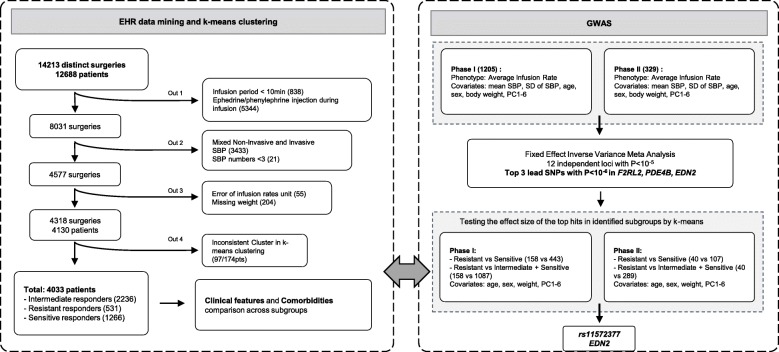
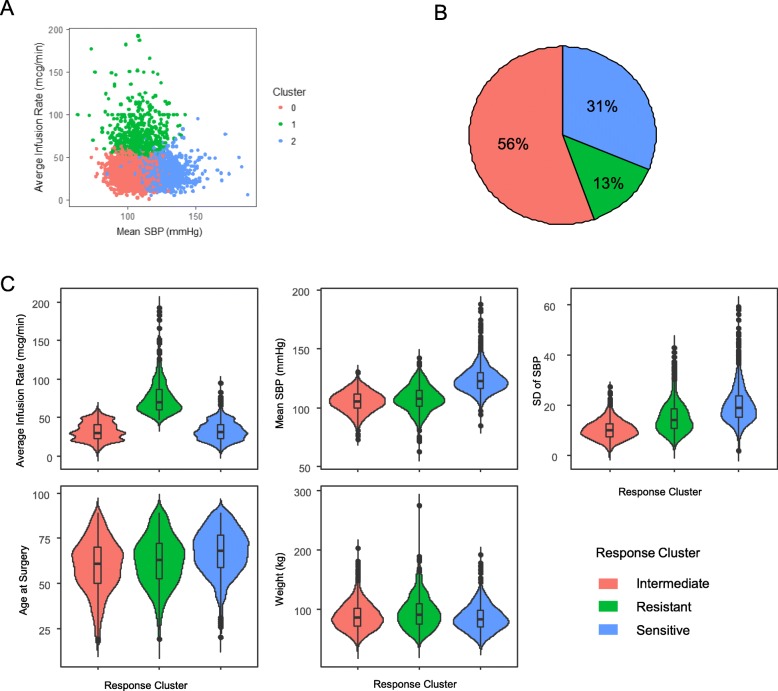
Pharmacological and physiological data were retrospectively extracted from routine clinical anesthetic records. Response to phenylephrine boluses could not be reliably assessed, so infusion rates were used for analysis. Unsupervised k-means clustering was conducted on clean data containing 4130 patients based on phenylephrine infusion rate and blood pressure parameters, to identify potential phenotypic subtypes. Genome-wide association studies (GWAS) were performed against average infusion rates in two cohorts: phase I (n = 1205) and phase II (n = 329). Top genetic variants identified from the meta-analysis were further examined to see if they could differentiate subgroups identified by k-means clustering.
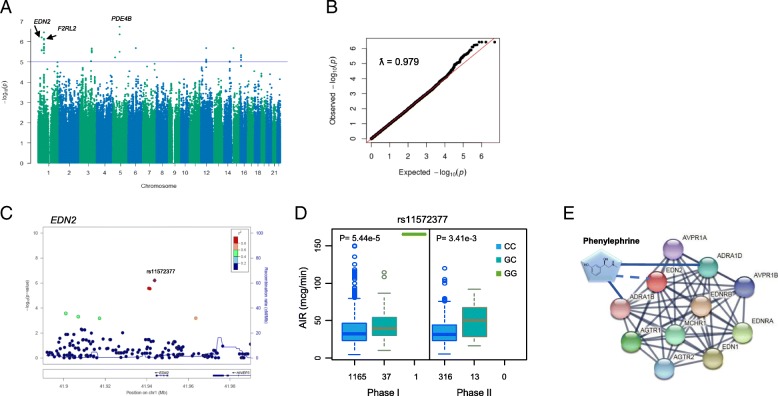
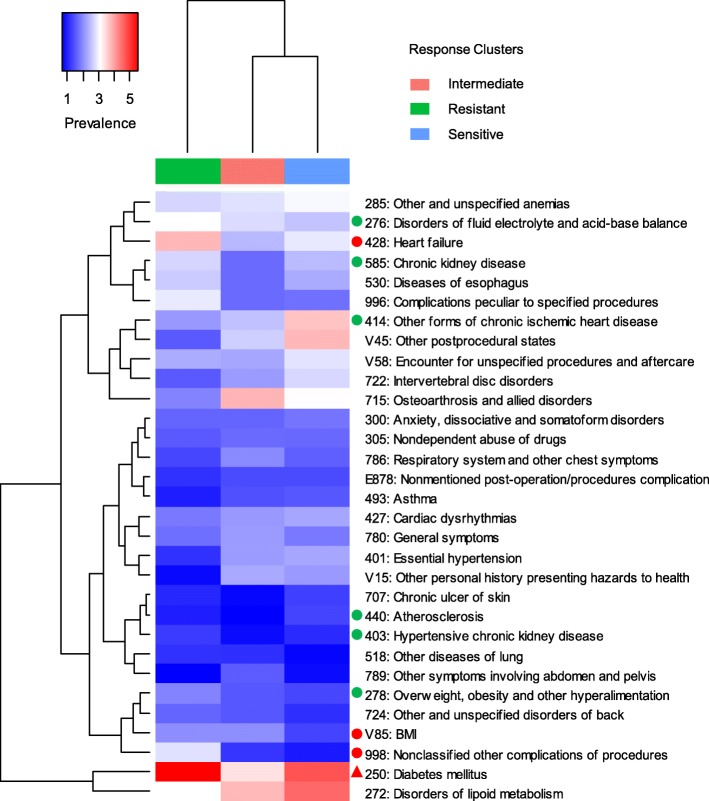
Three subgroups of patients with different response to phenylephrine were clustered and characterized: resistant (high infusion rate yet low mean systolic blood pressure (SBP)), intermediate (low infusion rate and low SBP), and sensitive (low infusion rate with high SBP). Differences among clusters were tabulated to assess for possible confounding influences. Comorbidity hierarchical clustering showed the resistant group had a higher prevalence of confounding factors than the intermediate and sensitive groups although overall prevalence is below 6%. Three loci with P < 1 × 10 were associated with phenylephrine infusion rate. Only rs11572377 with P = 6.09 × 10, a 3'UTR variant of EDN2, encoding a secretory vasoconstricting peptide, could significantly differentiate resistant from sensitive groups (P = 0.015 and 0.018 for phase I and phase II) or resistant from pooled sensitive and intermediate groups (P = 0.047 and 0.018).
Retrospective analysis of electronic anesthetic records data coupled with the genetic data identified genetic variants contributing to variable sensitivity to phenylephrine infusion during anesthesia. Although the identified top gene, EDN2, has robust biological relevance to vasoconstriction by binding to endothelin type A (ET) receptors on arterial smooth muscle cells, further functional as well as replication studies are necessary to confirm this association.
α-肾上腺素激动剂苯肾上腺素常用于治疗麻醉期间的低血压。在临床情况下,低血压可能需要通过静脉推注或输注迅速干预。在临床实践中,通常观察到对苯肾上腺素治疗的反应存在差异。候选基因研究表明,遗传变异可能导致这种可变反应。
从常规临床麻醉记录中回顾性提取药理学和生理学数据。由于无法可靠评估苯肾上腺素推注的反应,因此分析了输注率。基于苯肾上腺素输注率和血压参数,对包含 4130 名患者的清洁数据进行无监督 k-均值聚类,以识别潜在的表型亚型。对两个队列(I 期(n=1205)和 II 期(n=329))的平均输注率进行全基因组关联研究(GWAS)。从荟萃分析中确定的顶级遗传变异进一步检查,以查看它们是否可以区分 k-均值聚类识别的亚组。
聚类并表征了对苯肾上腺素反应不同的三组患者:耐药(高输注率但平均收缩压(SBP)低)、中间(低输注率和低 SBP)和敏感(低输注率但高 SBP)。列出了群组之间的差异,以评估可能的混杂影响。共病层次聚类显示,耐药组比中间组和敏感组更常见混杂因素,尽管总体患病率低于 6%。三个与苯肾上腺素输注率相关的 P<1×10 位点。只有 EDN2 的 rs11572377 具有统计学意义(P=6.09×10,EDN2 的 3'UTR 变体,编码一种分泌性血管收缩肽),可显著区分耐药组和敏感组(I 期和 II 期的 P=0.015 和 0.018)或耐药组和 pooled 敏感组和中间组(P=0.047 和 0.018)。
电子麻醉记录数据的回顾性分析与遗传数据相结合,确定了导致麻醉期间对苯肾上腺素输注敏感性变化的遗传变异。尽管确定的顶级基因 EDN2 通过与动脉平滑肌细胞上的内皮素 A(ET)受体结合对血管收缩具有强大的生物学相关性,但需要进一步的功能和复制研究来证实这种关联。