Institute of Electronics, Lodz University of Technology, 93-005 Lodz, Poland.
Department of Electrical Engineering and Computer Science, University of Stavanger, 4021 Stavanger, Norway.
Sensors (Basel). 2020 Nov 8;20(21):6372. doi: 10.3390/s20216372.
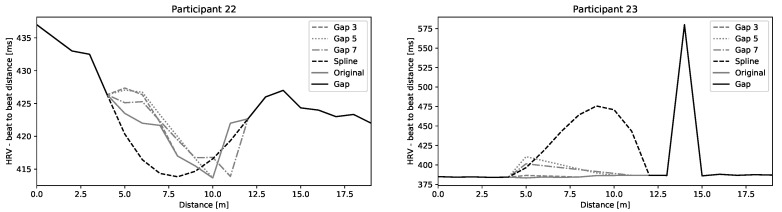
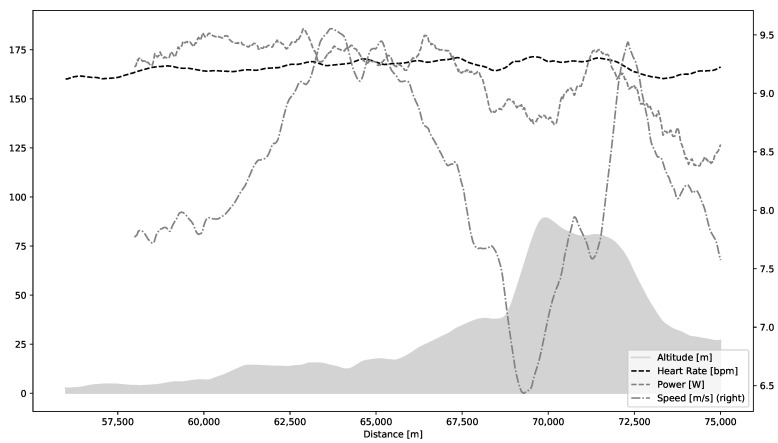
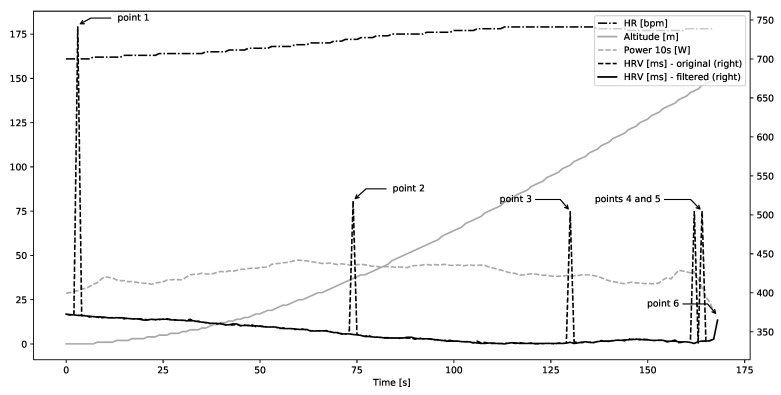
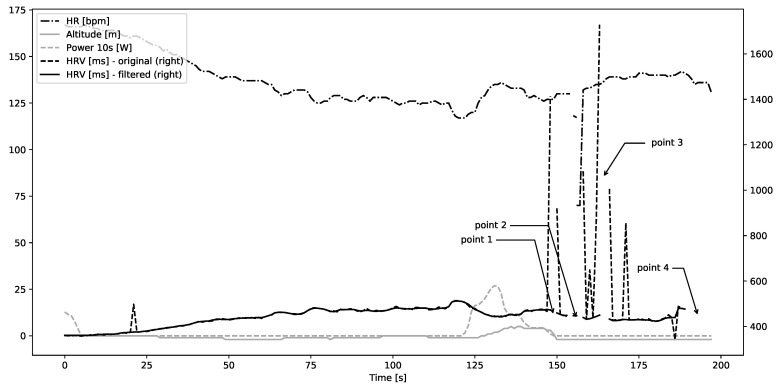
Heart rate variability (HRV) analysis can be a useful tool to detect underlying heart or even general health problems. Currently, such analysis is usually performed in controlled or semi-controlled conditions. Since many of the typical HRV measures are sensitive to data quality, manual artifact correction is common in literature, both as an exclusive method or in addition to various filters. With proliferation of Personal Monitoring Devices with continuous HRV analysis an opportunity opens for HRV analysis in a new setting. However, current artifact correction approaches have several limitations that hamper the analysis of real-life HRV data. To address this issue we propose an algorithm for automated artifact correction that has a minimal impact on HRV measures, but can handle more artifacts than existing solutions. We verify this algorithm based on two datasets. One collected during a recreational bicycle race and another one in a laboratory, both using a PMD in form of a GPS watch. Data include direct measurement of electrical myocardial signals using chest straps and direct measurements of power using a crank sensor (in case of race dataset), both paired with the watch. Early results suggest that the algorithm can correct more artifacts than existing solutions without a need for manual support or parameter tuning. At the same time, the error introduced to HRV measures for peak correction and shorter gaps is similar to the best existing solution (Kubios-inspired threshold-based cubic interpolation) and better than commonly used median filter. For longer gaps, cubic interpolation can in some cases result in lower error in HRV measures, but the shape of the curve it generates matches ground truth worse than our algorithm. It might suggest that further development of the proposed algorithm may also improve these results.
心率变异性(HRV)分析可以作为一种有用的工具来检测潜在的心脏甚至一般健康问题。目前,这种分析通常在受控或半受控条件下进行。由于许多典型的 HRV 测量对数据质量很敏感,因此在文献中通常会进行手动伪影校正,既可以作为一种单独的方法,也可以与各种滤波器结合使用。随着具有连续 HRV 分析功能的个人监测设备的普及,为在新环境中进行 HRV 分析提供了机会。然而,当前的伪影校正方法存在一些限制,阻碍了真实 HRV 数据的分析。为了解决这个问题,我们提出了一种自动伪影校正算法,该算法对 HRV 测量的影响最小,但可以处理比现有解决方案更多的伪影。我们基于两个数据集来验证该算法。一个数据集是在休闲自行车比赛中收集的,另一个数据集是在实验室中收集的,这两个数据集都使用了一种以 GPS 手表形式的 PMD。数据包括使用胸带直接测量心肌电信号和使用曲柄传感器直接测量功率(在比赛数据集的情况下),两者都与手表配对。初步结果表明,该算法可以校正比现有解决方案更多的伪影,而无需手动支持或参数调整。同时,对于峰值校正和较短间隙,引入到 HRV 测量中的误差与最佳现有解决方案(基于 Kubios 的阈值立方内插)相似,优于常用的中值滤波器。对于较长的间隙,在某些情况下,立方内插可以在 HRV 测量中产生较低的误差,但它生成的曲线形状与真实情况的匹配程度不如我们的算法好。这可能表明,进一步开发所提出的算法也可能改善这些结果。