
动力蓄电池回收利用体系企业驱动力研究。
Driving Mechanism of Power Battery Recycling Systems in Companies.
机构信息
School of Management Science and Engineering, Shanxi University of Finance and Economics, Taiyuan 030000, China.
School of Business, University of Wisconsin-Milwaukee, Milwaukee, WI 53211, USA.
出版信息
Int J Environ Res Public Health. 2020 Nov 6;17(21):8204. doi: 10.3390/ijerph17218204.
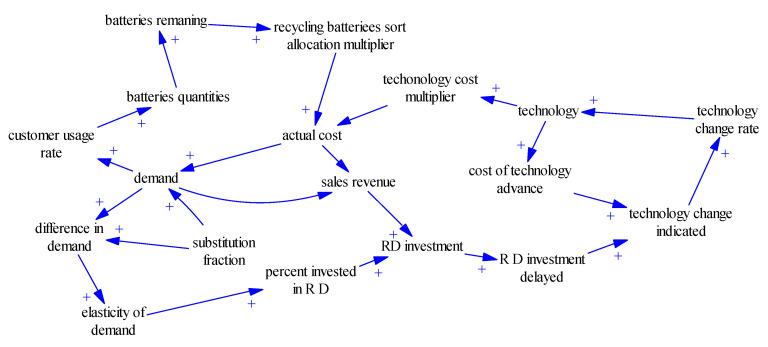
In recent years, international environmental and public health research has become a hot topic, and battery recycling, which is often mentioned separately from waste disposal, has likewise become an academic topic. Battery recycling research is beneficial not only for controlling toxic and harmful substances, but also for public health. In addition, battery recycling brings value-added benefits to company management. As the most important link in the battery supply chain, the driving mechanism of battery recycling in the new electric vehicle industry will become particularly important. The subject of battery recycling is diverse, and the relationships among influencing factors are complex, thereby presenting a fluctuating state. Against this background, this study constructs a system dynamics model from the perspective of a main sorting and recycling system, a technological innovation subsystem and a replacement subsystem. Moreover, this study examines the driving mechanism of the power battery recycling system of a microlevel company. Focusing on the systematic impact of technological innovation capability and substitution, we find that the technological innovation drive of companies increases the total effect of required costs and product demands. It is embodied in two aspects, that is, the increase in the recovery rate leads to an increase in demand, whereas the increase in actual expenditures is less than the increase in technology-driven benefits. After technological innovation capability is improved, the effect of the technological innovation multiplier on the driving mechanism of companies is shown as rapid response time changes. In the substitution component of a company recycling system, we find that the maximum substitution rate limiting expectations has no significant impact on product differentiation. The leading effect of technological innovation capability is more obvious than that of substitution activity. Based on these findings, several suggestions for company operation and environmental governance are presented.
近年来,国际环境与公共卫生研究成为热点,与废物处置分别论述的电池回收同样成为学术议题。电池回收研究不仅有益于控制有毒有害物质,而且有益于公共卫生。此外,电池回收为公司管理带来附加值。作为电池供应链中最重要的一环,新电动汽车产业中电池回收的驱动机制将变得尤为重要。电池回收的主题多样化,影响因素之间的关系复杂,呈现波动状态。在此背景下,本研究从主要分类回收系统、技术创新子系统和替换子系统的角度构建系统动力学模型,考察微观层面公司的动力蓄电池回收系统的驱动机制。着眼于技术创新能力和替代的系统影响,我们发现公司的技术创新驱动增加了所需成本和产品需求的总效果。这体现在两个方面,即回收率的提高导致需求增加,而实际支出的增加小于技术驱动效益的增加。技术创新能力提高后,技术创新乘数对公司驱动机制的影响表现为快速响应时间变化。在公司回收系统的替代组件中,我们发现最大替代率限制预期对产品差异化没有显著影响。技术创新能力的主导作用比替代活动更为明显。基于这些发现,提出了一些公司运营和环境治理的建议。




 Zotero 插件