Novoa-Cid Maria, Baldovi Herme G
Department of Chemistry, Universitat Politècnica de València, 46022 Valencia, Spain.
Instituto de Tecnología Química CSIC-UPV, Universitat Politènica de Valencia, 46022 Valencia, Spain.
Nanomaterials (Basel). 2020 Nov 6;10(11):2212. doi: 10.3390/nano10112212.
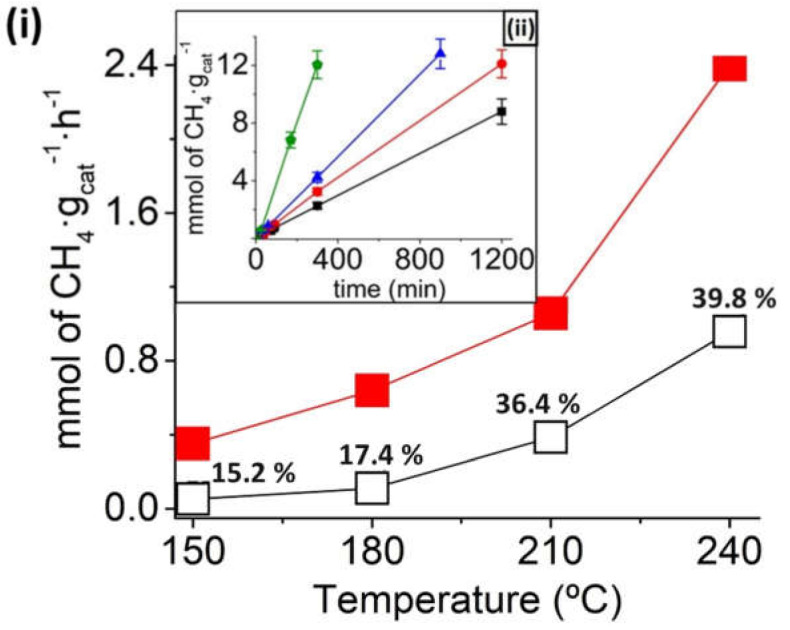
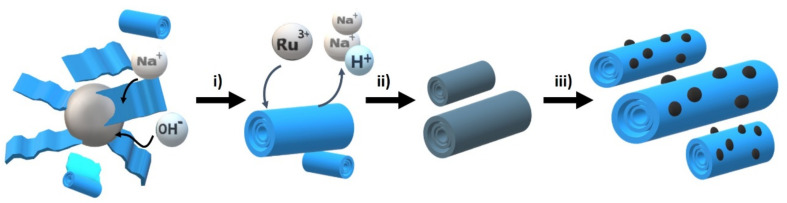
The Sabatier reaction could be a key tool for the future of the renewable energy field due to the potential of this reaction to produce either fuels or to stabilize H in the form of stable chemicals. For this purpose, a new composite made of ruthenium oxide nanoparticles (NPs) deposited on titanate nanotubes (TiNTs) was tested. Titanate nanotubes are a robust semiconductor with a one-dimensional (1D) morphology that results in a high contact area making this material suitable for photocatalysis. Small ruthenium nanoparticles (1.5 nm) were deposited on TiNTs at different ratios by Na-to-Ru ion exchanges followed by calcination. These samples were tested varying light power and temperature conditions to study the reaction mechanism during catalysis. Methanation of CO catalyzed by Ru/TiNT composite exhibit photonic and thermic contributions, and their ratios vary with temperature and light intensity. The synthesized composite achieved a production rate of 12.4 mmol CH·g·h equivalent to 110.7 mmol of CH·g·h under 150 mW/cm simulated sunlight irradiation at 210 °C. It was found that photo-response derives either from Ru nanoparticle excitation in the visible (VIS) and near-infrared (NIR) region (photothermal and plasmon excitation mechanism) or from TiNT excitation in the ultraviolet (UV) region leading to electron-hole separation and photoinduced electron transfer.
萨巴蒂尔反应可能是可再生能源领域未来的关键工具,因为该反应具有生产燃料或以稳定化学物质形式稳定氢的潜力。为此,测试了一种由沉积在钛酸盐纳米管(TiNTs)上的氧化钌纳米颗粒(NPs)制成的新型复合材料。钛酸盐纳米管是一种坚固的半导体,具有一维(1D)形态,导致高接触面积,使这种材料适用于光催化。通过钠与钌离子交换,然后进行煅烧,将小的钌纳米颗粒(1.5纳米)以不同比例沉积在TiNTs上。在不同的光功率和温度条件下对这些样品进行测试,以研究催化过程中的反应机理。Ru/TiNT复合材料催化的CO甲烷化表现出光子和热贡献,其比例随温度和光强度而变化。在210℃下,在150 mW/cm模拟太阳光照射下,合成的复合材料实现了12.4 mmol CH·g·h的产率,相当于110.7 mmol的CH·g·h。研究发现,光响应要么源于可见光(VIS)和近红外(NIR)区域中Ru纳米颗粒的激发(光热和等离子体激发机制),要么源于紫外(UV)区域中TiNT的激发,导致电子 - 空穴分离和光致电子转移。