Sigmund Audrey M, Sahasrabudhe Kieran D, Bhatnagar Bhavana
Division of Hematology, Department of Internal Medicine, The Ohio State University and the Ohio State University Comprehensive Cancer Center, Columbus, OH 43210, USA.
Blood Lymphat Cancer. 2020 Nov 3;10:7-20. doi: 10.2147/BLCTT.S223894. eCollection 2020.
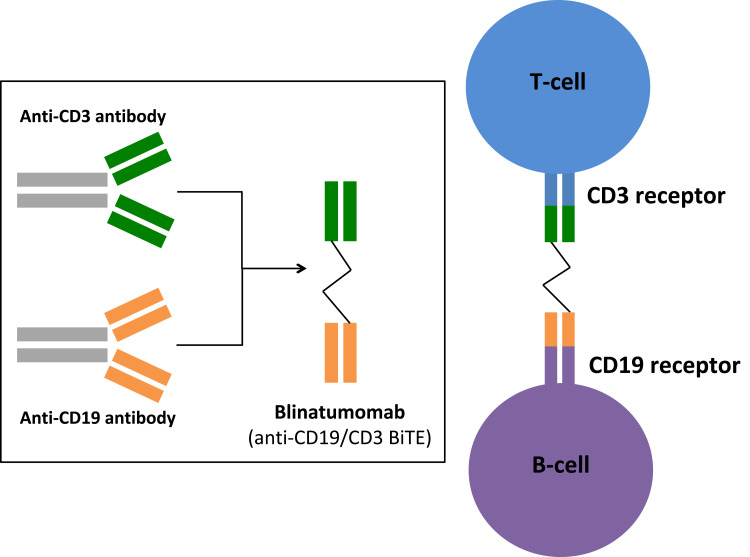
Although adults with B-cell acute lymphoblastic leukemia (B-ALL) achieve high complete remission (CR) rates following treatment with intensive multi-agent chemotherapy regimens, up to two-thirds of these patients eventually relapse. Unfortunately, adults with relapsed or refractory (R/R) B-ALL have a poor prognosis, with variable responses to salvage chemotherapy regimens and allogeneic stem cell transplant. As such, the need to develop effective and well-tolerated treatments for this patient population has been of paramount importance over the past decade. In this regard, treatment options for R/R B-ALL patients have expanded considerably over a relatively short period of time, with the approvals of blinatumomab, inotuzumab ozogamicin and tisagenlecleucel occurring within only the past six years. Blinatumomab, a CD19 x CD3 bispecific T-cell engager (BiTE) was the first of these immune therapies to receive approval, and for many patients, is used as first-line salvage therapy. A number of large clinical trials have demonstrated improved progression-free survival and overall survival for R/R B-ALL patients receiving blinatumomab as compared to those receiving conventional salvage chemotherapy. In addition to being approved for both Philadelphia chromosome-negative and Philadelphia chromosome-positive R/R B-ALL, blinatumomab is also the only ALL therapy that carries approval for the treatment of measurable residual disease (MRD). Although blinatumomab has changed the therapeutic landscape for adults with R/R B-ALL, a number of important clinical considerations and questions remain, including the potential role of blinatumomab in the frontline setting, mechanisms of resistance, optimal goal MRD level, the role of transplant following MRD clearance, the optimal place for blinatumomab in the context of other recently approved immune-mediated therapies, and real world outcomes for patients treated outside the context of clinical trials. These issues are the focus of ongoing studies, which will hopefully inform future clinical practice regarding the utility of blinatumomab in the treatment of B-ALL patients.
尽管成年B细胞急性淋巴细胞白血病(B-ALL)患者在接受强化多药化疗方案治疗后可实现较高的完全缓解(CR)率,但这些患者中高达三分之二最终会复发。不幸的是,复发或难治性(R/R)B-ALL成年患者预后较差,对挽救性化疗方案和异基因干细胞移植的反应各不相同。因此,在过去十年中,为这一患者群体开发有效且耐受性良好的治疗方法至关重要。在这方面,R/R B-ALL患者的治疗选择在相对较短的时间内有了显著扩展,在过去六年内,博纳吐单抗、奥加伊妥珠单抗和替沙格赛基因细胞疗法相继获批。博纳吐单抗是一种CD19×CD3双特异性T细胞衔接器(BiTE),是这些免疫疗法中首个获批的药物,对许多患者而言,它被用作一线挽救疗法。多项大型临床试验表明,与接受传统挽救性化疗的患者相比,接受博纳吐单抗治疗的R/R B-ALL患者的无进展生存期和总生存期有所改善。除了获批用于费城染色体阴性和费城染色体阳性的R/R B-ALL外,博纳吐单抗也是唯一获批用于治疗可测量残留病(MRD)的ALL疗法。尽管博纳吐单抗改变了R/R B-ALL成年患者的治疗格局,但仍存在一些重要的临床考虑因素和问题,包括博纳吐单抗在一线治疗中的潜在作用、耐药机制、最佳目标MRD水平、MRD清除后移植的作用、博纳吐单抗在其他近期获批的免疫介导疗法背景下的最佳位置,以及在临床试验背景之外接受治疗的患者的真实世界结局。这些问题是正在进行的研究的重点,有望为博纳吐单抗在B-ALL患者治疗中的应用提供未来临床实践的参考。