Department of Intensive Care Unit, Shenzhen Hospital of Integrated Traditional Chinese and Western Medicine, Shenzhen, Guangdong 518104, P.R. China.
Mol Med Rep. 2020 Dec;22(6):5135-5144. doi: 10.3892/mmr.2020.11637. Epub 2020 Oct 26.
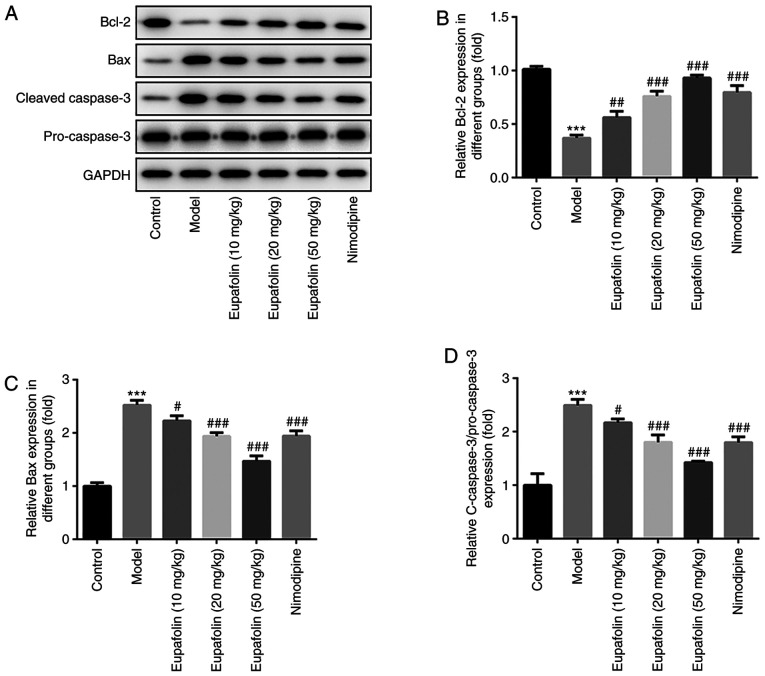
Eupatorium perfoliatum L. (E. perfoliatium) has been used traditionally for treating fever, malaria and inflammation‑associated diseases. Eupafolin, the extract of E. perfoliatium, was also reported to suppress inflammation. The present study aimed to investigate the protective effects of eupafolin on cerebral ischemia/reperfusion (I/R) injury in rats and its possible underlying mechanisms. Cerebral I/R injury was induced in rats by middle cerebral artery occlusion (MCAO) for 1.5 h, followed by reperfusion. The rats were randomly assigned into six groups: Control, model, 10 mg/kg eupafolin, 20 mg/kg eupafolin, 50 mg/kg eupafolin and 20 mg/kg nimodipine. Eupafolin and nimodipine were intragastrically administrated to the rats 1 week before MCAO induction. Following reperfusion for 24 h, the neurological deficit was scored, and brain samples were harvested for evaluating encephaledema, infarct volume, oxidative stress, apoptosis, inflammation and the expression of TLR4/NF‑κB signaling. The results revealed that eupafolin decreased the neurological score, relieved encephaledema and decreased infarct volume. Eupafolin also attenuated oxidative stress, neuronal apoptosis and inflammation, with decreases in lactate dehydrogenase, malondialdehyde, TUNEL‑positive cells, Bax and caspase‑3, along with TNF‑α, IL‑1β and IL‑6, but increases in superoxide dismutase and Bcl‑2 levels. Furthermore, eupafolin may decrease the expression of TLR4 downstream proteins and proteins involved in the NF‑κB pathway. Treatment with TLR4 agonist‑LPS significantly blunted the protective effect of eupafolin on encephaledema and cerebral infarct. Meanwhile, 20 mg/kg eupafolin showed nearly equivalent effects to the positive‑control drug nimodipine. In conclusion, eupafolin protected against cerebral I/R injury in rats and the underlying mechanism may be associated with the suppression of apoptosis and inflammation via inhibiting the TLR4/ NF‑κB signaling pathway.
佩兰(Eupatorium perfoliatum L.)被传统用于治疗发热、疟疾和炎症相关疾病。佩兰叶中的佩兰醇提物也被报道具有抗炎作用。本研究旨在探讨佩兰醇提物对大鼠脑缺血再灌注(I/R)损伤的保护作用及其可能的机制。通过大脑中动脉阻塞(MCAO) 1.5 小时诱导大鼠脑 I/R 损伤,随后再灌注。将大鼠随机分为六组:对照组、模型组、10mg/kg 佩兰醇提物组、20mg/kg 佩兰醇提物组、50mg/kg 佩兰醇提物组和 20mg/kg 尼莫地平组。MCAO 诱导前一周,通过灌胃给予佩兰醇提物和尼莫地平。再灌注 24 小时后,对神经功能缺损进行评分,并采集脑组织样本,评估脑水肿、梗死体积、氧化应激、细胞凋亡、炎症和 TLR4/NF-κB 信号通路的表达。结果显示,佩兰醇提物降低了神经功能评分,减轻了脑水肿,减少了梗死体积。佩兰醇提物还减轻了氧化应激、神经元凋亡和炎症反应,降低了乳酸脱氢酶、丙二醛、TUNEL 阳性细胞、Bax 和 caspase-3 的水平,同时增加了超氧化物歧化酶和 Bcl-2 的水平。此外,佩兰醇提物可能降低了 TLR4 下游蛋白和 NF-κB 通路相关蛋白的表达。TLR4 激动剂 LPS 的处理显著削弱了佩兰醇提物对脑水肿和脑梗死的保护作用。同时,20mg/kg 佩兰醇提物的作用与阳性对照药物尼莫地平相当。综上所述,佩兰醇提物对大鼠脑 I/R 损伤具有保护作用,其机制可能与通过抑制 TLR4/NF-κB 信号通路抑制细胞凋亡和炎症有关。