Department of Health, Medicine and Caring Sciences, Linköping University, Linköping, Sweden.
Primary Health Care Center in Ljungsbro, Linköping University, Linköping, Sweden.
Scand J Prim Health Care. 2020 Dec;38(4):421-429. doi: 10.1080/02813432.2020.1842966. Epub 2020 Nov 11.
To explore family members' experiences of advance care planning in nursing homes.
Individual interviews. Thematic analysis.
Four nursing homes in Sweden.
Eighteen family members of deceased nursing home patients.
Family members' experiences of advance care planning in nursing homes.
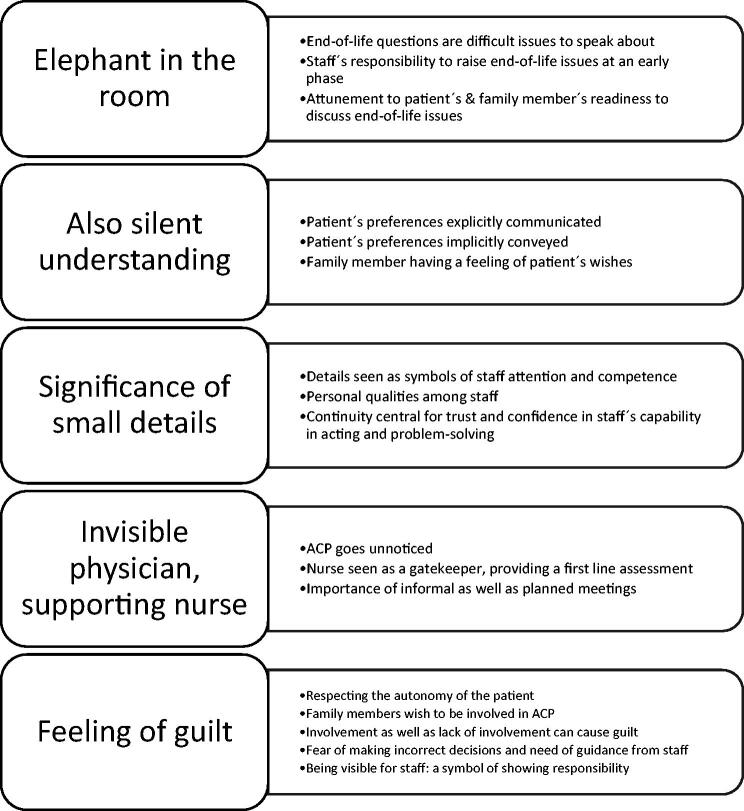
Family members' experiences of advance care planning in a nursing home context involved five themes: , comprising end-of-life issues being difficult to talk about; , e.g. patient's preferences explicitly communicated, but also implicitly conveyed. In some cases family members had a sense of the patient's wishes although preferences had not been communicated openly; , e.g. family members perceive everyday details as symbols of staff commitment; , e.g. nurse being a gatekeeper, providing a first line assessment in the physician's absence; and , e.g. family members wish to participate in decisions regarding direction of care and treatment limits, and need guidance in the decisions.
Our study stresses the significance of staff involving the patient and family members in the advance care planning process in nursing homes, thereby adapting the care in line with patient's wishes, and for the patient to share these preferences with family members. Education in communication related to the subject may be important to shape advance care planning. Key points Knowledge on advance care planning (ACP) in a nursing home (NH) context from the perspective of family members is limited. Role of the nurse in ACP is seen as central, whereas physician involvement is often perceived to be lacking. Significance of small details, perceive to symbolize staff competence and respect for patient autonomy. To limit family members' feeling of guilt, communicating end-of-life issues is important in order to align ACP with patient preferences.
探索护理院中家庭成员对预先医疗指示的体验。
个人访谈。主题分析。
瑞典的 4 家养老院。
18 名已故养老院患者的家属。
护理院中家庭成员对预先医疗指示的体验。
护理院背景下家庭成员对预先医疗指示的体验包括 5 个主题:(1)困难的对话,包括临终问题难以讨论;(2)隐含的偏好,例如患者的偏好明确传达,但也隐含传达。在某些情况下,尽管没有公开传达偏好,但家庭成员对患者的意愿有一定的感觉;(3)日常细节的意义,例如家庭成员将日常细节视为工作人员承诺的象征;(4)护士的把关作用,在医生不在的情况下提供一线评估;(5)决策指导,例如家庭成员希望参与关于护理方向和治疗限制的决策,并需要在决策中得到指导。
我们的研究强调了工作人员在护理院预先医疗指示过程中让患者和家庭成员参与的重要性,从而使护理符合患者的意愿,并使患者与家庭成员分享这些偏好。与该主题相关的沟通教育可能对预先医疗指示的制定很重要。
从家庭成员的角度了解护理院中预先医疗指示(ACP)的知识有限。
护士在 ACP 中的角色被视为核心,而医生的参与往往被认为是缺乏的。
小细节的意义,被认为象征着工作人员的能力和对患者自主权的尊重。
为了减轻家庭成员的内疚感,沟通临终问题对于使 ACP 与患者的偏好保持一致非常重要。