Centre for Elderly and Nursing Home Medicine, Department of Global Public Health and Primary Care, University of Bergen, P.O. Box: 7804, Bergen, Norway.
Department of Nursing Home Medicine, Municipality of Bergen, Bergen, Norway.
BMC Geriatr. 2018 Jan 25;18(1):26. doi: 10.1186/s12877-018-0713-7.
Advance Care Planning (ACP) is the repeated communication and decision-making process between the patient, family, and healthcare professionals. This study describes an ACP intervention in nursing homes and evaluates the outcomes of the implementation process.
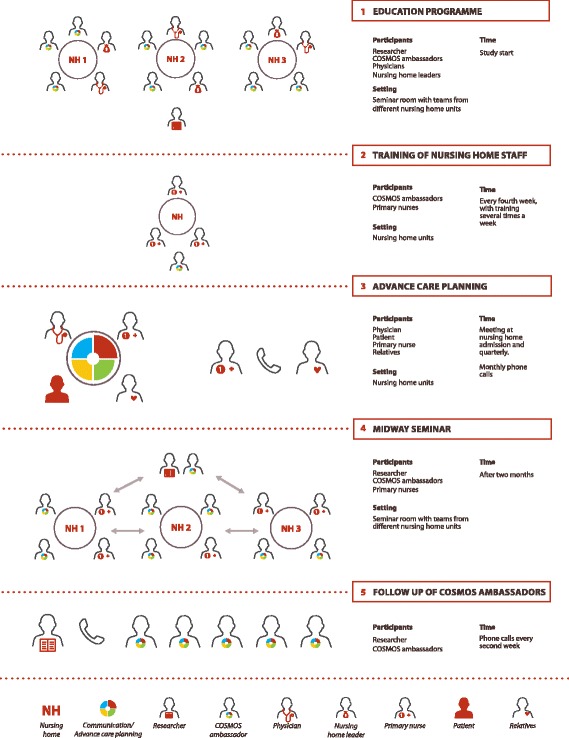
The ACP intervention was part of a 4-month complex, cluster randomized controlled trial (COSMOS). 37 Norwegian nursing homes with 72 units (1 cluster = 1 unit) and 765 patients were invited to participate and eligible units were randomised to the intervention group or control. Nursing home staff in the intervention group was offered a standardized education programme to learn early and repeated communication with patients and families and to implement ACP in their units. We used a train-the-trainer approach to educate staff in the units, supported by regular telephone calls and a midway seminar after two months. Individual patient logs consisting of different communication deliverables were used to evaluate the implementation process. Supported by Qualitative Content Analyses, we identified facilitators and barriers of the ACP implementation based on feedback during midway seminars and individual patient logs.
The ACP intervention was conducted in 36 NH units (n = 297); 105 healthcare providers participated at the education seminar prior to the study, and 3-4 employees from each unit participated in the midway seminar. NH staff reported the educational material relevant for the implementation strategy. The patient logs showed that ACP was successfully implemented in 62% (n = 183) of the patients using our predefined implementation criteria. The staff emphasized the clear communication of the relevance of ACP addressed to leaders and staff as important facilitators, along with the clearly defined routines, roles and responsibilities. Identified barriers included lack of competence, perceived lack of time, and conflicting culture and staff opinions.
Monthly communication with the family was the most frequently conducted communication, and the predefined criteria of successfully implemented ACP were largely achieved. Nursing home routines and engagement of leaders and staff were crucial facilitators, whereas lack of time and competence reduced the implementation success.
The COSMOS-trial was registered in the ClinicalTrials.gov ( NCT02238652 ) July 7th, 2014.
预先医疗照护计划(ACP)是患者、家属和医疗保健专业人员之间反复进行的沟通和决策过程。本研究描述了疗养院中的 ACP 干预措施,并评估了实施过程的结果。
ACP 干预措施是为期 4 个月的复杂、集群随机对照试验(COSMOS)的一部分。37 家挪威疗养院的 72 个单元(1 个集群=1 个单元)和 765 名患者受邀参加,符合条件的单元被随机分配到干预组或对照组。干预组的疗养院工作人员接受了标准化的教育计划,以学习与患者和家属进行早期和反复的沟通,并在其单元中实施 ACP。我们采用培训师培训方法对单元中的工作人员进行教育,通过定期电话和两个月后的中途研讨会提供支持。使用不同沟通可交付成果的个人患者日志来评估实施过程。根据中途研讨会和个人患者日志中的反馈,我们通过定性内容分析确定了 ACP 实施的促进因素和障碍。
ACP 干预措施在 36 个 NH 单元(n=297)中进行;105 名医疗保健提供者参加了研究前的教育研讨会,每个单元有 3-4 名员工参加了中途研讨会。NH 工作人员报告说,教育材料与实施策略相关。患者日志显示,根据我们预先定义的实施标准,62%(n=183)的患者成功实施了 ACP。工作人员强调,向领导和工作人员明确传达 ACP 的相关性是重要的促进因素,同时明确规定了常规、角色和责任。确定的障碍包括缺乏能力、认为缺乏时间以及文化和员工意见冲突。
每月与家属沟通是最常进行的沟通方式,并且成功实施 ACP 的预定标准在很大程度上得到了实现。疗养院的常规程序以及领导和工作人员的参与是至关重要的促进因素,而缺乏时间和能力则降低了实施的成功。
COSMOS 试验于 2014 年 7 月 7 日在 ClinicalTrials.gov (NCT02238652)注册。