Schnipper Julie, Dhennin-Duthille Isabelle, Ahidouch Ahmed, Ouadid-Ahidouch Halima
Laboratory of Cellular and Molecular Physiology, UR-4667, University of Picardie Jules Verne, Amiens, France.
Department of Biology, Faculty of Sciences, Ibn Zohr University, Agadir, Morocco.
Front Pharmacol. 2020 Oct 16;11:568993. doi: 10.3389/fphar.2020.568993. eCollection 2020.
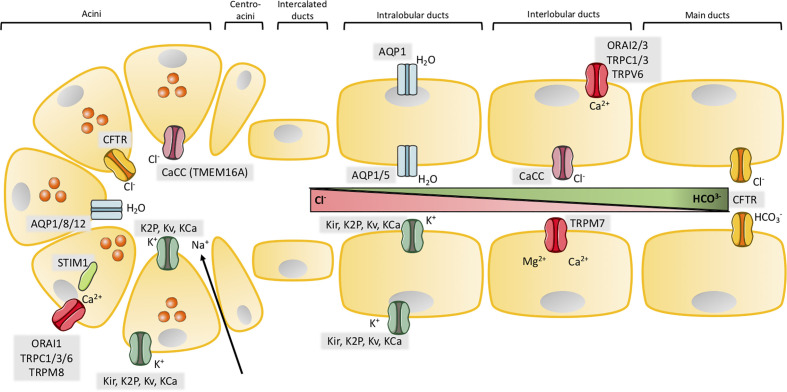
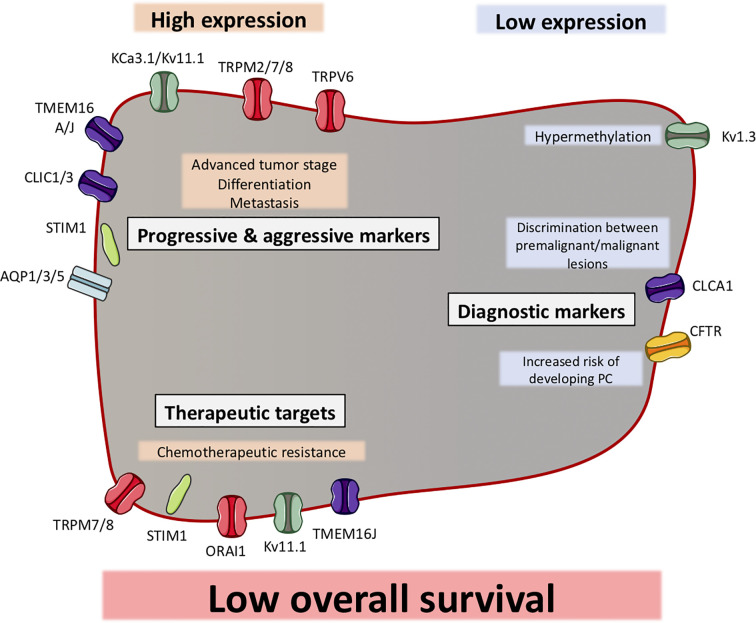
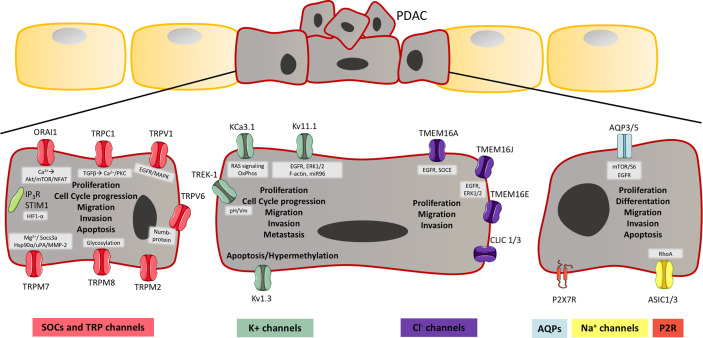
Pancreatic ductal adenocarcinoma (PDAC) is the fourth most common cause of cancer-related deaths in United States and Europe. It is predicted that PDAC will become the second leading cause of cancer-related deaths during the next decades. The development of PDAC is not well understood, however, studies have shown that dysregulated exocrine pancreatic fluid secretion can contribute to pathologies of exocrine pancreas, including PDAC. The major roles of healthy exocrine pancreatic tissue are secretion of enzymes and bicarbonate rich fluid, where ion channels participate to fine-tune these biological processes. It is well known that ion channels located in the plasma membrane regulate multiple cellular functions and are involved in the communication between extracellular events and intracellular signaling pathways and can function as signal transducers themselves. Hereby, they contribute to maintain resting membrane potential, electrical signaling in excitable cells, and ion homeostasis. Despite their contribution to basic cellular processes, ion channels are also involved in the malignant transformation from a normal to a malignant phenotype. Aberrant expression and activity of ion channels have an impact on essentially all hallmarks of cancer defined as; uncontrolled proliferation, evasion of apoptosis, sustained angiogenesis and promotion of invasion and migration. Research indicates that certain ion channels are involved in the aberrant tumor growth and metastatic processes of PDAC. The purpose of this review is to summarize the important expression, localization, and function of ion channels in normal exocrine pancreatic tissue and how they are involved in PDAC progression and development. As ion channels are suggested to be potential targets of treatment they are furthermore suggested to be biomarkers of different cancers. Therefore, we describe the importance of ion channels in PDAC as markers of diagnosis and clinical factors.
胰腺导管腺癌(PDAC)是美国和欧洲癌症相关死亡的第四大常见原因。据预测,在未来几十年中,PDAC将成为癌症相关死亡的第二大主要原因。然而,PDAC的发病机制尚未完全明确,不过研究表明,外分泌性胰腺液分泌失调会导致外分泌胰腺的病变,包括PDAC。健康的外分泌胰腺组织的主要作用是分泌酶和富含碳酸氢盐的液体,离子通道参与微调这些生物学过程。众所周知,位于质膜上的离子通道调节多种细胞功能,参与细胞外事件与细胞内信号通路之间的通信,并且自身可作为信号转导器发挥作用。因此,它们有助于维持静息膜电位、可兴奋细胞中的电信号以及离子稳态。尽管离子通道对基本细胞过程有贡献,但它们也参与从正常表型到恶性表型的恶性转化。离子通道的异常表达和活性对定义为以下所有癌症特征都有影响:不受控制的增殖、逃避凋亡、持续的血管生成以及促进侵袭和迁移。研究表明,某些离子通道参与了PDAC的异常肿瘤生长和转移过程。本综述的目的是总结离子通道在正常外分泌胰腺组织中的重要表达、定位和功能,以及它们如何参与PDAC的进展和发展。由于离子通道被认为是潜在的治疗靶点,因此它们还被认为是不同癌症的生物标志物。因此,我们描述了离子通道在PDAC中作为诊断标志物和临床因素的重要性。