Jeon Kun-Rok, Jeon Jae-Chun, Zhou Xilin, Migliorini Andrea, Yoon Jiho, Parkin Stuart S P
Max Planck Institute of Microstructure Physics, Weinberg 2, 06120 Halle (Saale), Germany.
ACS Nano. 2020 Nov 24;14(11):15874-15883. doi: 10.1021/acsnano.0c07187. Epub 2020 Nov 12.
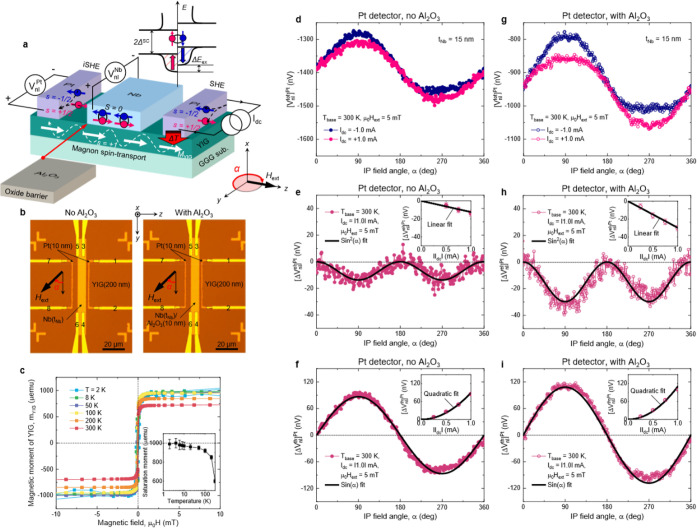
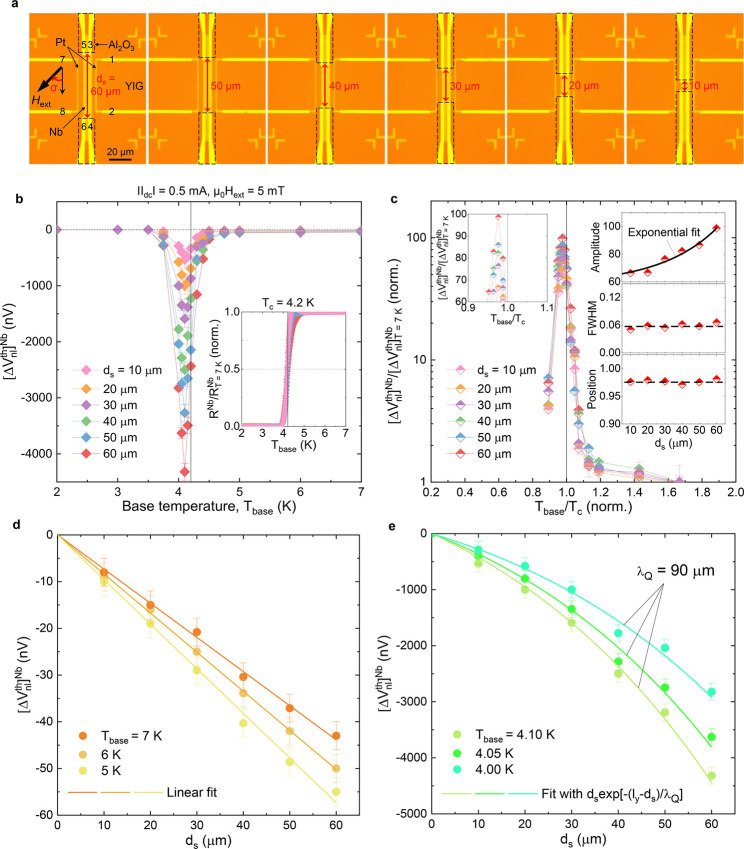
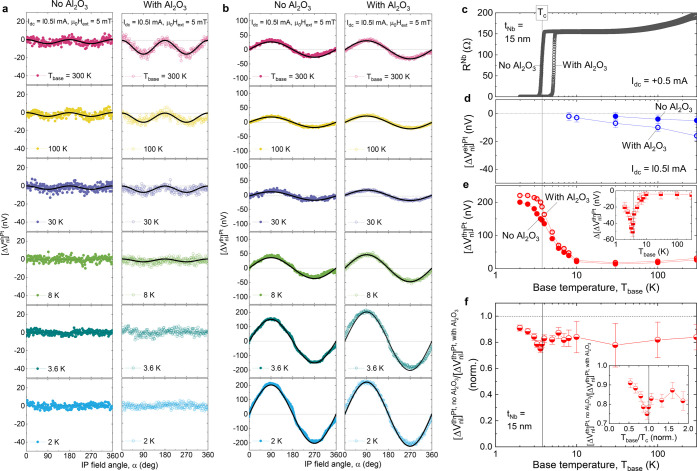
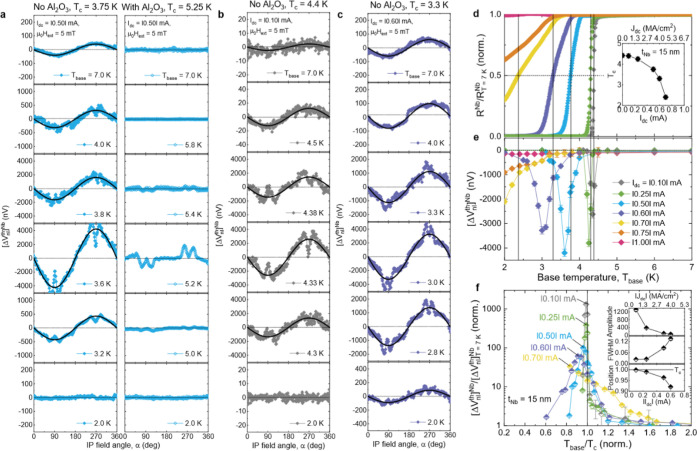
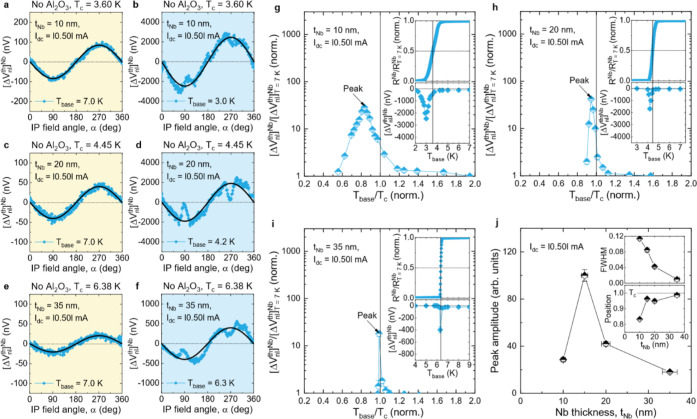
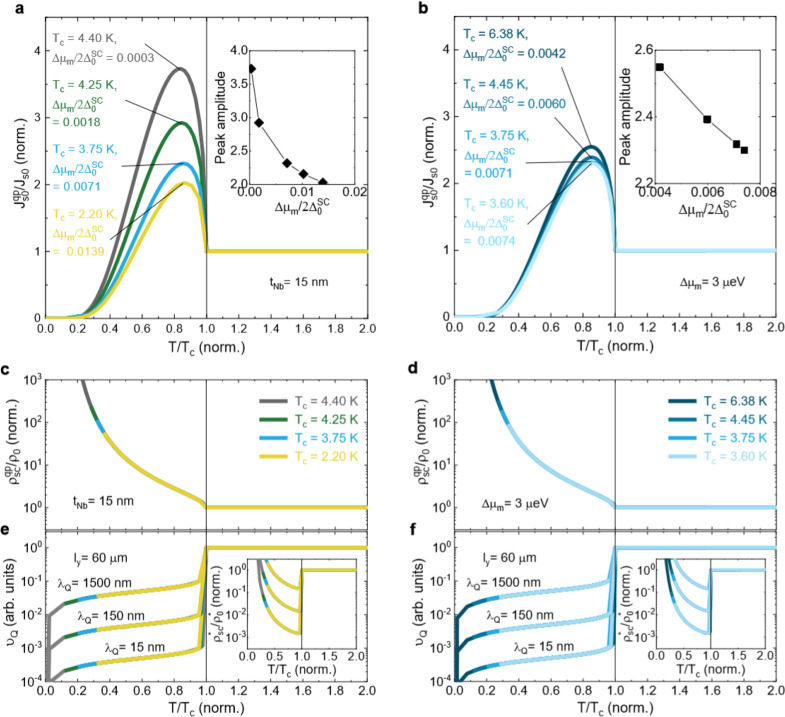
Although recent experiments and theories have shown a variety of exotic transport properties of nonequilibrium quasiparticles (QPs) in superconductor (SC)-based devices with either Zeeman or exchange spin-splitting, how a QP interplays with magnon spin currents remains elusive. Here, using nonlocal magnon spin-transport devices where a singlet SC (Nb) on top of a ferrimagnetic insulator (YFeO) serves as a magnon spin detector, we demonstrate that the conversion efficiency of magnon spin to QP charge inverse spin-Hall effect (iSHE) in such an exchange-spin-split SC can be greatly enhanced by up to 3 orders of magnitude compared with that in the normal state, particularly when its interface superconducting gap matches the magnon spin accumulation. Through systematic measurements by varying the current density and SC thickness, we identify that superconducting coherence peaks and exchange spin-splitting of the QP density-of-states, yielding a larger spin excitation while retaining a modest QP charge-imbalance relaxation, are responsible for the giant QP iSHE. The latter exchange-field-modified QP relaxation is experimentally proved by spatially resolved measurements with varying the separation of electrical contacts on the spin-split Nb.
尽管最近的实验和理论表明,在具有塞曼或交换自旋分裂的基于超导体(SC)的器件中,非平衡准粒子(QP)具有各种奇异的输运特性,但QP如何与磁振子自旋电流相互作用仍然难以捉摸。在这里,我们使用非局域磁振子自旋输运器件,其中在亚铁磁绝缘体(YFeO)顶部的单重态SC(Nb)用作磁振子自旋探测器,我们证明,与正常状态相比,在这种交换自旋分裂的SC中,磁振子自旋到QP电荷的转换效率——逆自旋霍尔效应(iSHE)可以大大提高多达3个数量级,特别是当其界面超导能隙与磁振子自旋积累相匹配时。通过改变电流密度和SC厚度进行系统测量,我们确定超导相干峰和QP态密度的交换自旋分裂,在保持适度的QP电荷不平衡弛豫的同时产生更大的自旋激发,是巨大QP iSHE的原因。通过改变自旋分裂Nb上电接触的间距进行空间分辨测量,实验证明了后者交换场修正的QP弛豫。