Division of Bacterial Diseases, National Center for Immunization and Respiratory Diseases, CDC, Atlanta, GA, United States of America.
Division of Health Informatics and Surveillance, Center for Surveillance, Epidemiology, and Laboratory Services, CDC, Atlanta, GA, United States of America.
PLoS One. 2020 Nov 12;15(11):e0241989. doi: 10.1371/journal.pone.0241989. eCollection 2020.
Eculizumab is a licensed treatment for several rare, complement-mediated diseases. Eculizumab use is associated with an approximately 2,000-fold increased meningococcal disease risk. In the United States, meningococcal vaccines are recommended for eculizumab recipients but there are no recommendations on use of long-term antibiotic prophylaxis. We describe characteristics of and meningococcal vaccine and antibiotic receipt in U.S. eculizumab recipients to inform meningococcal disease prevention strategies.
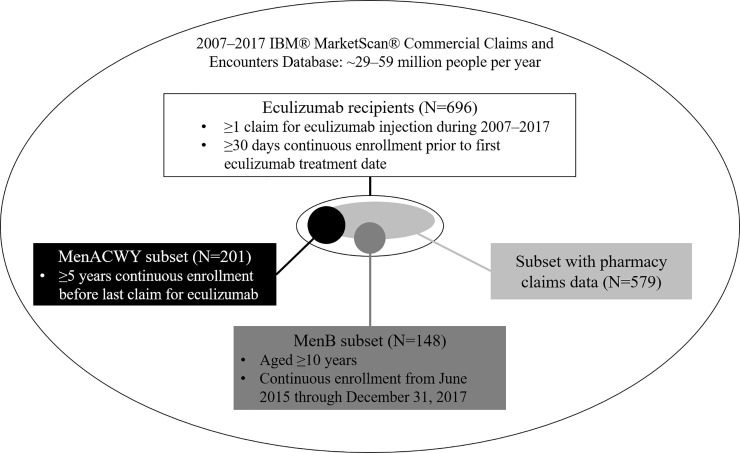
Persons in the IBM® MarketScan® Research Databases with ≥1 claim for eculizumab injection during 2007-2017 were included. Indication for eculizumab use, meningococcal vaccine receipt, and antibiotic receipt were assessed using International Classification of Diseases-9/10 diagnosis codes, vaccine administration procedure codes, and antibiotic codes from pharmacy claims, respectively.
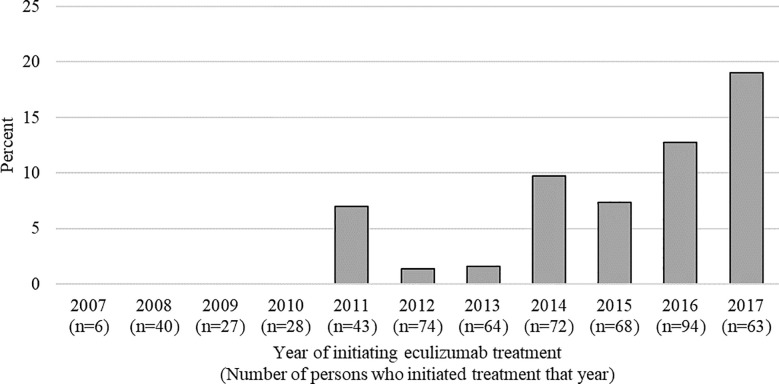
Overall 696 persons met the inclusion criteria. Paroxysmal nocturnal hemoglobinuria (PNH) and atypical hemolytic uremic syndrome (aHUS) were the most common indications for eculizumab use (41% and 37%, respectively); 20% had an undetermined indication. From June 2015 through December 2017, 28% (41/148) of continuously-enrolled patients received ≥1 serogroup B vaccine dose. For serogroup ACWY conjugate vaccine, 45% (91/201) of patients received ≥1 dose within five years of their most recent eculizumab dose, as recommended. Of eculizumab recipients with outpatient prescription data, 7% (41/579) received antibiotics for ≥50% of the period of increased risk for meningococcal disease.
Many eculizumab recipients had an undetermined indication for eculizumab use; few were up-to-date for recommended meningococcal vaccines or were prescribed antibiotics long-term. These findings can inform further investigation of how to best protect this population from meningococcal disease.
依库珠单抗是一种经许可用于几种罕见的补体介导疾病的治疗药物。使用依库珠单抗与脑膜炎奈瑟球菌病风险增加约 2000 倍相关。在美国,建议对接受依库珠单抗治疗的患者接种脑膜炎奈瑟球菌疫苗,但没有关于长期使用抗生素预防的建议。我们描述了美国依库珠单抗治疗者的脑膜炎奈瑟球菌疫苗和抗生素使用情况,以提供脑膜炎奈瑟球菌病预防策略的信息。
2007 年至 2017 年期间,至少有 1 项依库珠单抗注射用药索赔的 IBM® MarketScan® Research Databases 中的患者被纳入研究。通过使用国际疾病分类第 9 版/第 10 版诊断代码、疫苗接种程序代码和来自药房索赔的抗生素代码,分别评估依库珠单抗使用的适应证、脑膜炎奈瑟球菌疫苗接种和抗生素使用情况。
总体上,有 696 人符合纳入标准。阵发性夜间血红蛋白尿症(PNH)和非典型溶血尿毒症综合征(aHUS)是依库珠单抗使用的最常见适应证(分别占 41%和 37%);20%的患者适应证不明确。自 2015 年 6 月至 2017 年 12 月,连续入组的患者中有 28%(41/148)接受了至少 1 剂 B 型脑膜炎奈瑟球菌疫苗。对于 ACWY 型结合疫苗,在最近一次依库珠单抗治疗后 5 年内,201 名患者中有 45%(91/201)接受了至少 1 剂推荐剂量的疫苗。在有门诊处方数据的依库珠单抗接受者中,7%(41/579)接受了抗生素治疗,治疗时间占脑膜炎奈瑟球菌病高风险期的 50%以上。
许多依库珠单抗治疗者的适应证不明确;很少有人及时接种了推荐的脑膜炎奈瑟球菌疫苗,或长期服用抗生素。这些发现可以为进一步研究如何保护这一人群免受脑膜炎奈瑟球菌病提供信息。