Harhaj Edward W, Shembade Noula
Department of Microbiology and Immunology, Penn State College of Medicine, Hershey, PA 17033, USA.
Department of Microbiology and Immunology, Sylvester Comprehensive Cancer Center Miller School of Medicine, University of Miami, Miami, FL 33136, USA.
Biology (Basel). 2020 Nov 10;9(11):390. doi: 10.3390/biology9110390.
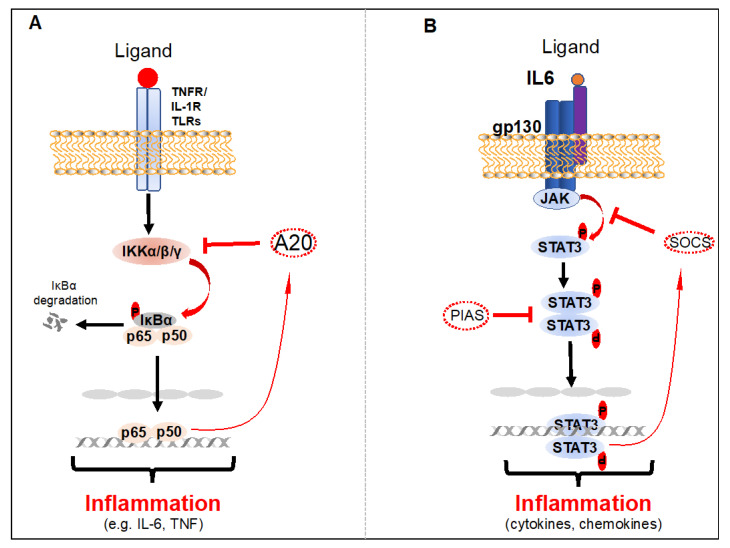
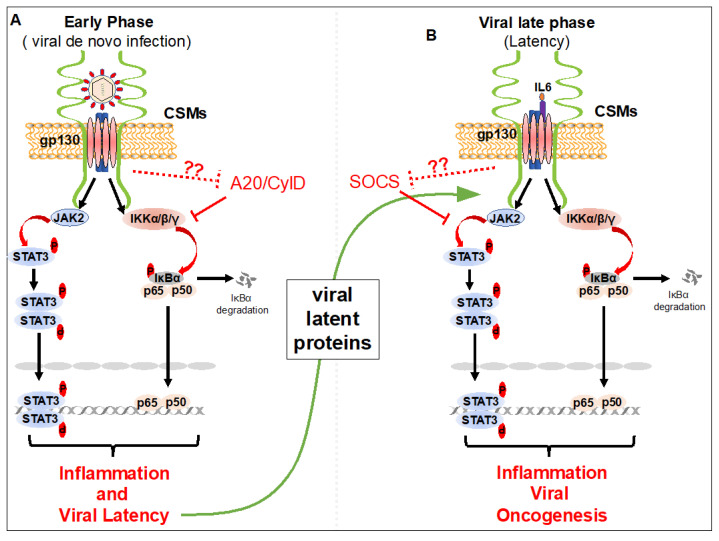
Inflammation induced by transcription factors, including Signal Transducers and Activators of Transcription (STATs) and NF-κB, in response to microbial pathogenic infections and ligand dependent receptors stimulation are critical for controlling infections. However, uncontrolled inflammation induced by these transcription factors could lead to immune dysfunction, persistent infection, inflammatory related diseases and the development of cancers. Although the induction of innate immunity and inflammation in response to viral infection is important to control virus replication, its effects can be modulated by lymphotropic viruses including human T-cell leukemia virus type 1 (HTLV-1), Κaposi's sarcoma herpesvirus (KSHV), and Epstein Barr virus (EBV) during de novo infection as well as latent infection. These lymphotropic viruses persistently activate JAK-STAT and NF-κB pathways. Long-term STAT and NF-κB activation by these viruses leads to the induction of chronic inflammation, which can support the persistence of these viruses and promote virus-mediated cancers. Here, we review how HTLV-1, KSHV and EBV hijack the function of host cell surface molecules (CSMs), which are involved in the regulation of chronic inflammation, innate and adaptive immune responses, cell death and the restoration of tissue homeostasis. Thus, better understanding of CSMs-mediated chronic activation of STATs and NF-κB pathways in lymphotropic virus-infected cells may pave the way for therapeutic intervention in malignancies caused by lymphotropic viruses.
由转录因子(包括信号转导子和转录激活子(STATs)以及核因子κB(NF-κB))在响应微生物病原体感染和配体依赖性受体刺激时所引发的炎症,对于控制感染至关重要。然而,这些转录因子引发的不受控制的炎症可能导致免疫功能障碍、持续性感染、炎症相关疾病以及癌症的发生。尽管对病毒感染做出反应时诱导先天免疫和炎症对于控制病毒复制很重要,但在初次感染以及潜伏感染期间,其作用可能会受到嗜淋巴细胞病毒的调节,这些病毒包括1型人类T细胞白血病病毒(HTLV-1)、卡波西肉瘤疱疹病毒(KSHV)和爱泼斯坦-巴尔病毒(EBV)。这些嗜淋巴细胞病毒持续激活JAK-STAT和NF-κB信号通路。这些病毒长期激活STAT和NF-κB会导致慢性炎症的诱导,这可以支持这些病毒的持续存在并促进病毒介导的癌症。在这里,我们综述了HTLV-1、KSHV和EBV如何劫持宿主细胞表面分子(CSMs)的功能,这些分子参与慢性炎症、先天和适应性免疫反应、细胞死亡以及组织稳态恢复的调节。因此,更好地理解CSMs介导的嗜淋巴细胞病毒感染细胞中STAT和NF-κB信号通路的慢性激活,可能为嗜淋巴细胞病毒引起的恶性肿瘤的治疗干预铺平道路。