Faculty of Agricultural & Environmental Sciences, Juan de Castellanos University, 150001 Tunja, Colombia.
Department of Earth & Environmental Sciences, University of Pavia, 27100 Pavia, Italy.
Int J Environ Res Public Health. 2020 Nov 10;17(22):8311. doi: 10.3390/ijerph17228311.
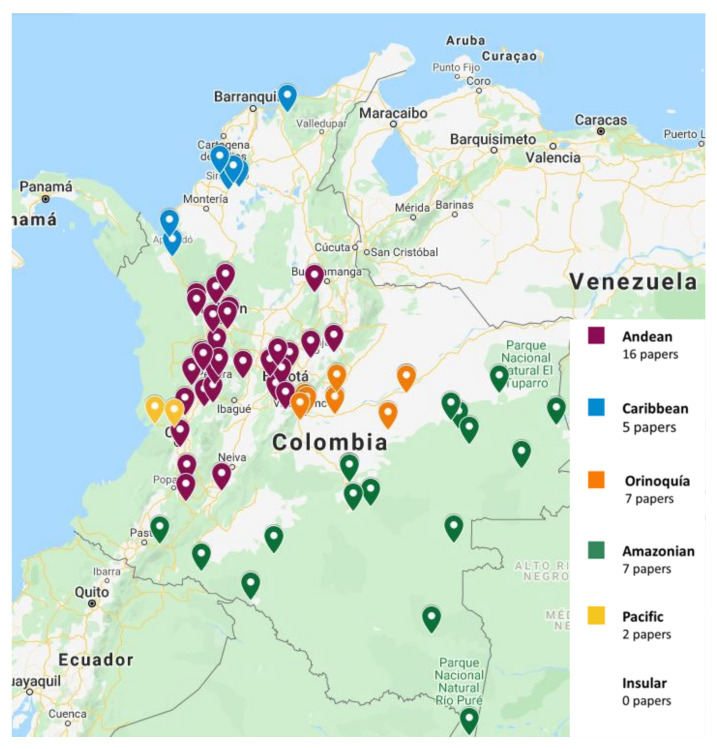
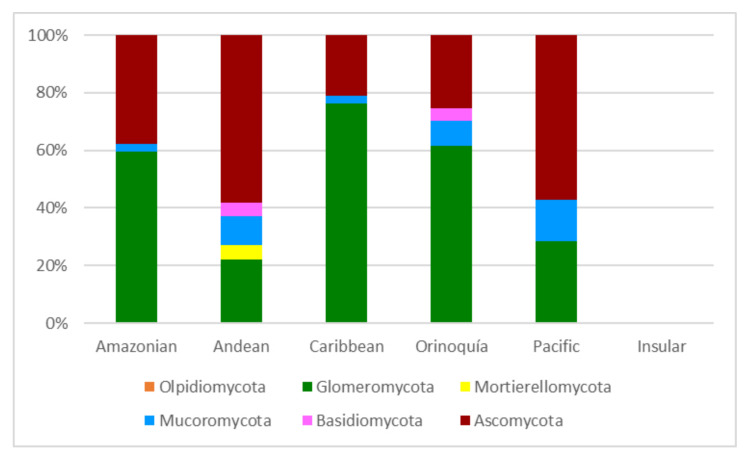
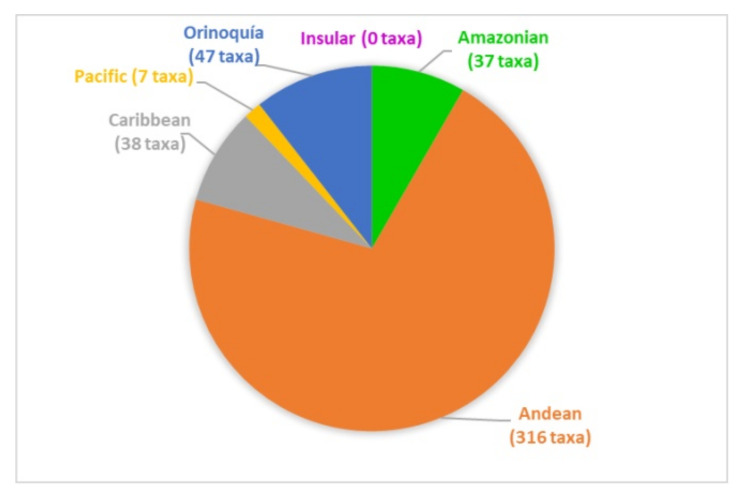
Although Colombia was one of the first tropical countries where an effort was made to gather mycological flora, contributions to the taxonomy, diversity, and ecology of soil microfungi are still scarce. In this study, the diversity of soil microfungi was studied collecting data from literature according to the Colombian natural regions: Andean, Amazonian, Caribbean, Orinoquía, Pacific, and Insular. The majority of the records comes from the Andean region, the most accessible to research. The other regions have been much less studied, with the Insular one with no data at all. International literature reported, up to now, ca. 300 different species of soil microfungi belonging to 126 different genera and 6 phyla (, , , , and ). Vescicular-Arbuscular fungi were widely investigated with and , the most recorded genera with ca. 20 species each. was the most diverse phylum with , , and representing the majority. is strongly present in , and in the panorama of all recorded fungi, too. The other phyla and genera were less recorded. It is, therefore, evident the need to continue studying the soil microfungi in Colombia to have a better understanding of soil functioning and its ecosystem services.
尽管哥伦比亚是最早尝试收集真菌区系的热带国家之一,但对土壤微型真菌的分类学、多样性和生态学的贡献仍然很少。在这项研究中,根据哥伦比亚的自然区域(安第斯山脉、亚马逊、加勒比海、奥里诺科、太平洋和岛屿),从文献中收集数据来研究土壤微型真菌的多样性。记录的大部分来自最容易研究的安第斯地区。其他地区的研究较少,而岛屿地区则完全没有数据。截至目前,国际文献报道了约 300 种不同的土壤微型真菌,属于 126 个不同的属和 6 个门(、、、、和)。泡囊丛枝菌被广泛研究,其中 和 是记录最多的属,每个属约有 20 个种。 是最多样化的门,其中 、 和 占大多数。 在 和中也很常见,在所有记录的真菌中也占有重要地位。其他的门和属记录较少。因此,显然需要继续研究哥伦比亚的土壤微型真菌,以更好地了解土壤功能及其生态系统服务。