O'Leary Noreen, Salmon Nancy, Clifford Amanda M
School of Allied Health, Faculty of Education & Health Sciences, Health Research Institute, University of Limerick, Limerick, Ireland.
BMC Med Educ. 2020 Nov 12;20(1):424. doi: 10.1186/s12909-020-02356-2.
Practice-based interprofessional education (IPE) is essential to prepare students for collaborative working. Pockets of practice-based IPE are integrated into healthcare curriculums in some regions. Yet practice-based IPE is not globally valued as a key element of healthcare curriculums. As students and clinical educators are key stakeholders, this study presents a case example of their experiences in a country where practice-based IPE is at an emergent stage. Their experiential knowledge generated important insights into how practice-based IPE is perceived. This learning can be applied, both locally and further afield, by those seeking to embed practice-based IPE in their placement curriculums.
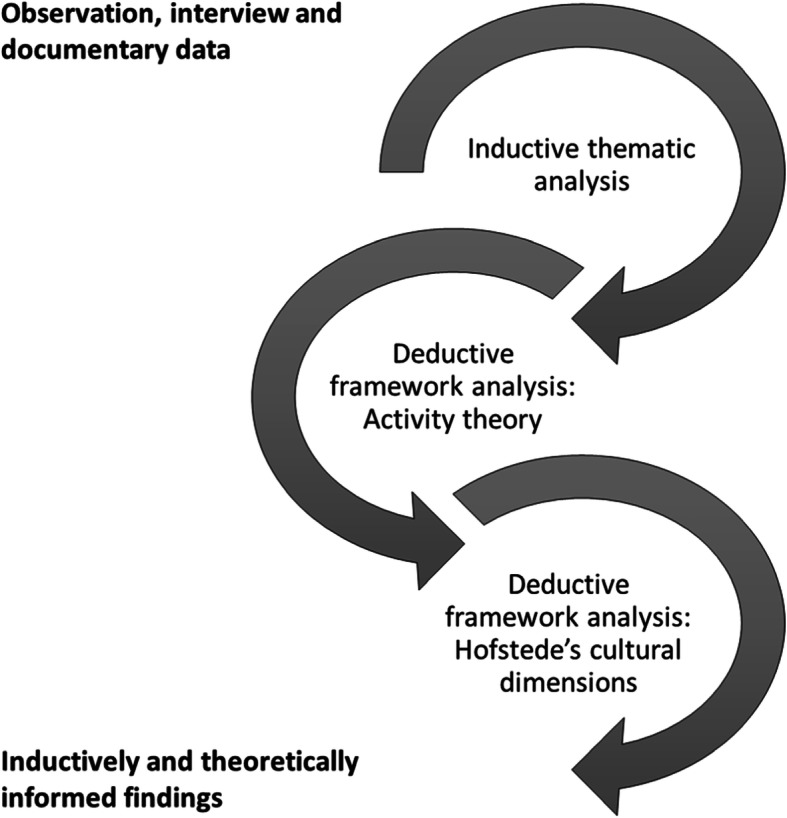
A qualitative case study was conducted at a school of allied health and partner placement sites in Ireland. Data collection comprised two participant observations, 13 interviews and 12 document analyses. Inductive thematic analysis and deductive framework analysis, underpinned by activity theory and Hofstede's cultural dimensions, informed data analysis and interpretations.
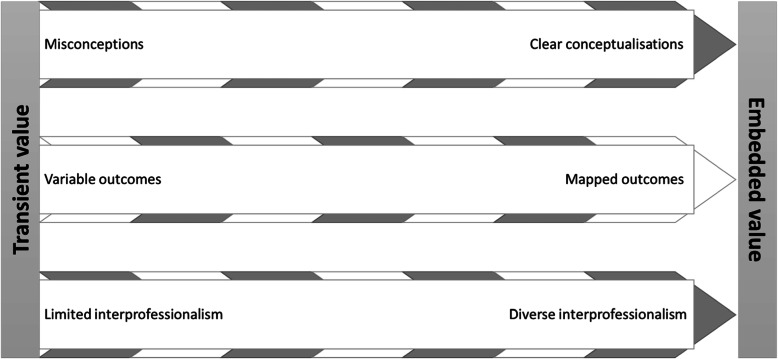
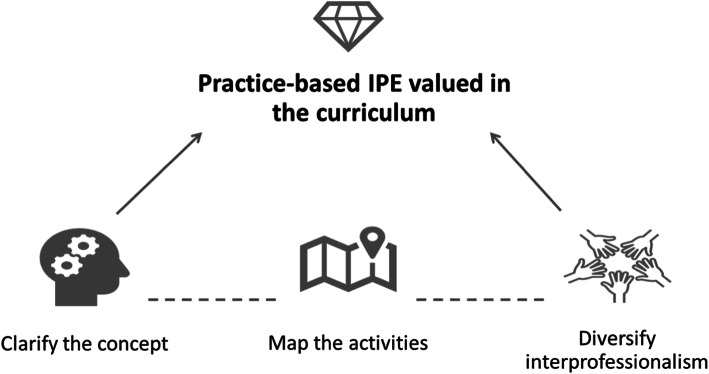
Participants are grappling to establish the value of practice-based IPE, illustrated in three themes: clarifying the concept of practice-based IPE, mapping IPE activities and diversifying interprofessionalism. First, ambiguous conceptualisation of why and how to implement practice-based IPE was identified. Highlighting how practice-based IPE improved patient care and safety created a clear rationale for implementation. It was also helpful to demonstrate how adaptations to existing practice education models, rather than entirely new models, could achieve high-quality practice-based IPE. Second, the positioning of practice-base IPE in the placement curriculum was unclear. Overt mapping of practice-based IPE activities onto learning outcomes within assessment tools enhanced its value within practice education. Third, varying levels of professional engagement were noted, perpetuating stereotypes. Creating diverse educator networks and embedding practice-based IPE in organisational strategy may incentivise engagement across a greater range of professions.
Implementing these recommendations could enhance the value of practice-based IPE and optimise student preparation for collaborative working. Practice-based IPE remains a complex model and the trajectory of embedding in healthcare curriculums will differ globally.
基于实践的跨专业教育(IPE)对于培养学生的协作工作能力至关重要。在一些地区,基于实践的IPE片段已融入医疗保健课程中。然而,基于实践的IPE在全球范围内并未被视为医疗保健课程的关键要素。由于学生和临床教育工作者是关键利益相关者,本研究展示了在一个基于实践的IPE处于新兴阶段的国家中他们的经历案例。他们的经验知识为理解基于实践的IPE的认知方式提供了重要见解。这些经验教训可供那些寻求将基于实践的IPE纳入其实习课程的人在本地及更广泛的范围内应用。
在爱尔兰的一所联合健康学院及其合作伙伴实习地点进行了一项定性案例研究。数据收集包括两次参与观察、13次访谈和12次文件分析。以活动理论和霍夫斯泰德文化维度为基础的归纳主题分析和演绎框架分析为数据分析和解释提供了依据。
参与者正在努力确立基于实践的IPE的价值,体现在三个主题中:明确基于实践的IPE的概念、规划IPE活动以及使跨专业主义多样化。首先,确定了在实施基于实践的IPE的原因和方式上存在概念模糊的问题。强调基于实践的IPE如何改善患者护理和安全为实施提供了明确的理由。展示如何对现有实践教育模式进行调整而非完全采用全新模式来实现高质量的基于实践的IPE也很有帮助。其次,基于实践的IPE在实习课程中的定位不明确。将基于实践的IPE活动明确映射到评估工具中的学习成果上,增强了其在实践教育中的价值。第三,注意到专业参与程度各不相同,刻板印象持续存在。建立多样化的教育工作者网络并将基于实践的IPE纳入组织战略可能会激励更多专业的参与。
实施这些建议可以提高基于实践的IPE的价值,并优化学生为协作工作做准备的情况。基于实践的IPE仍然是一个复杂的模式,在全球范围内嵌入医疗保健课程的轨迹会有所不同。