Elsahoryi Nour, Al-Sayyed Hiba, Odeh Mohanad, McGrattan Andrea, Hammad Fwziah
Department of Nutrition, Faculty of Pharmacy and Medical Sciences, University of Petra, P.O. Box. 961343, Amman, 11196, Jordan.
Faculty of Pharmaceutical Science, The Hashemite University, PO. Box 150459, Zarqa, 13115, Jordan.
Clin Nutr ESPEN. 2020 Dec;40:171-178. doi: 10.1016/j.clnesp.2020.09.026. Epub 2020 Oct 4.
Novel coronavirus (COVID-19) and subsequent quarantine could raise the risk of food inadequacy and nutrition deficiency crises.
This study aimed to assess the impacts of COVID-19 on household food security in Jordan, determined the percentage of food security and the levels of food insecurity during the quarantine, determined the associated factor with food insecurity, and determined main food groups associated with FINS during the quarantine.
A cross-sectional study was conducted using a Web-based validated questionnaire. The Food Insecurity Experience Scale was used to measure the food insecurity during the first four weeks of the quarantine, and a modified food consumption score was used to determine the number of times the household consumes each food group. Univariate and multiple logistic regression models were used to describe, explore, and predict risk factors correlated with food insecurity among Jordanians, during the first four weeks of the quarantine.
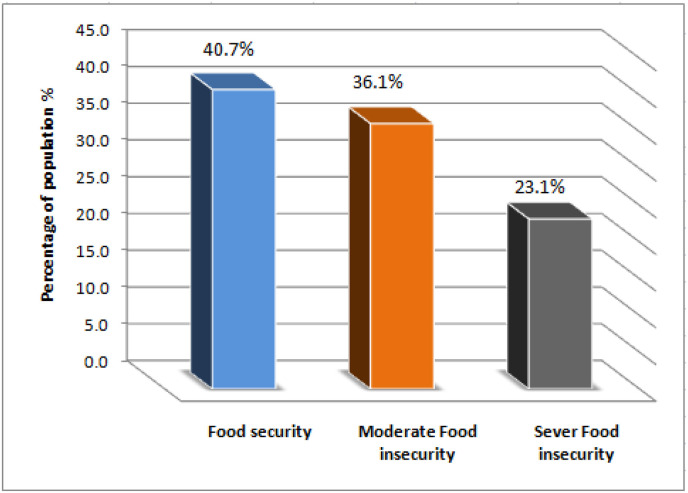
A total of 3129 Jordanians had responded to the assessment and fully answered the questionnaire. 23.1% of the total participants were severe food insecure, while 36.1% were moderate food insecure, 40.7% were food secure. The regression model demonstrated the monthly income per capita below the poverty line and a number of the family member (1-4 and 5-7) associated significantly with moderate food insecurity (OR: 5.33; 95% CI: 4.44-6.40, OR: 0.64; 95% CI: 0.47-0.86, OR: 0.76; 95% CI: 0.58-0.98, respectively). As well as with the severe food insecurity (OR: 6.87; 95% CI: 5.542-8.512, OR: 0.52; 95% CI: 0.37-0.74, 0.64; 95% CI: 0.48-0.87, respectively). Age 18-30 years old (OR: 1.80; 95% CI: 1.23-2.65) and living in a rented house (OR: 1.30; 95% CI: 1.01-1.69) were associated significantly with severe food insecurity. Carbohydrates and the meat group were significantly related to food insecurity (p-value was <0.001 for both groups).
Covid-19 and its subsequent quarantine have a tangible impact on food security levels for the populations. Awareness and strategies to support individuals at higher risks should be guided not only by the income but also by other risk factors identified in the present study as the number of persons in the family, younger adults (18-30 years old), and those who do not own their houses).
新型冠状病毒(COVID-19)及其后的隔离措施可能会增加粮食不足和营养缺乏危机的风险。
本研究旨在评估COVID-19对约旦家庭粮食安全的影响,确定隔离期间粮食安全的百分比和粮食不安全水平,确定与粮食不安全相关的因素,以及确定隔离期间与粮食不安全相关的主要食物类别。
采用基于网络的有效问卷进行横断面研究。使用粮食不安全体验量表来衡量隔离前四周的粮食不安全情况,并使用改良的食物消费得分来确定家庭消费每种食物类别的次数。单因素和多因素逻辑回归模型用于描述、探索和预测隔离前四周约旦人与粮食不安全相关的风险因素。
共有3129名约旦人对评估做出了回应并完整回答了问卷。在所有参与者中,23.1%为严重粮食不安全,36.1%为中度粮食不安全,40.7%为粮食安全。回归模型表明,人均月收入低于贫困线以及家庭成员数量(1 - 4人和5 - 7人)与中度粮食不安全显著相关(比值比分别为:5.33;95%置信区间:4.44 - 6.40,0.64;95%置信区间:0.47 - 0.86,0.76;95%置信区间:0.58 - 0.98)。同样也与严重粮食不安全相关(比值比分别为:6.87;95%置信区间:5.542 - 8.512,0.52;95%置信区间:0.37 - 0.74,0.64;95%置信区间:0.48 - 0.87)。18 - 30岁(比值比:1.80;95%置信区间:1.23 - 2.65)以及居住在出租房(比值比:1.30;95%置信区间:1.01 - 1.69)与严重粮食不安全显著相关。碳水化合物类食物和肉类食物类别与粮食不安全显著相关(两组的p值均<0.001)。
COVID-19及其后的隔离措施对民众的粮食安全水平有切实影响。支持高风险人群的意识和策略不仅应以收入为指导,还应以本研究中确定的其他风险因素为指导,如家庭人口数量、年轻成年人(18 - 30岁)以及无自有住房者)。