Department of Neurology, Mie University Graduate School of Medicine, Mie, Japan.
Department of Dementia Prevention and Therapeutics, Mie University Graduate School of Medicine, Mie, Japan.
J Alzheimers Dis. 2020;78(4):1765-1774. doi: 10.3233/JAD-200992.
Hypertensive arteriopathy (HA) and cerebral amyloid angiopathy (CAA) may contribute to the development of mixed cerebral microbleeds (CMBs). Recently, the total small vessel disease (SVD) scores for HA and CAA were proposed, which are determined by a combination of MRI markers to reflect overall severity of these microangiopathies.
We investigated whether or not total HA-SVD and CAA-SVD scores could be used to predict overlap of HA and CAA in patients with mixed CMBs.
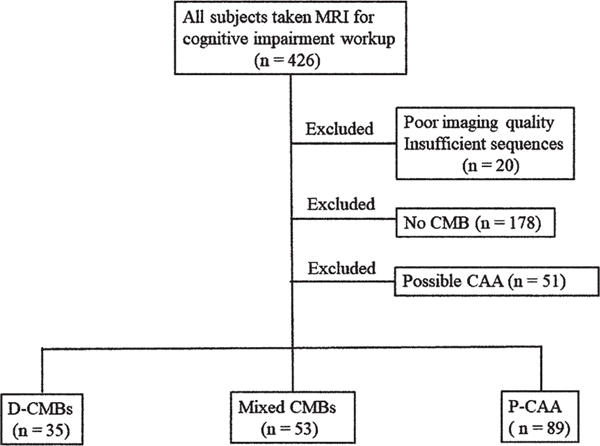
Fifty-three subjects with mixed CMBs were retrospectively analyzed. MRI markers (CMBs, lacunes, perivascular space, white matter hyperintensity [WMH] and cortical superficial siderosis [cSS]) were assessed. The HA-SVD score and CAA-SVD score were obtained for each subject. Anterior or posterior WMH was also assessed using the age-related white matter changes scale.
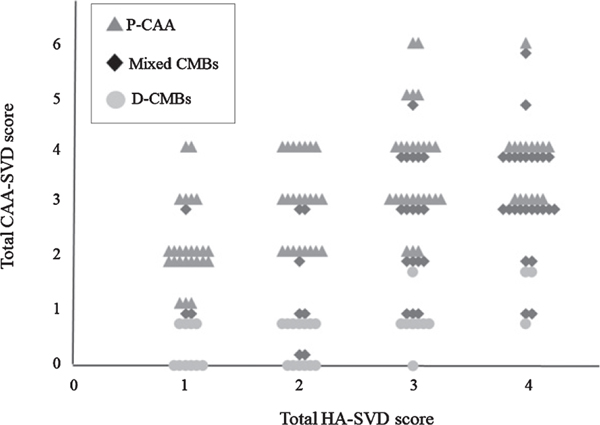
The two scores were positively correlated (ρ= 0.449, p < 0.001). The prevalence of lobar dominant CMB distribution (p < 0.001) and lacunes in the centrum semiovale (p < 0.001) and the severity of WMH in the parieto-occipital lobes (p = 0.004) were significantly higher in the high CAA-SVD score group. cSS was found in four patients with high CAA-SVD score who showed lobar-dominant CMB distribution and severe posterior WMH.
Mixed CMBs are mainly due to HA. Assessing both two scores may predict the overlap of HA and CAA in individuals with mixed CMBs. Patients with a high CAA-SVD score may have some degree of advanced CAA, especially when lobar predominant CMBs, severe posterior WMH, lobar lacunes, or cSS are observed.
高血压性小血管病(HA)和脑淀粉样血管病(CAA)可能导致混合性脑微出血(CMBs)的发生。最近,提出了 HA 和 CAA 的总小血管疾病(SVD)评分,该评分通过 MRI 标志物的组合确定,以反映这些小血管疾病的总体严重程度。
我们研究了 HA 和 CAA 的总 SVD 评分是否可用于预测混合性 CMBs 患者中 HA 和 CAA 的重叠。
回顾性分析了 53 例混合性 CMBs 患者。评估 MRI 标志物(CMBs、腔隙、血管周围间隙、脑白质高信号[WMH]和皮质表面铁沉积[cSS])。获得每个患者的 HA-SVD 评分和 CAA-SVD 评分。还使用年龄相关性脑白质改变量表评估了前后 WMH。
两个评分呈正相关(ρ=0.449,p<0.001)。高 CAA-SVD 评分组的脑叶为主的 CMB 分布(p<0.001)、半卵圆中心腔隙(p<0.001)和顶枕叶 WMH 严重程度(p=0.004)的发生率显著更高。在 4 例 CAA-SVD 评分较高的患者中发现了 cSS,这些患者表现为脑叶为主的 CMB 分布和严重的后 WMH。
混合性 CMBs 主要归因于 HA。评估两个评分可能有助于预测混合性 CMBs 患者中 HA 和 CAA 的重叠。CAA-SVD 评分较高的患者可能存在一定程度的 CAA 进展,特别是在观察到脑叶为主的 CMBs、严重的后 WMH、脑叶腔隙或 cSS 时。