Maternal and Child Health Division, International Centre for Diarrhoeal Disease Research, Bangladesh (icddr,b), Dhaka, Bangladesh.
United Nations Population Fund, Dhaka, Bangladesh.
PLoS One. 2020 Nov 13;15(11):e0242135. doi: 10.1371/journal.pone.0242135. eCollection 2020.
Early initiation of breastfeeding within one hour of birth (EIBF) and no prelacteal feeding are WHO recommended practices for improving maternal and newborn health outcomes. Globally, EIBF can avert around 22% of newborn death. In recent years, Bangladesh has experienced increasing facility delivery coverage and cesarean section rates. However, the impact of these changes on early breastfeeding initiation in hard to reach areas (HtR) of the country is still poorly understood. Therefore, this study aimed to examine the independent associations between childbirth locations and mode of delivery with favorable early breastfeeding practices in four hard to reach areas of Bangladesh.
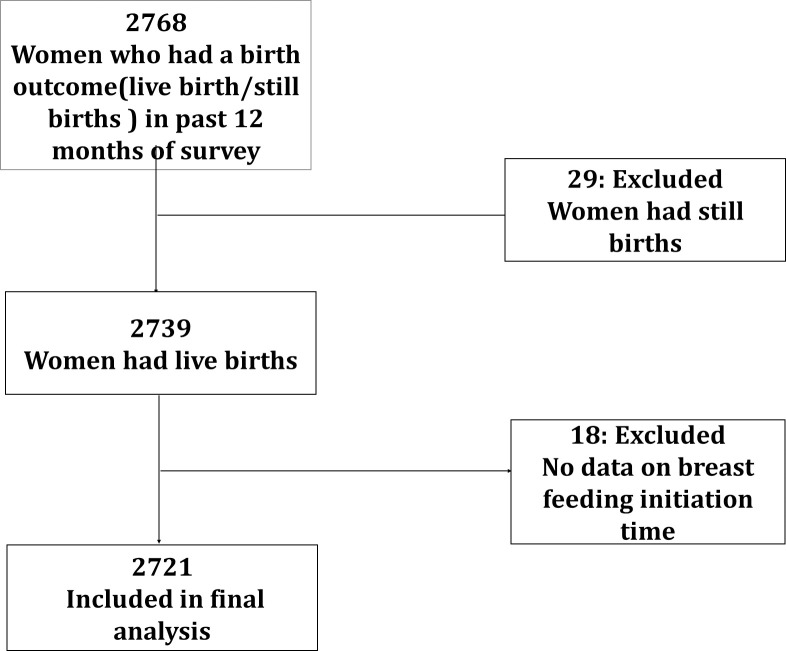
We extracted data from a cross-sectional study conducted in four HtR areas of Bangladesh in 2017. A total of 2768 women, having birth outcomes in the past 12 months of the survey, were interviewed using structured questionnaires. EIBF and no prelacteal feeding were considered as favorable early breastfeeding practices. The categories of childbirth locations were defined by the place of birth (home vs. facility) and the delivery sector (public/NGO vs. private). The mode of delivery was categorized into vaginal delivery and cesarean section. Generalized linear models were used to test the independent associations while adjusting for potential confounders.
The prevalence of EIBF practices were 69.6%(95% CI:67.8-71.3); 72.2%(95% CI:67.8-71.3) among home births Vs 63.0%(95% CI:59.5%-66.4%) among facility births. Around 73.9% (95% CI:72.3-75.6) mother's in the study areas reported no-prelacteal feeding. Compared to home births, women delivering in the facilities had lower adjusted odds of EIBF (aOR = 0.51; 95%CI:0.35-0.75). Cesarean section was found to be negatively associated with EIBF (aOR = 0.20; 95%CI:0.12-0.35), after adjusting for potential confounders. We could not find any significant associations between the place of birth and mode of delivery with no prelacteal feeding.
This study found that facility births and cesarean deliveries were negatively associated with EIBF. Although the implementation of "Baby-Friendly Hospital Initiatives" could be a potential solution for improving EIBF and no prelacteal feeding practices, the challenges of reduced service availability and accessibility in HtR areas must be considered while devising effective intervention strategies. Future studies can explore potential interventions to promote early breastfeeding for facility births and cesarean deliveries in HtR areas.
在出生后一小时内尽早开始母乳喂养(EIBF)和避免给新生儿喂任何食物是世卫组织推荐的改善母婴健康结果的做法。在全球范围内,EIBF 可以避免大约 22%的新生儿死亡。近年来,孟加拉国的设施分娩覆盖率和剖腹产率不断提高。然而,这些变化对该国偏远地区(HtR)早期母乳喂养的影响仍知之甚少。因此,本研究旨在探讨分娩地点和分娩方式与孟加拉国四个偏远地区有利的早期母乳喂养实践之间的独立关联。
我们从 2017 年在孟加拉国四个 HtR 地区进行的一项横断面研究中提取数据。使用结构化问卷对过去 12 个月内有生育结果的 2768 名妇女进行了访谈。EIBF 和不喂初乳被认为是有利的早期母乳喂养做法。分娩地点的类别由分娩地点(家中与设施)和分娩部门(公共/非政府组织与私人)定义。分娩方式分为阴道分娩和剖腹产。使用广义线性模型来测试调整潜在混杂因素后的独立关联。
EIBF 实践的流行率为 69.6%(95%CI:67.8-71.3);家中分娩的比例为 72.2%(95%CI:67.8-71.3),而设施分娩的比例为 63.0%(95%CI:59.5%-66.4%)。在研究地区,约有 73.9%(95%CI:72.3-75.6)的母亲报告没有喂初乳。与家中分娩相比,在设施中分娩的妇女进行 EIBF 的调整后优势比(aOR)较低(aOR=0.51;95%CI:0.35-0.75)。在调整了潜在混杂因素后,剖腹产与 EIBF 呈负相关(aOR=0.20;95%CI:0.12-0.35)。我们没有发现分娩地点和分娩方式与不喂初乳之间有任何显著关联。
本研究发现,设施分娩和剖腹产与 EIBF 呈负相关。尽管实施“爱婴医院倡议”可能是改善 EIBF 和不喂初乳做法的一个潜在解决方案,但在制定有效干预策略时,必须考虑到偏远地区服务可用性和可及性降低的挑战。未来的研究可以探索促进偏远地区设施分娩和剖腹产的早期母乳喂养的潜在干预措施。