TRIA Orthopedic Center, Bloomington, MN 55431, USA.
TRIA Orthopedic Center, Bloomington, MN 55431, USA.
J Sport Health Sci. 2021 Mar;10(2):154-161. doi: 10.1016/j.jshs.2020.11.005. Epub 2020 Nov 11.
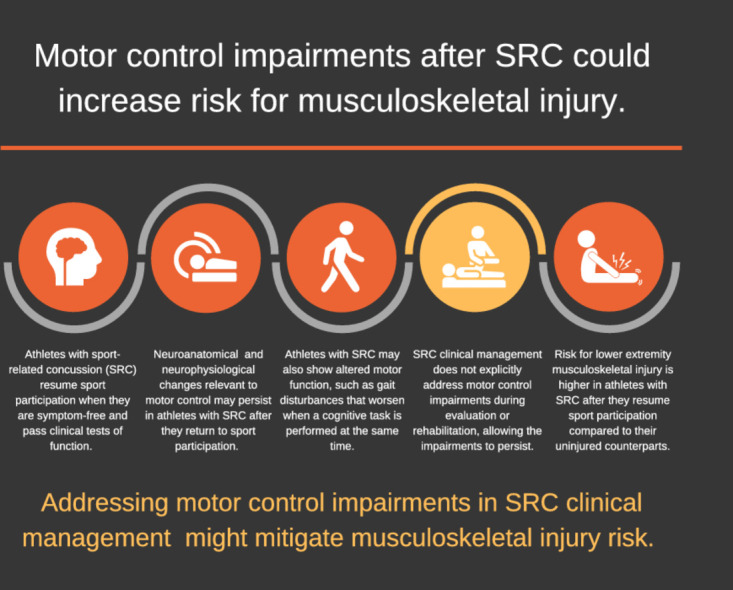
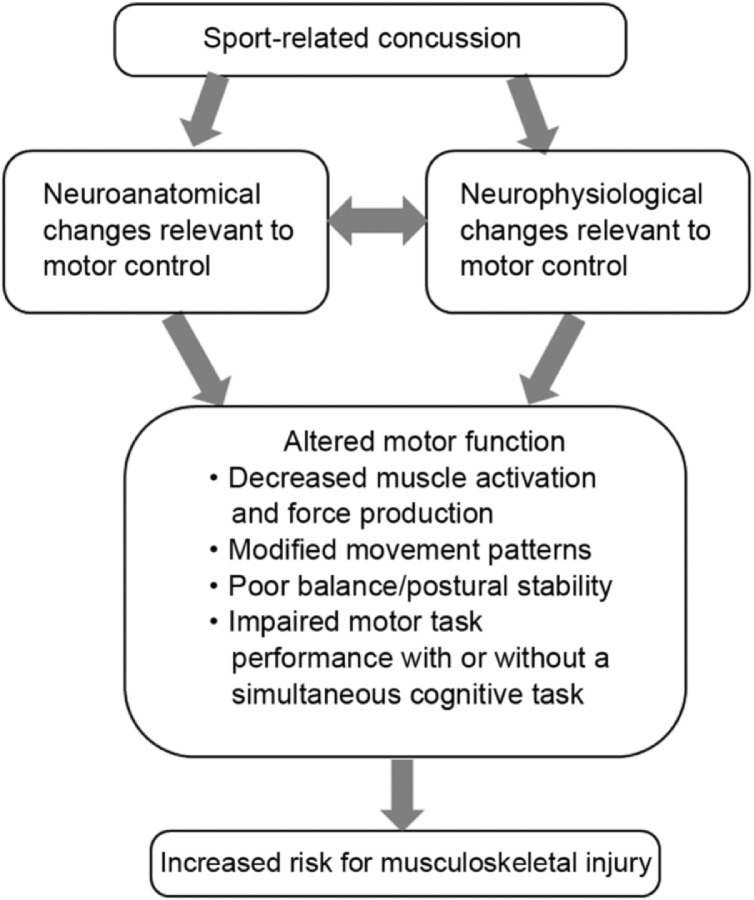
This review presents a conceptual framework and supporting evidence that links impaired motor control after sport-related concussion (SRC) to increased risk for musculoskeletal injury. Multiple studies have found that athletes who are post-SRC have higher risk for musculoskeletal injury compared to their counterparts. A small body of research suggests that impairments in motor control are associated with musculoskeletal injury risk. Motor control involves the perception and processing of sensory information and subsequent coordination of motor output within the central nervous system to perform a motor task. Motor control is inclusive of motor planning and motor learning. If sensory information is not accurately perceived or there is interference with sensory information processing and cognition, motor function will be altered, and an athlete may become vulnerable to injury during sport participation. Athletes with SRC show neuroanatomic and neurophysiological changes relevant to motor control even after meeting return to sport criteria, including a normal neurological examination, resolution of symptoms, and return to baseline function on traditional concussion testing. In conjunction, altered motor function is demonstrated after SRC in muscle activation and force production, movement patterns, balance/postural stability, and motor task performance, especially performance of a motor task paired with a cognitive task (i.e., dual-task condition). The clinical implications of this conceptual framework include a need to intentionally address motor control impairments after SRC to mitigate musculoskeletal injury risk and to monitor motor control as the athlete progresses through the return to sport continuum.
本综述提出了一个概念框架和支持性证据,将运动相关性脑震荡(SRC)后运动控制受损与肌肉骨骼损伤风险增加联系起来。多项研究发现,与对照组相比,SRC 后的运动员肌肉骨骼损伤风险更高。少量研究表明,运动控制受损与肌肉骨骼损伤风险相关。运动控制涉及感知和处理感觉信息,以及随后在中枢神经系统中协调运动输出以执行运动任务。运动控制包括运动规划和运动学习。如果感觉信息不能准确感知,或者感觉信息处理和认知受到干扰,运动功能将会改变,运动员在运动参与过程中可能容易受伤。即使符合重返运动标准,包括正常的神经系统检查、症状消退以及传统的脑震荡测试恢复到基线功能后,SRC 后的运动员仍表现出与运动控制相关的神经解剖和神经生理变化。此外,SRC 后肌肉激活和力量产生、运动模式、平衡/姿势稳定性以及运动任务表现(尤其是在运动任务与认知任务相结合的情况下)会出现运动功能改变。这一概念框架的临床意义包括需要在 SRC 后有意解决运动控制障碍,以降低肌肉骨骼损伤风险,并在运动员通过重返运动连续体时监测运动控制。