University of Kansas Health System, University of Kansas School of Medicine, Department of Cardiovascular Medicine, Kansas City, Kansas, USA.
Cardiovascular Service Line, Ascension, St. Vincent Hospital, Indianapolis, Indiana, USA.
J Cardiothorac Surg. 2020 Nov 14;15(1):329. doi: 10.1186/s13019-020-01373-y.
Left ventricular assist devices (LVAD) have been increasingly used in the treatment of end-stage heart failure. While warfarin has been uniformly recommended in the long-term as anticoagulation strategy, no clear recommendation exists for the post-operative period. We sought to evaluate the feasibility of enoxaparin in the immediate and early postoperative period after LVAD implantation.
This is a two-center, retrospective analysis of 250 consecutive patients undergoing LVAD implantation between January 2017 and December 2018. Patients were bridged postoperatively to therapeutic INR by either receiving unfractionated heparin (UFH) or low molecular weight heparin (LMWH). Patients were followed while inpatient and for 3 months after LVAD implantation. The efficacy outcome was occurrence of first and subsequent cerebrovascular accident while safety outcome was the occurrence of bleeding events. Length of stay (LOS) was also assessed.
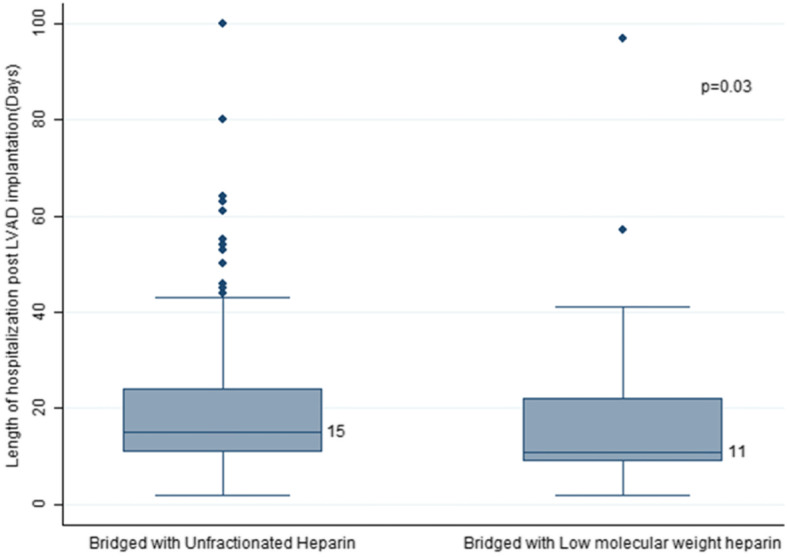
Two hundred fifty and 246 patients were analyzed for index admission and 3-month follow up respectively. No statistically significant differences were found between the two groups in CVA (OR = 0.67; CI = 0.07-6.39, P = 0.73) or bleeding events (OR = 0.91; CI = 0.27-3.04, P = 0.88) during index admission. Similarly, there were no differences at 3 months in either CVAs or bleeding events (OR = 0.85; 0.31-2.34; p = 0.76). No fatal events occurred during the study follow-up period. Median LOS was significantly lower (4 days; p = 0.03) in the LMWH group.
LMWH in the immediate and early postoperative period after LVAD implantation appears to be a concurrently safe and efficacious option allowing earlier postoperative discharge and avoidance of recurrent hospitalizations due to sub-therapeutic INR.
左心室辅助装置(LVAD)已越来越多地用于治疗终末期心力衰竭。虽然华法林一直被推荐作为长期抗凝策略,但术后期间没有明确的推荐。我们旨在评估在 LVAD 植入术后即刻和早期应用依诺肝素的可行性。
这是一项对 2017 年 1 月至 2018 年 12 月期间进行 LVAD 植入的 250 例连续患者进行的回顾性、多中心研究。术后患者通过接受普通肝素(UFH)或低分子肝素(LMWH)使 INR 达到治疗范围。对患者进行住院期间及 LVAD 植入后 3 个月的随访。疗效结局为首次和随后发生的脑血管意外,安全性结局为出血事件的发生。同时评估住院时间(LOS)。
250 例患者用于分析索引入院,246 例患者用于分析 3 个月的随访。在索引入院时,两组患者的 CVA(OR=0.67;95%CI=0.07-6.39,P=0.73)或出血事件(OR=0.91;95%CI=0.27-3.04,P=0.88)发生率无统计学差异。同样,在 3 个月时,CVAs 或出血事件也无差异(OR=0.85;95%CI=0.31-2.34;p=0.76)。在研究随访期间没有发生致命事件。LMWH 组的中位 LOS 明显较低(4 天;p=0.03)。
在 LVAD 植入术后即刻和早期应用 LMWH 似乎是一种安全有效的选择,可允许更早的术后出院,并避免因 INR 低于治疗范围而反复住院。