Rodemund Christian, Krenn Ronny, Kihm Carl, Leister Iris, Ortmaier Reinhold, Litzlbauer Werner, Schwarz Angelika M, Mattiassich Georg
AUVA - Traumacenter (UKH) Linz, Teaching Hospital of the Paracelsus Medical University Salzburg, Linz, Austria.
Norton Audubon Hospital, Attending Podiatric Surgeon, Louisville, KY, USA.
BMC Musculoskelet Disord. 2020 Nov 14;21(1):753. doi: 10.1186/s12891-020-03762-9.
A fracture of the calcaneus can be a painful and disabling injury. Treatment modalities may be conservative or operative. Surgical treatment strategies include open reduction and internal fixation (ORIF) techniques, as well as a variety of minimally invasive methods. The aim of this study was to evaluate the treatment options and post-treatment complication rates for intra-articular calcaneal fractures at the Traumacenter Linz over a 9-year period.
All patients with calcaneal fractures treated at the Traumacenter Linz between 2007 and 2015 were included in this study. The patients records were retrospectively reviewed, and the data, including demographic parameters, cause of injury, and the time between injury and operative treatment were analyzed. The number of secondary operative interventions due to soft-tissue complications, hardware removal, and the long-term arthrodesis rate were evaluated.
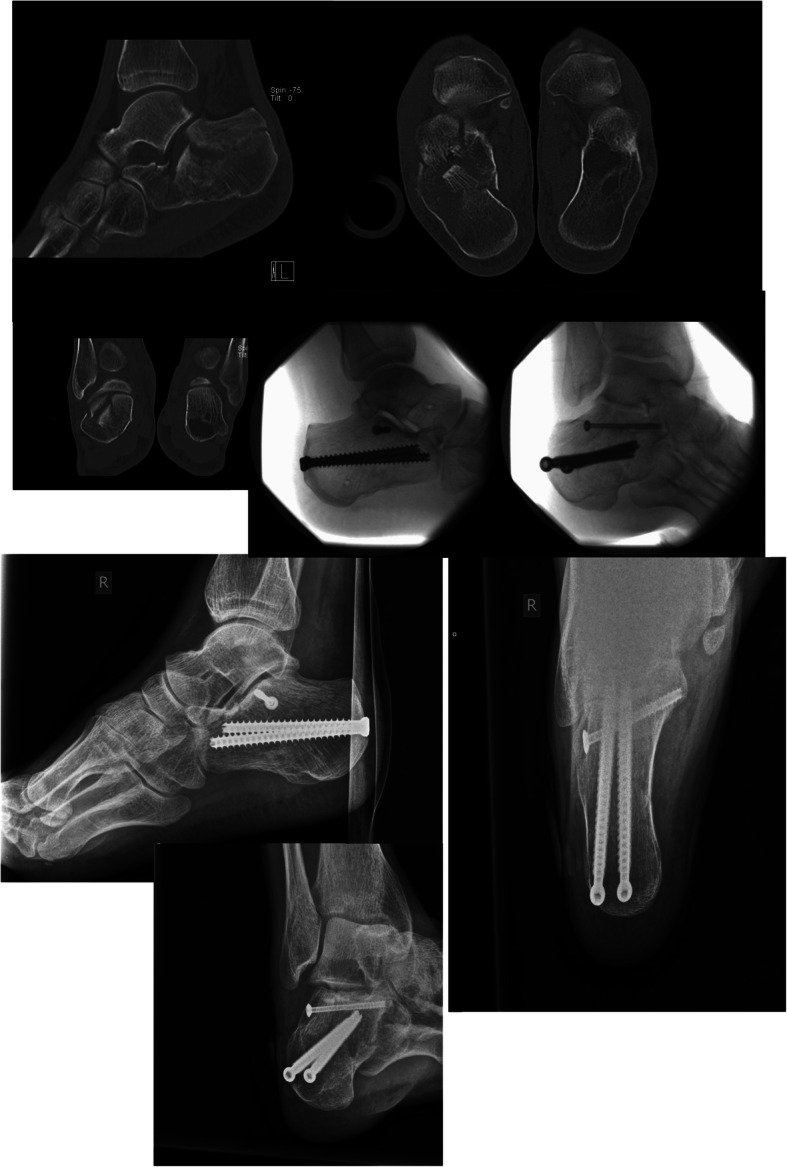
A minimally invasive 2-point-distractor method was used in 85.8% (n = 182) of all operatively managed calcaneal fractures (n = 212) in our department. The majority of the operations (88.7%) were performed within 2 days after the accident. The secondary operation rate resulting from wound complications was 2.7% in the 2-point distractor group and 16.7% in the ORIF group. A secondary arthrodesis was performed in 4.7% (n = 9) of the subtalar joints in the entire study population.
Our data supported the assumption that severe wound complications would be less likely to occur after minimally invasive treatment compared to ORIF treatment. The rate of secondary arthrodesis in the study cohort was comparable to that in the literature.
IV.
跟骨骨折可能是一种疼痛且致残的损伤。治疗方式可以是保守治疗或手术治疗。手术治疗策略包括切开复位内固定(ORIF)技术以及多种微创方法。本研究的目的是评估林茨创伤中心9年间关节内跟骨骨折的治疗选择及治疗后并发症发生率。
本研究纳入了2007年至2015年在林茨创伤中心接受治疗的所有跟骨骨折患者。对患者记录进行回顾性审查,并分析包括人口统计学参数、损伤原因以及损伤与手术治疗之间的时间等数据。评估因软组织并发症、取出内固定装置而进行的二次手术干预次数以及长期关节融合率。
在我们科室所有接受手术治疗的跟骨骨折(n = 212)中,85.8%(n = 182)采用了微创两点撑开器方法。大多数手术(88.7%)在事故发生后2天内进行。两点撑开器组因伤口并发症导致的二次手术率为2.7%,切开复位内固定组为16.7%。在整个研究人群中,4.7%(n = 9)的距下关节进行了二次关节融合术。
我们的数据支持这样一种假设,即与切开复位内固定治疗相比,微创治疗后严重伤口并发症发生的可能性较小。研究队列中的二次关节融合率与文献中的相当。
IV级。