Synairgen Research, Southampton General Hospital, Southampton, UK.
Veramed, Regal House, Twickenham, UK.
Lancet Respir Med. 2021 Feb;9(2):196-206. doi: 10.1016/S2213-2600(20)30511-7. Epub 2020 Nov 12.
Severe acute respiratory syndrome coronavirus 2 (SARS-CoV-2) infection carries a substantial risk of severe and prolonged illness; treatment options are currently limited. We assessed the efficacy and safety of inhaled nebulised interferon beta-1a (SNG001) for the treatment of patients admitted to hospital with COVID-19.
We did a randomised, double-blind, placebo-controlled, phase 2 pilot trial at nine UK sites. Adults aged 18 years or older and admitted to hospital with COVID-19 symptoms, with a positive RT-PCR or point-of-care test, or both, were randomly assigned (1:1) to receive SNG001 (6 MIU) or placebo by inhalation via a mouthpiece daily for 14 days. The primary outcome was the change in clinical condition on the WHO Ordinal Scale for Clinical Improvement (OSCI) during the dosing period in the intention-to-treat population (all randomised patients who received at least one dose of the study drug). The OSCI is a 9-point scale, where 0 corresponds to no infection and 8 corresponds to death. Multiple analyses were done to identify the most suitable statistical method for future clinical trials. Safety was assessed by monitoring adverse events for 28 days. This trial is registered with Clinicaltrialsregister.eu (2020-001023-14) and ClinicalTrials.gov (NCT04385095); the pilot trial of inpatients with COVID-19 is now completed.
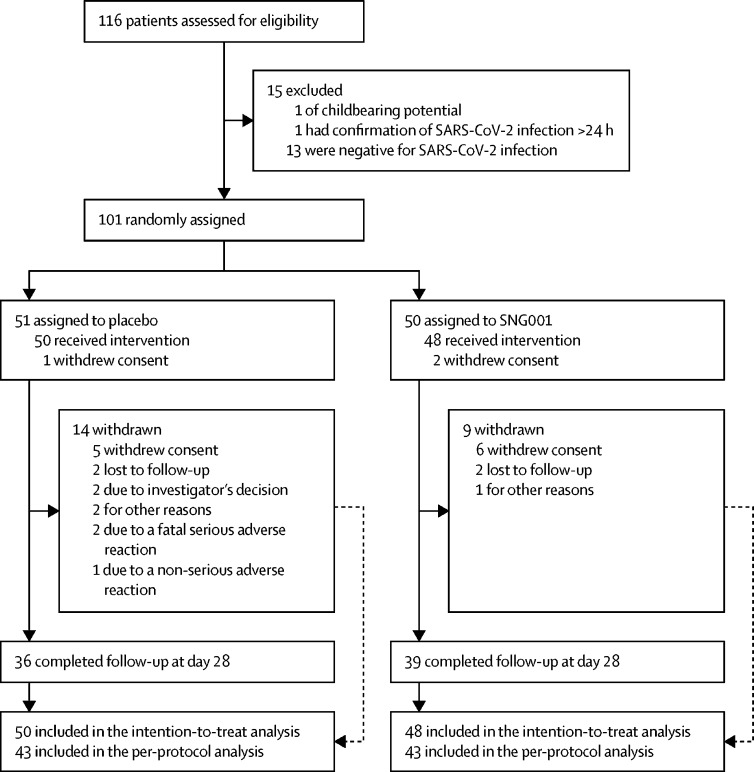
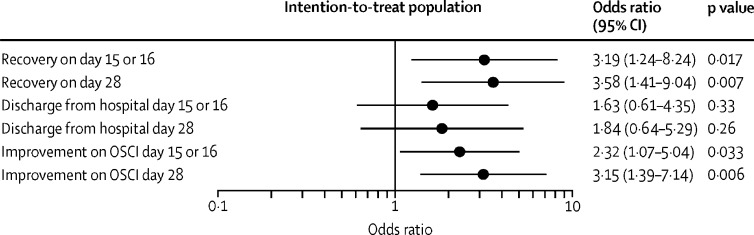
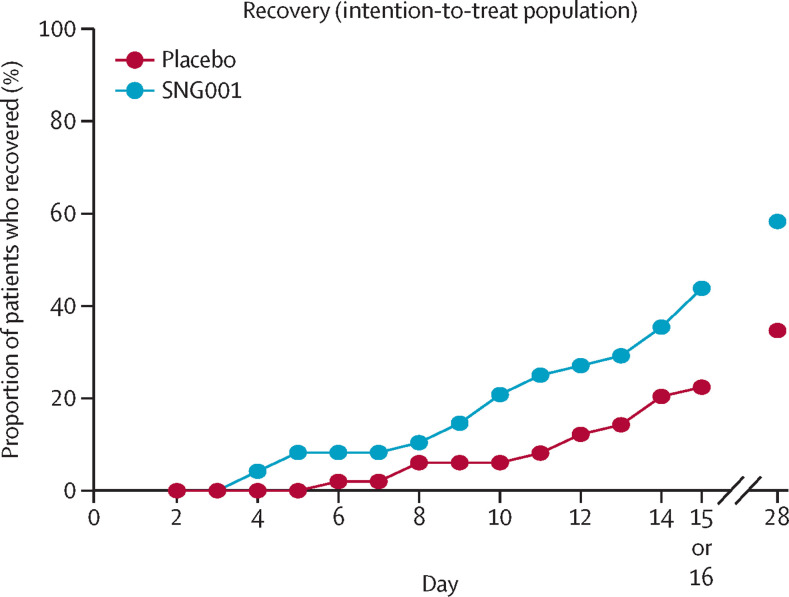
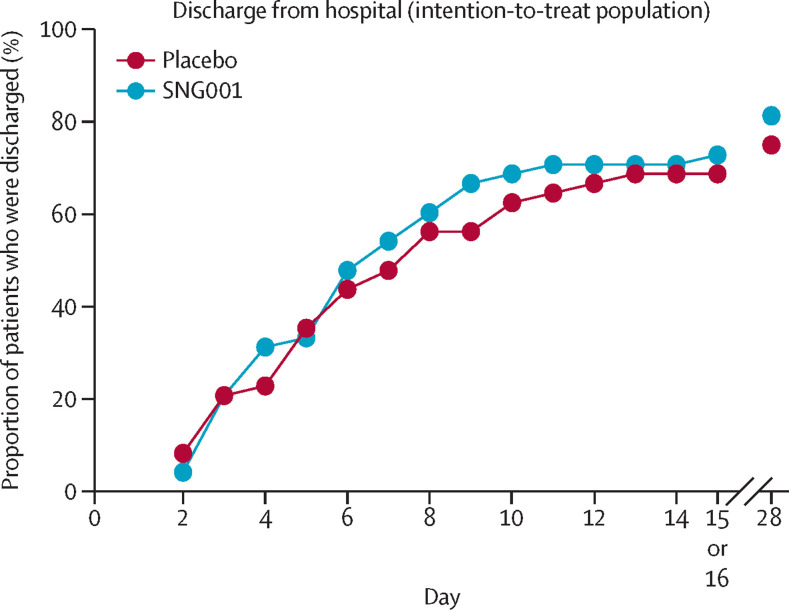
Between March 30 and May 30, 2020, 101 patients were randomly assigned to SNG001 (n=50) or placebo (n=51). 48 received SNG001 and 50 received placebo and were included in the intention-to-treat population. 66 (67%) patients required oxygen supplementation at baseline: 29 in the placebo group and 37 in the SNG001 group. Patients receiving SNG001 had greater odds of improvement on the OSCI scale (odds ratio 2·32 [95% CI 1·07-5·04]; p=0·033) on day 15 or 16 and were more likely than those receiving placebo to recover to an OSCI score of 1 (no limitation of activities) during treatment (hazard ratio 2·19 [95% CI 1·03-4·69]; p=0·043). SNG001 was well tolerated. The most frequently reported treatment-emergent adverse event was headache (seven [15%] patients in the SNG001 group and five [10%] in the placebo group). There were three deaths in the placebo group and none in the SNG001 group.
Patients who received SNG001 had greater odds of improvement and recovered more rapidly from SARS-CoV-2 infection than patients who received placebo, providing a strong rationale for further trials.
Synairgen Research.
严重急性呼吸综合征冠状病毒 2(SARS-CoV-2)感染存在严重和长期疾病的巨大风险;目前的治疗选择有限。我们评估了吸入式雾化干扰素 β-1a(SNG001)治疗因 COVID-19 住院的患者的疗效和安全性。
我们在英国的九个地点进行了一项随机、双盲、安慰剂对照、2 期试点试验。年龄在 18 岁或以上、因 COVID-19 症状入院、RT-PCR 或即时检测阳性、或两者均阳性的患者,通过面罩接受每日 1 次、6 MIU 的 SNG001 或安慰剂治疗,共 14 天。主要结局是在治疗期内,按意向治疗人群(接受至少一剂研究药物的所有随机患者)的世界卫生组织临床改善等级量表(OSCI)的临床状况变化。OSCI 是一个 9 分制量表,0 对应无感染,8 对应死亡。进行了多种分析以确定未来临床试验最适合的统计方法。通过监测 28 天的不良事件来评估安全性。该试验在 Clinicaltrialsregister.eu(2020-001023-14)和 ClinicalTrials.gov(NCT04385095)上注册;目前已完成对 COVID-19 住院患者的试点试验。
2020 年 3 月 30 日至 5 月 30 日期间,101 名患者被随机分配至 SNG001(n=50)或安慰剂(n=51)组。48 名患者接受 SNG001,50 名患者接受安慰剂,并纳入意向治疗人群。基线时需要氧疗的患者有 66 例(67%):安慰剂组 29 例,SNG001 组 37 例。接受 SNG001 治疗的患者 OSCI 评分改善的可能性更大(比值比 2.32 [95%CI 1.07-5.04];p=0.033),在第 15 或 16 天,并且在治疗期间更有可能恢复到 OSCI 评分为 1(无活动受限)(风险比 2.19 [95%CI 1.03-4.69];p=0.043)。SNG001 耐受性良好。最常报告的治疗期不良事件是头痛(SNG001 组 7 例[15%],安慰剂组 5 例[10%])。安慰剂组有 3 例死亡,SNG001 组无死亡。
与接受安慰剂的患者相比,接受 SNG001 治疗的患者 OSCI 评分改善的可能性更大,从 SARS-CoV-2 感染中恢复得更快,这为进一步的试验提供了强有力的依据。
Synairgen Research