Third Faculty of Medicine, Charles University Prague, Prague, Czech Republic.
National Institute of Mental Health, Klecany, Czech Republic.
Eur Psychiatry. 2020 Nov 16;63(1):e97. doi: 10.1192/j.eurpsy.2020.100.
Increasing educational attainment (EA) could decrease the occurrence of depression. We investigated the relationship between EA and depressive symptoms in older individuals across four European regions.
We studied 108,315 Europeans (54% women, median age 63 years old) from the Survey on Health, Ageing and Retirement in Europe assessing EA (seven educational levels based on International Standard Classification of Education [ISCED] classification) and depressive symptoms (≥4 points on EURO-D scale). Logistic regression estimated the association between EA and depressive symptoms, adjusting for sociodemographic and health-related factors, testing for sex/age/region and education interactions.
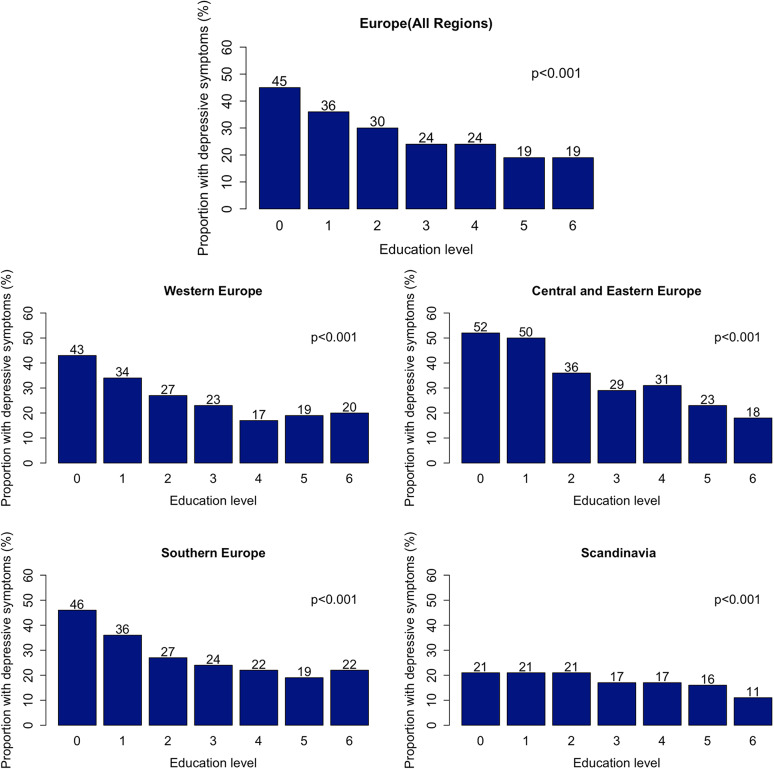
Higher EA was associated with lower odds of depressive symptoms, independent of sociodemographic and health-related factors. A threshold of the lowest odds of depressive symptoms was detected at the first stage of tertiary education (OR 0.60; 95% confidence interval [CI] 0.55-0.65; p < 0.001; relative to no education). Central and Eastern Europe showed the strongest association (OR for high vs. low education 0.37; 95% CI 0.33-0.40; p < 0.001) and Scandinavia the weakest (OR for high vs. low education 0.69; 95% CI 0.60-0.80; p < 0.001). The association was strongest among younger individuals. There was a sex and education interaction only within Central and Eastern Europe.
Level of EA is reflected in later-life depressive symptoms, suggesting that supporting individuals in achieving EA, and considering those with lower EA at increased risk for depression, could lead to decreased burden of depression across the life course. Further educational support in Central and Eastern Europe may decrease the higher burden of depressive symptoms in women.
教育程度的提高(EA)可能会降低抑郁的发生。我们调查了四个欧洲地区的老年人中 EA 与抑郁症状之间的关系。
我们研究了来自欧洲健康、老龄化和退休调查的 108315 名欧洲人(54%为女性,中位年龄 63 岁),评估了 EA(基于国际教育分类标准[ISCED]分类的七个教育水平)和抑郁症状(EURO-D 量表上≥4 分)。使用 logistic 回归估计 EA 与抑郁症状之间的关联,调整了社会人口统计学和与健康相关的因素,检验了性别/年龄/地区和教育的相互作用。
较高的 EA 与较低的抑郁症状几率独立于社会人口统计学和与健康相关的因素有关。在第三级教育的第一阶段检测到最低抑郁症状几率的阈值(OR 0.60;95%置信区间 [CI] 0.55-0.65;p<0.001;与无教育相比)。中欧和东欧的关联最强(高 vs. 低教育的 OR 为 0.37;95% CI 0.33-0.40;p<0.001),斯堪的纳维亚的关联最弱(高 vs. 低教育的 OR 为 0.69;95% CI 0.60-0.80;p<0.001)。这种关联在年轻个体中最强。仅在中欧和东欧存在性别和教育的相互作用。
EA 的水平反映在晚年的抑郁症状中,这表明支持个人获得 EA,并考虑那些 EA 较低的人有更高的抑郁风险,可能会降低整个生命周期的抑郁负担。在中欧和东欧提供更多的教育支持可能会降低女性更高的抑郁症状负担。