Wang Ke, Zhao Ye, Wang Yi-Min
Department of Gynaecology and Obstetrics, China-Japan Union Hospital of Jilin University, Changchun 130000, Jilin, People's Republic of China.
Department of Dermatology, China-Japan Union Hospital of Jilin University, Changchun, Jilin, 130000, People's Republic of China.
Cancer Manag Res. 2020 Nov 6;12:11359-11369. doi: 10.2147/CMAR.S267355. eCollection 2020.
This paper was aimed at investigating the regulatory mechanism of long non-coding RNA metastasis-associated lung adenocarcinoma transcript-1 (MALAT1) in epithelial ovarian cancer (EOC).
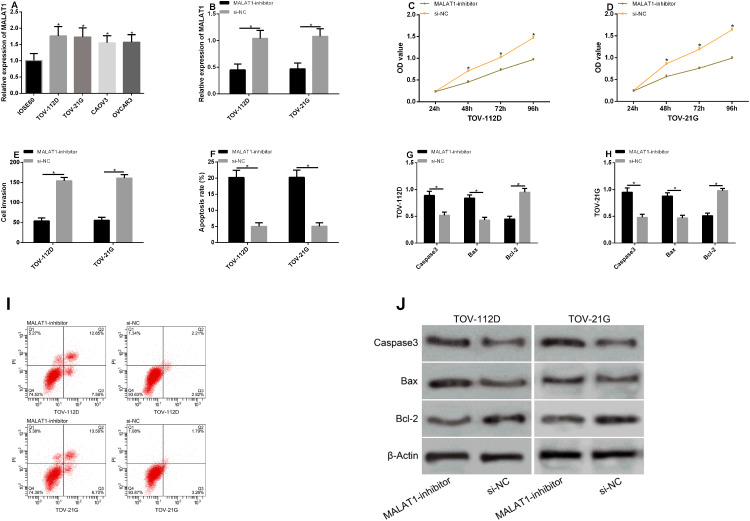
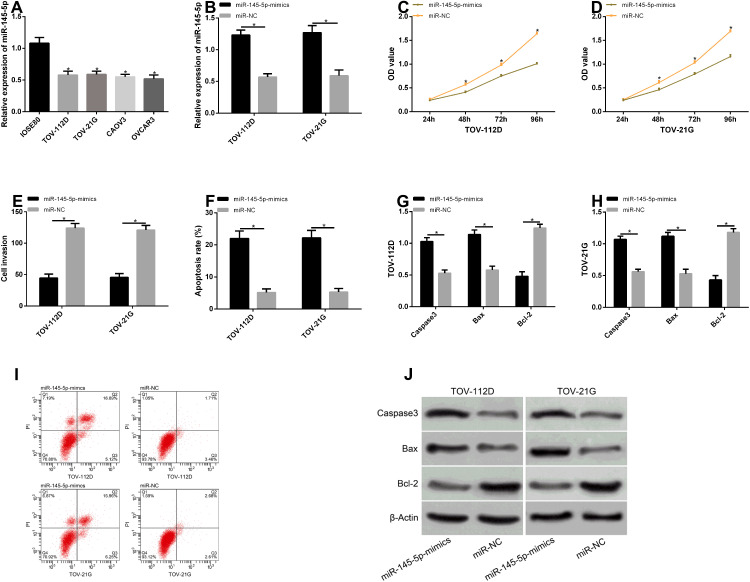
MALAT1 and miR-145-5p expression in the tissues, serum, and EOC cell lines (TOV-112D, TOV-21G) of patients with EOC were detected. The two genes were transfected into the cells via upregulating or downregulating their expression. Levels of apoptosis-related proteins (Caspase-3, Bax, Bcl-2) were analyzed. Mechanisms of cell proliferation, invasion, and apoptosis were studied.
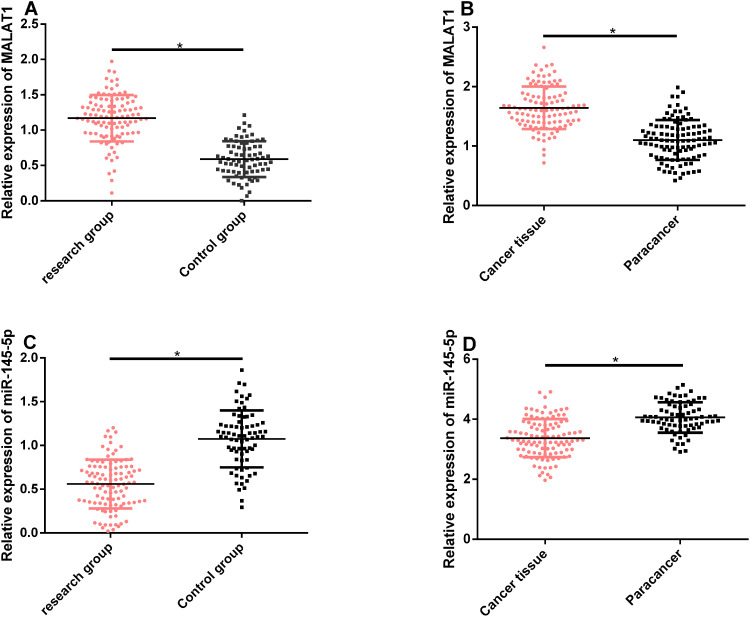
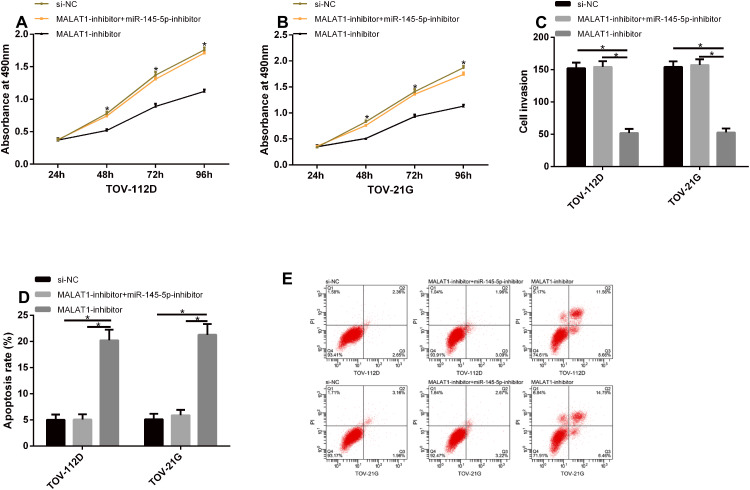
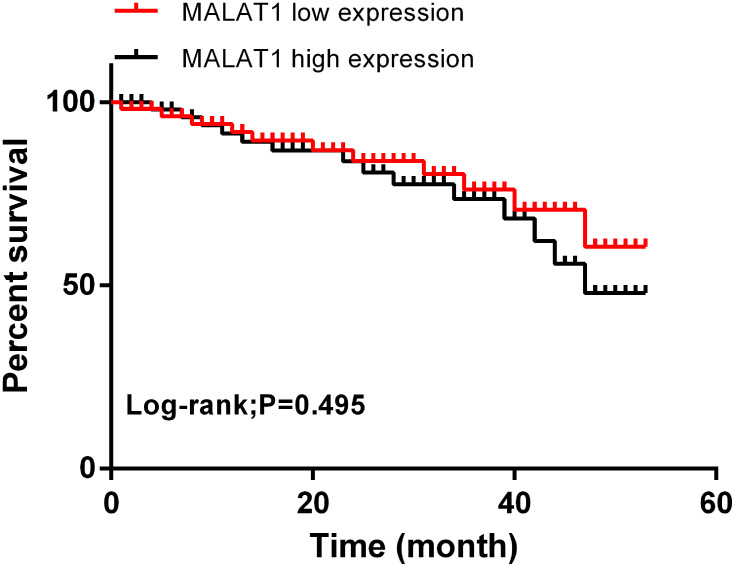
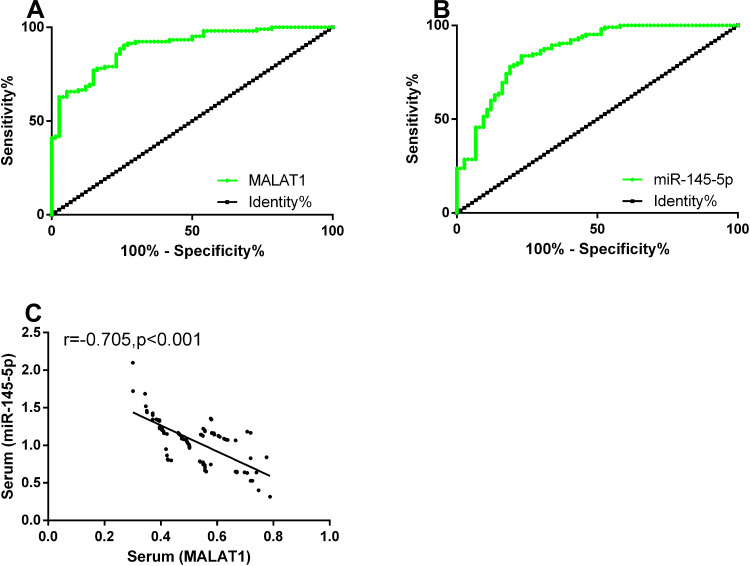
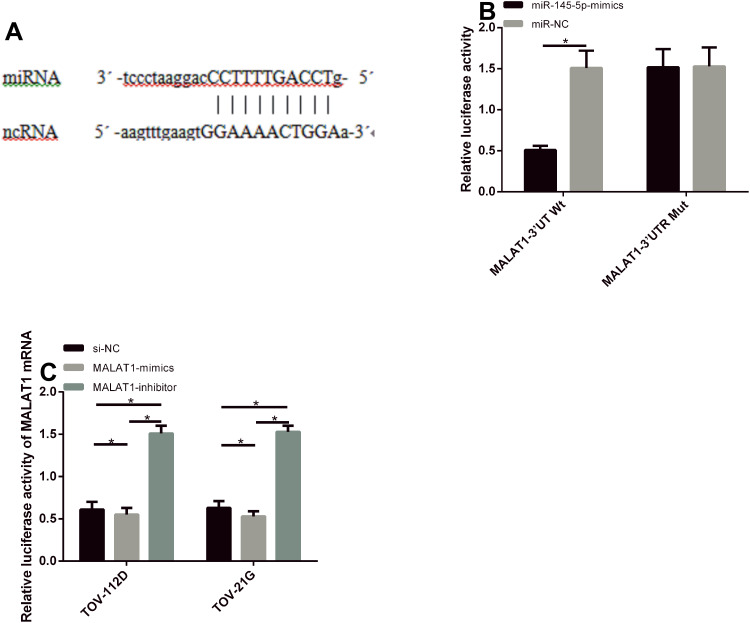
MALAT1 was high expressed in EOC tissues, while miR-145-5p was poorly expressed in them. The areas under the curves (AUCs) of the two genes for diagnosing EOC were greater than 0.850, and the two had a significantly negative correlation. According to multivariate Cox regression analysis, high MALAT1 expression, tumor size, degree of differentiation, case staging, and lymph node metastasis were the independent risk factors affecting prognosis. The 5-year overall survival rate (OSR) of patients with low MALAT1 expression was remarkably higher than that of those with high expression. Overexpressing miR-145-5p and silencing MALAT1 could inhibit EOC cells from proliferating and invading, increase their apoptotic rate, and improve levels of the apoptosis-related proteins. After co-transfection with MALAT1-inhibitor + miR-145-5p-inhibitor, the proliferation and invasion of TOV-112D and TOV-21G cells were inhibited and the apoptotic rate rose more obviously. Inhibiting MALAT1 could increase miR-145-5p expression, thus inhibiting EOC cells from proliferating and invading and thereby increasing their apoptotic rate.
MALAT1 promotes EOC cells' survival by downregulating miR-145-5p so it may become a new direction for EOC diagnosis and gene therapy.
本文旨在研究长链非编码RNA转移相关肺腺癌转录本1(MALAT1)在上皮性卵巢癌(EOC)中的调控机制。
检测EOC患者组织、血清及EOC细胞系(TOV-112D、TOV-21G)中MALAT1和miR-145-5p的表达。通过上调或下调其表达将这两个基因转染至细胞中。分析凋亡相关蛋白(Caspase-3、Bax、Bcl-2)的水平。研究细胞增殖、侵袭和凋亡的机制。
MALAT1在EOC组织中高表达,而miR-145-5p在其中低表达。这两个基因诊断EOC的曲线下面积(AUC)均大于0.850,且二者呈显著负相关。根据多因素Cox回归分析,MALAT1高表达、肿瘤大小、分化程度、病例分期及淋巴结转移是影响预后的独立危险因素。MALAT1低表达患者的5年总生存率(OSR)显著高于高表达患者。过表达miR-145-5p并沉默MALAT1可抑制EOC细胞增殖和侵袭,提高其凋亡率,并改善凋亡相关蛋白水平。与MALAT1抑制剂+miR-145-5p抑制剂共转染后,TOV-112D和TOV-21G细胞的增殖和侵袭受到抑制,凋亡率升高更明显。抑制MALAT1可增加miR-145-5p表达,从而抑制EOC细胞增殖和侵袭,进而提高其凋亡率。
MALAT1通过下调miR-145-5p促进EOC细胞存活,因此可能成为EOC诊断和基因治疗的新方向。