Department of Immunology, Landspitali, The National University Hospital of Iceland, Reykjavik, Iceland.
Faculty of Medicine, School of Health Sciences, University of Iceland, Reykjavik, Iceland.
Front Immunol. 2020 Oct 23;11:527310. doi: 10.3389/fimmu.2020.527310. eCollection 2020.
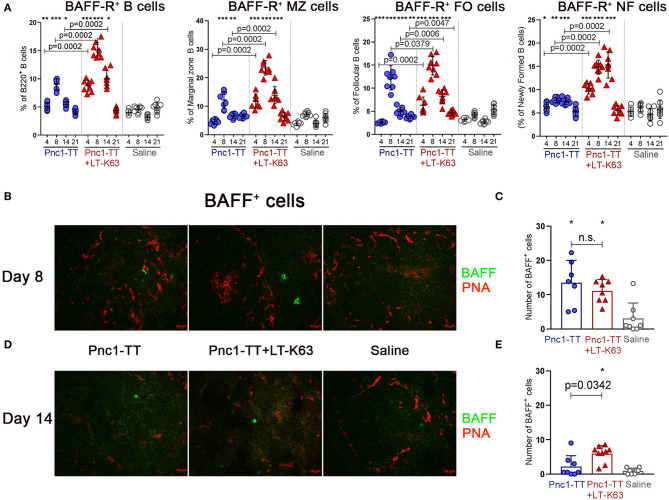
Adjuvants enhance magnitude and duration of immune responses induced by vaccines. In this study we assessed in neonatal mice if and how the adjuvant LT-K63 given with a pneumococcal conjugate vaccine, Pnc1-TT, could affect the expression of tumor necrosis factor receptor (TNF-R) superfamily members, known to be involved in the initiation and maintenance of antibody responses; B cell activating factor receptor (BAFF-R) and B cell maturation antigen (BCMA) and their ligands, BAFF, and a proliferation inducing ligand (APRIL). Initially we assessed the maturation status of different B cell populations and their expression of BAFF-R and BCMA. Neonatal mice had dramatically fewer B cells than adult mice and the composition of different subsets within the B cell pool differed greatly. Proportionally newly formed B cells were most abundant, but they had diminished BAFF-R expression which could explain low proportions of marginal zone and follicular B cells observed. Limited BCMA expression was also detected in neonatal pre-plasmablasts/plasmablasts. LT-K63 enhanced vaccine-induced BAFF-R expression in splenic marginal zone, follicular and newly formed B cells, leading to increased plasmablast/plasma cells, and their enhanced expression of BCMA in spleen and bone marrow. Additionally, the induction of BAFF and APRIL expression occurred early in neonatal mice immunized with Pnc1-TT either with or without LT-K63. However, BAFF and APRIL cells in spleens were maintained at a higher level in mice that received the adjuvant. Furthermore, the early increase of APRIL cells in bone marrow was more profound in mice immunized with vaccine and adjuvant. Finally, we assessed, for the first time in neonatal mice, accessory cells of the plasma cell niche in bone marrow and their secretion of APRIL. We found that LT-K63 enhanced the frequency and APRIL expression of eosinophils, macrophages, and megakaryocytes, which likely contributed to plasma cell survival, even though APRIL cells showed a fast decline. All this was associated with enhanced, sustained vaccine-specific antibody-secreting cells in bone marrow and persisting vaccine-specific serum antibodies. Our study sheds light on the mechanisms behind the adjuvanticity of LT-K63 and identifies molecular pathways that should be triggered by vaccine adjuvants to induce sustained humoral immunity in early life.
佐剂增强疫苗诱导的免疫反应的幅度和持续时间。在这项研究中,我们评估了在新生小鼠中,佐剂 LT-K63 与肺炎球菌结合疫苗 Pnc1-TT 一起使用是否以及如何影响肿瘤坏死因子受体 (TNF-R) 超家族成员的表达,这些成员已知参与抗体反应的启动和维持;B 细胞激活因子受体 (BAFF-R) 和 B 细胞成熟抗原 (BCMA) 及其配体 BAFF 和增殖诱导配体 (APRIL)。最初,我们评估了不同 B 细胞群体的成熟状态及其 BAFF-R 和 BCMA 的表达。新生小鼠的 B 细胞数量明显少于成年小鼠,并且 B 细胞池内的不同亚群组成差异很大。新形成的 B 细胞比例最多,但它们的 BAFF-R 表达减少,这可以解释观察到的边缘区和滤泡 B 细胞比例低的原因。在新生的前浆母细胞/浆母细胞中也检测到有限的 BCMA 表达。LT-K63 增强了疫苗诱导的脾边缘区、滤泡和新形成 B 细胞中 BAFF-R 的表达,导致浆母细胞/浆细胞增多,其在脾和骨髓中的 BCMA 表达增强。此外,在免疫接种 Pnc1-TT 的新生小鼠中,无论是单独使用还是与 LT-K63 一起使用,均能早期诱导 BAFF 和 APRIL 的表达。然而,在接受佐剂的小鼠中,脾脏中的 BAFF 和 APRIL 细胞维持在更高的水平。此外,在接受疫苗和佐剂免疫的小鼠中,骨髓中 APRIL 细胞的早期增加更为明显。最后,我们首次在新生小鼠中评估了骨髓中浆细胞龛的辅助细胞及其 APRIL 的分泌。我们发现,LT-K63 增强了嗜酸性粒细胞、巨噬细胞和巨核细胞的频率和 APRIL 表达,这可能有助于浆细胞存活,尽管 APRIL 细胞的数量迅速下降。所有这些都与骨髓中增强的、持续的疫苗特异性抗体分泌细胞和持续的疫苗特异性血清抗体有关。我们的研究揭示了 LT-K63 佐剂作用的机制,并确定了疫苗佐剂应触发的分子途径,以在生命早期诱导持续的体液免疫。